India warns on Canada travel after row over Sikh murder

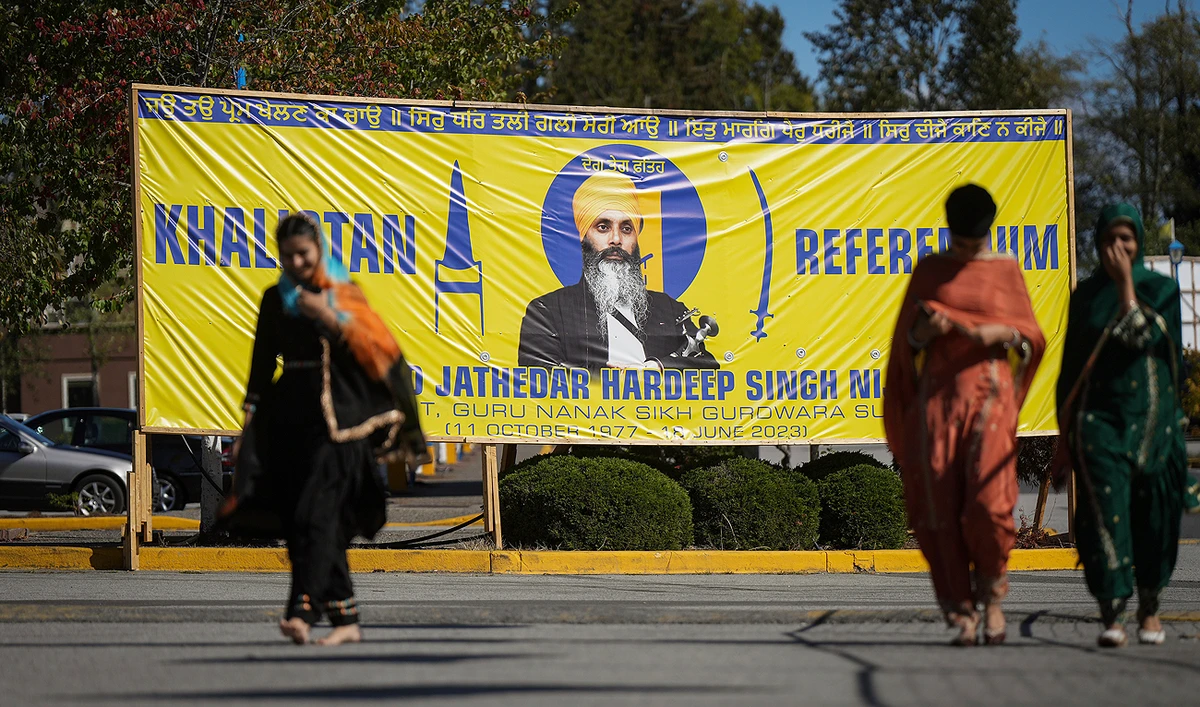
A photograph of late temple president Hardeep Singh Nijjar is seen on a banner outside the Guru Nanak Sikh Gurdwara Sahib in Surrey, British Columbia, on Monday, Sept. 18, 2023, where temple president Hardeep Singh Nijjar was gunned down in his vehicle while leaving the temple parking lot in June. (The Canadian Press via AP)
Short Url
Updated 20 September 2023
Follow

India warns on Canada travel after row over Sikh murder

  • India’s foreign ministry says concerned for citizens due to ‘politically-condoned hate crimes’
  • Development comes amid escalating tensions between Canada, India over Sikh separatist’s killing

NEW DELHI: India on Wednesday warned its citizens against visiting parts of Canada amid a diplomatic row sparked by Canada’s bombshell accusation that New Delhi was involved in the killing of a Sikh separatist near Vancouver.

Canadian Prime Minister Justin Trudeau has demanded that India treat with “utmost seriousness” its allegations about the murder.

The fallout prompted tit-for-tat diplomatic expulsions and a forceful denial from India, which said any suggestion it played a role in the killing of Hardeep Singh Nijjar was “absurd.”

Without explicitly referring to the dispute, India’s foreign ministry said it was concerned for the safety of its citizens in Canada because of “politically-condoned hate crimes and criminal violence.”

“Threats have particularly targeted Indian diplomats and sections of the Indian community who oppose the anti-India agenda,” a ministry statement said.

“Indian nationals are therefore advised to avoid traveling to regions and potential venues in Canada that have seen such incidents.”

The advisory did not name specific cities or locations for Indians to avoid.

In Ottawa, Canadian Public Safety Minister Dominic LeBlanc dismissed the Indian warning.

“Canada is a safe country,” he told reporters.

Nijjar was shot by two masked assailants outside the Sikh temple he presided over in Surrey, an outer suburb of Vancouver.

An activist for the creation of a Sikh state known as Khalistan, Nijjar was wanted by Indian authorities for alleged terrorism and conspiracy to commit murder.

He had denied those charges, according to the World Sikh Organization of Canada, a nonprofit organization that says it defends the interests of Canadian Sikhs.

The Indian government accuses Ottawa of turning a blind eye to the activities of radical Sikh nationalists who advocate the creation of an independent Sikh state to be carved out of northern India.

Relations between Canada and India have been strained in recent months since the assassination of the Sikh leader and the demonstrations that followed in Canada.

Trudeau, who met with Modi on the sidelines of this month’s G20 in New Delhi, said Tuesday that his government did not rush to judgment in the case and had worked closely with its intelligence agencies.

“India needs to take this matter with the utmost seriousness,” he said. “We are doing that, we are not looking to provoke or escalate.”

The United States has joined Canada in calling for India to reveal what it knows about the slaying.

“We are deeply concerned about the allegations referenced by Prime Minister Trudeau,” National Security Council spokeswoman Adrienne Watson said in a statement.

“It is critical that Canada’s investigation proceed, and the perpetrators be brought to justice.”

A representative of the World Sikh Organization of Canada, Mukhbir Singh, said his countrymen may have been “shocked” by Trudeau’s assertion “but it was no surprise to the Sikh community.”

“For decades, India has targeted Sikhs in Canada with espionage, disinformation and now murder,” he alleged.

Balraj Singh Nijjar, son of the slain leader, said: “It was just a matter of time for when the truth would come out.”

He added, referring to government authorities: “Hopefully, you can take this a step further and get specific individuals.”

The head of Canada’s New Democratic Party, Jagmeet Singh, an ally of Trudeau, called for the inclusion of India in a probe launched in September of alleged interference in Canadian affairs by other countries, especially China.

“In my experience, as a Sikh Canadian, there have always been suspicions that India was interfering in the democratic rights of Canadians. Yesterday’s announcement confirms that these suspicions are valid,” Singh said.

There were signs of a brewing crisis before Trudeau revealed the probe into Nijjar’s death on Monday.

Modi expressed “strong concerns about continuing anti-India activities of extremist elements in Canada” during his meeting with Trudeau at the G20.

Canada had also suspended negotiations for a free-trade agreement with India, and last week its trade minister canceled a trip to the country planned for October.

The affair could complicate US government overtures to India, which have seen both countries steadily upgrade their relations over recent years.

Washington views New Delhi as a key ally in countering Chinese influence in the Indo-Pacific region.

New ‘superfood’ transforms livelihoods in India’s rural east

A farmer harvests makhana, or lotus seeds, in Kapchhahi village in India’s eastern state of Bihar. (Mahesh Mukhia)
Updated 08 December 2025
Follow

New ‘superfood’ transforms livelihoods in India’s rural east

  • Known as fox nut or lotus seed, makhana is rich in protein, dietary fiber, minerals
  • Most of the world’s makhana production is in Bihar, one of India’s poorest states

BIHAR: Wading through knee-deep, stagnant water, Mahesh Mukhia plunges his hands into the mud, pulling up handfuls of sludge that he and others toss into a large, partially submerged basket.

After a while, they shake the basket to drain away the water and debris. What remains is makhana — round black seeds that have lately gained popularity as India’s new superfood.

A regional Indian snack, also known as fox nut or lotus seed, makhana is the edible seed of the prickly waterlily. The plant grows in freshwater ponds and wetlands in southern and eastern Asia.

After makhana seeds are handpicked from pond beds, cleaned, and sun-dried, they are roasted at high heat so their hard black shells crack open and release the white, popcorn-like puffed kernels, which are eaten as snacks or used in dishes.

It has long been known for its nutritional value — high in plant-based protein and dietary fiber, the seeds are also rich in minerals and gluten-free — which over the past few years have helped it gain global attention and are transforming farmlands in Bihar, one of India’s poorest states.

“Earlier, people were not researching it but now, after research, makhana’s nutritional values have been highlighted. Now this is a superfood. That’s why demand is growing everywhere,” said Mahesh Mukhia, a farmer in Kapchhahi village in Bihar’s Darbhanga district, whose family has been harvesting the seeds for generations.

“The difference is that my forefathers did farming in a traditional way, but we’ve learnt to do it in a scientific way,” Mukhia told Arab News.

“There is Bhola Paswan Shastri Agricultural College in the neighboring Purnea district. I went there for training. After I started practicing farming the way I learnt, the yield increased by more than 30 percent.”

Makhana farming is highly labor-intensive, starting with the cultivation of water lilies in shallow ponds. The plants require constant monitoring as they are sensitive to water levels and pests.

Harvesting takes place between August and October. Workers pluck the seeds by hand and then dry them under the sun for several days before they can be processed.

The processing and roasting of makhana also require significant effort. The dried seeds are first de-shelled by manually cracking them, followed by multiple rounds of roasting to make them crisp.

Whole families are involved in the production, which has been expanding since 2020, when the state government introduced the Makhana Development Scheme.

Besides training in farming and processing, growers who cultivate fox nut receive $820 per hectare.

“The rate has also gone up. The makhana that we used to sell at 200-300 ($2-$3) rupees per kg is now selling at 1,000 ($12) or 1,500 rupees per kg,” Mukhia said.

“Makhana farmers are now making a profit. Those who are growing makhana are earning well, those who are popping it are also doing well, and those involved in trading are making profits too. We are getting good demand from everywhere. I just received an order for 25 tonnes recently.”

Bihar currently produces over 85 percent of India’s makhana and accounts for most of the world’s production, according to Ministry of Commerce and Industry estimates.

According to reports by the Indian Brand Equity Foundation and the Agricultural and Processed Food Products Export Development Authority, India accounts for roughly 85 to 90 percent of the world’s production.

Farmland where the crop is grown has increased many times over the past decade and can now be compared to the area covering half of New York City.

More than 600,000 people are involved in the makhana industry in Bihar, according to Niraj Kumar Jha, Darbhanga district’s horticulture officer.

“Earlier, we were cultivating 5,000 hectares in the Kosi and Mithlanchal regions. But now it has expanded to 35,000 hectares, and with many supportive schemes, farmers are increasingly encouraged to grow makhana,” he said.

“We are strengthening our marketing channels. We’ll reach the metro cities as well as world markets ... We can see that makhana is growing very popular, not only in India.”