KSrelief launches food security project for flood-affected families in Pakistan

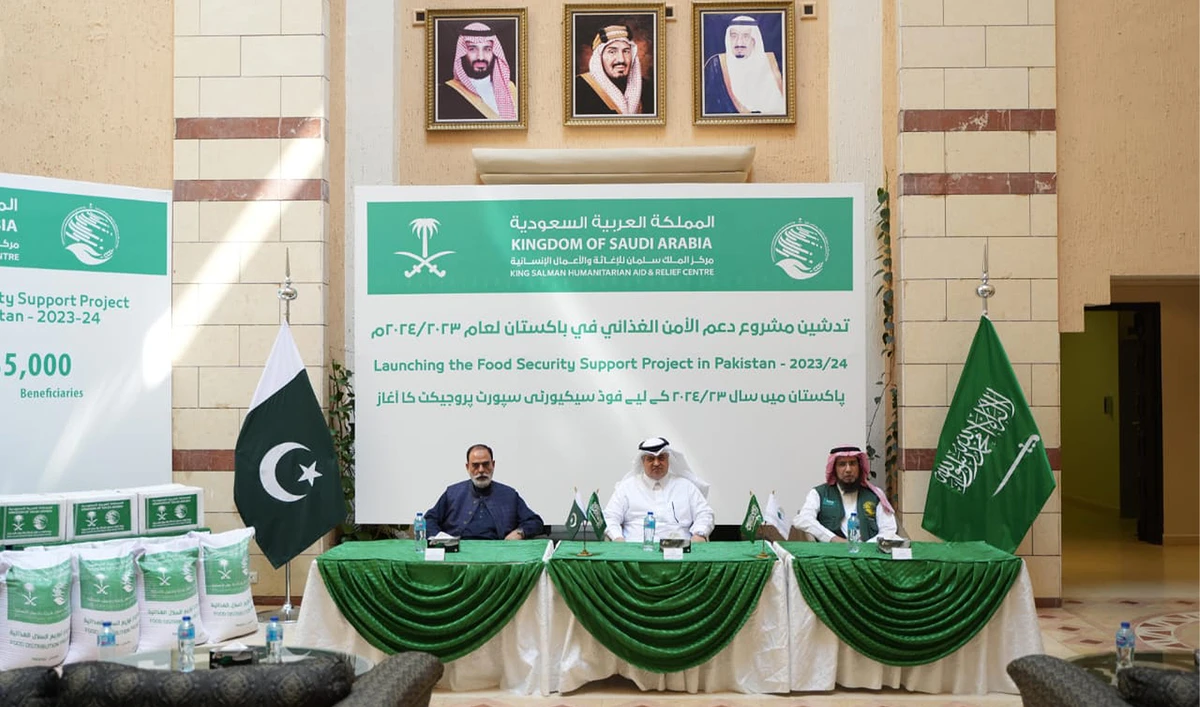
Saudi ambassador to Pakistan Nawaf bin Said Al-Malki (center) and Pakistan's religious affairs minister Senator Talha Mahmood (left) attend the launch ceremony of a food security project for flood-affected families in Pakistan in Islamabad on July 17, 2023. (KSrelief)
Short Url
Updated 12 July 2023
Follow

KSrelief launches food security project for flood-affected families in Pakistan

  • The Saudi humanitarian organization will distribute food packages among deserving people in 40 districts of the country
  • The initiative aims to benefit 735,000 individuals across Pakistan through distribution of flour, cooking oil, sugar and pulses

ISLAMABAD: King Salman Humanitarian Aid and Relief Center (KSrelief) has launched a food distribution project in to help food-affected and other marginalized people residing in 40 districts of Pakistan, said an official statement circulated by the organization on Wednesday.

KSrelief has provided humanitarian and development assistance to more than 92 countries over four continents. With international, regional, and local partners, the organization has benefitted millions worldwide.

“King Salman Humanitarian Aid & Relief Center has initiated a project aimed at ensuring food security for the year 2023-24,” the statement said. “In collaboration with the National Disaster Management Authority, KSrelief will distribute a total of 105,000 food packages weighing 10,013 tons in four phases among flood affected and deserving people living in 40 districts … across all the provinces of Pakistan.”


Saudi ambassador to Pakistan Nawaf bin Said Al-Malki (center) and Pakistan's religious affairs minister Senator Talha Mahmood (right) attend the launch ceremony of a food security project for flood-affected families in Pakistan in Islamabad on July 17, 2023. (KSrelief)

The statement said the initiative would benefit 735,000 individuals throughout the country.

It informed that each package would weigh 95 kilograms, with 80 kilograms of flour, five liters of cooking oil and five kilograms each of sugar and pulses. The package, it added, would be sufficient for a family throughout the month.

This project falls under the umbrella of Saudi humanitarian projects, represented by KSrelief, to assist needy families in different parts of Pakistan.

Pakistan has strong political, cultural, economic, and defense ties with Saudi Arabia. The kingdom is also home to more than 2.5 million Pakistani expatriates and serves as a key source of remittances and oil supply to Islamabad.

The South Asian country is also the fifth largest recipient of KSrelief’s humanitarian assistance.

Pakistan army chief assumes role as first Chief of Defense Forces, signaling unified command

Updated 5 sec ago
Follow

Pakistan army chief assumes role as first Chief of Defense Forces, signaling unified command

  • New role is held simultaneously with Gen Asim Munir’s existing position as Chief of Army Staff
  • It is designed to centralize operational planning, war-fighting doctrine, modernization across services

ISLAMABAD: Pakistan’s most senior military officer, Field Marshal Syed Asim Munir, formally took charge as the country’s first Chief of Defense Forces (CDF) on Monday, marking a structural change in Pakistan’s defense command and placing the army, navy and air force under a single integrated leadership for the first time.

The new role, held simultaneously with Munir’s existing position as Chief of Army Staff, is designed to centralize operational planning, war-fighting doctrine and modernization across the services. It reflects a trend seen in several advanced militaries where a unified command oversees land, air, maritime, cyber and space domains, rather than service-level silos.

Pakistan has also established a Chief of Defense Forces Headquarters, which Munir described as a “historic” step toward joint command integration.

In remarks to officers from all three forces after receiving a tri-services Guard of Honor at the General Headquarters (GHQ) in Rawalpindi, Munir said the military must adapt to new theaters of conflict that extend far beyond traditional ground warfare.

He stressed the need for “a formalized arrangement for tri-services integration and synergy,” adding that future war will involve emerging technologies including cyber operations, the electromagnetic spectrum, outer-space platforms, information warfare, artificial intelligence and quantum computing.

“He termed the newly instituted CDF Headquarters as historic, which will afford requisite integration, coherence and coordination to meet the dynamics of future threat spectrum under a tri-services umbrella,” the military quoted Munir as saying in a statement. 

The ceremony also included gallantry awards for Pakistan Navy and Air Force personnel who fought in Marka-e-Haq, the brief May 2025 conflict between Pakistan and India, which Pakistan’s military calls a model for integrated land, air, maritime, cyber and electronic combat. During his speech, Munir paid tribute to the personnel who served in the conflict, calling their sacrifice central to Pakistan’s defense narrative.

The restructuring places Pakistan closer to command models used by the United States, United Kingdom and other nuclear-armed states where a unified chief directs inter-service readiness and long-range war planning. It also comes at a time when militaries worldwide are re-engineering doctrine to counter threats spanning satellites, data networks, information space and unmanned strike capabilities.