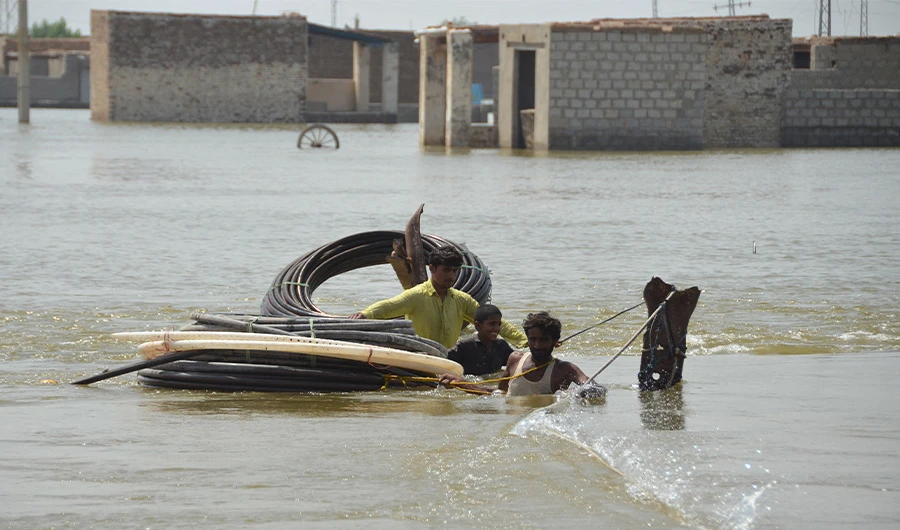
Geneva: The United Nations warned on Tuesday the humanitarian situation in flood-ravaged Pakistan was expected to get worse, a day after establishing an air bridge to deliver aid to victims.
More than 33 million people in Pakistan have been affected by the flooding, brought on by record monsoon rains amplified by climate change. The floods have caused at least 1,300 deaths and washed away homes, businesses, roads and bridges.
The UN’s World Health Organization said more than 1,460 health centers had been damaged, of which 432 were fully wrecked, the majority of them in the southeastern province of Sindh.
More than 4,500 medical camps have been set up by the WHO and its partners, while more than 230,000 rapid tests for acute watery diarrhea, malaria, dengue, hepatitis and chikungunya have been distributed.
Such diseases are already circulating in Pakistan, alongside Covid-19, HIV and polio, and “now all these are at risk of getting worse,” WHO spokesman Tarik Jasarevic told reporters in Geneva.
“We have already received reports of increased number of cases of acute watery diarrhea, typhoid, measles and malaria, especially in the worst-affected areas.”
Jasarevic said it was still difficulty to get to areas hit hard by the floods, which have submerged a third of the country — an area the size of the United Kingdom
Mortality among newborn babies and severe acute malnutrition are at risk of increasing due to disruption of services.
“The situation is expected to worsen,” Jasarevic warned.
The WHO has delivered $1.5 million in medicines and emergency stockpiles, including tents, water purification kits and oral rehydration sachets.
It is appealing for $19 million from donors.
UNHCR, the UN refugee agency, has launched an air bridge to deliver aid from Dubai.
The first four flights took off on Monday, said Indrika Ratwatte, UNHCR’s regional director for Asia and the Pacific.
Six other flights are planned, with mattresses, tarpaulins and cooking utensils on board.
“The food insecurity is going to be huge because the crops are devastated, obviously, and the little they had in terms of livestock is also destroyed,” he said.
UN preparing for worse to come in Pakistan floods
https://arab.news/nnfha
UN preparing for worse to come in Pakistan floods
- UN’s World Health Organization said more than 1,460 health centers had been damaged
- UNHCR, the UN refugee agency, has launched an air bridge to deliver aid from Dubai
‘Terrified’ Sydney man misidentified as Bondi shooter turns to Pakistan consulate for help
- The man says he received death threats after his images were spread widely on social media
- He sought consular help after relatives in home country began receiving alarmed phone calls
SYDNEY: A Sydney man said he had received death threats and was “terrified” to leave his home Monday after his photo was widely shared online as the gunman responsible for the Bondi Beach shooting.
A father and son duo opened fire on a Jewish festival at Australia’s best-known beach on Sunday evening, killing 15 people, including a child, and wounding 42 more.
Authorities have condemned the attack as an act of terrorism, though they have not named the two shooters — one killed at the scene, and the other now in hospital.
However, Australian public broadcaster ABC said the alleged assailant was Naveed Akram from the western Sydney suburb of Bonnyrigg, quoting an anonymous official, and other local media reported that police had raided his home.
Photos of a beaming man in a green Pakistan cricket jersey pinged across social media.
Some of the posts were shared thousands of times, drawing vitriolic comments.
But the photo was taken from the Facebook profile of a different Naveed Akram, who pleaded Monday for people to stop the misinformation in a video published by the Pakistan Consulate of Sydney.
“Per media reports, one of the shooters’ name is Naveed Akram and my name is Naveed Akram as well,” he said in the video.
“That is not me. I have nothing to do with the incident or that person,” he said, condemning the “terrible” Bondi Beach shooting.
“I just want everyone’s help to help me stop this propaganda,” he said, asking for users to report accounts that misused his photo, which he had shared in a 2019 post.
’ LIFE-THREATENING’
The 30-year-old, who lives in a northwestern suburb of Sydney, told AFP he first heard around 9:30 p.m. on Sunday that he had been falsely identified as the shooter.
“I could not even sleep last night,” Akram told AFP by phone, adding he deleted all the “terrible” messages he got.
“I’m terrified. I could not go outside, like it’s a life-threatening issue, so I don’t want to risk anything... my family is worried as well, so it’s quite a hard time for me.”
He asked the Pakistan Consulate to put out the video because relatives in the country’s Punjab province were getting phone calls as well.
“It was destroying my image, my family’s image,” he said.
“People started to call them. They were worried, and they have told the police over there.”
The Pakistan native moved to Australia in 2018 to attend Central Queensland University and later did a masters at Sydney’s Holmes Institute.
Today he runs a car rental business, and he said Australia is “the perfect country.”
“I love this country. I have never had any safety issues here, like everyone is so nice, the people are so nice here,” Akram said.
“It’s only this incident that has caused me this trauma.”