



JEDDAH: The world has a new richest race, with the announcement of the creation of the $20 million Saudi Cup, to be run at King Abdul Aziz Racetrack in Riyadh on Feb. 29, 2020.
Details of the contest were announced by Prince Bandar bin Khalid Al-Faisal, chairman of the Jockey Club of Saudi Arabia, at a launch event in Saratoga, New York, on Wednesday.
The race will be run on over a distance of nine furlongs (1,800 meters) on dirt, and will have a maximum field of 14 starters. The race will be free to enter and to participate in.
BACKGROUND
- The Saudi Cup will take place four weeks after the Pegasus World Cup at Gulfstream Park, Florida, and four weeks prior to the Dubai World Cup.
- The Pegasus World Cup had a peak value of $16 million in 2018, while the Dubai World Cup is currently worth $12 million.
The prize for the winning horse will be $10 million, with horses down to 10th place sharing another $10 million between them.
“The introduction of the Saudi Cup as an international race is without doubt the most significant event in the history of horseracing in Saudi Arabia, and demonstrates our resolve to develop this great sport in the Kingdom of Saudi Arabia, and also our ambition to become a leading player on horseracing’s world stage,” said Prince Bandar.
“We look forward to welcoming international horsemen and women, the media, racing enthusiasts and the public to Riyadh in 2020.” The Saudi Cup will take place four weeks after the Pegasus World Cup at Gulfstream Park, Florida, and four weeks prior to the Dubai World Cup.
This means that the top horses in training have the opportunity to compete in all three of the most valuable dirt races in the world.
The Pegasus World Cup had a peak value of $16 million in 2018, while the Dubai World Cup is currently worth $12 million.
In terms of turf races, the richest is in Australia (the Everest) and is worth $9.8 million. In Japan, the mark is $6 million for the Japan Cup.
Europe’s most lucrative event, the Prix de l’Arc de Triomphe, has a prize fund of $5.6 million.
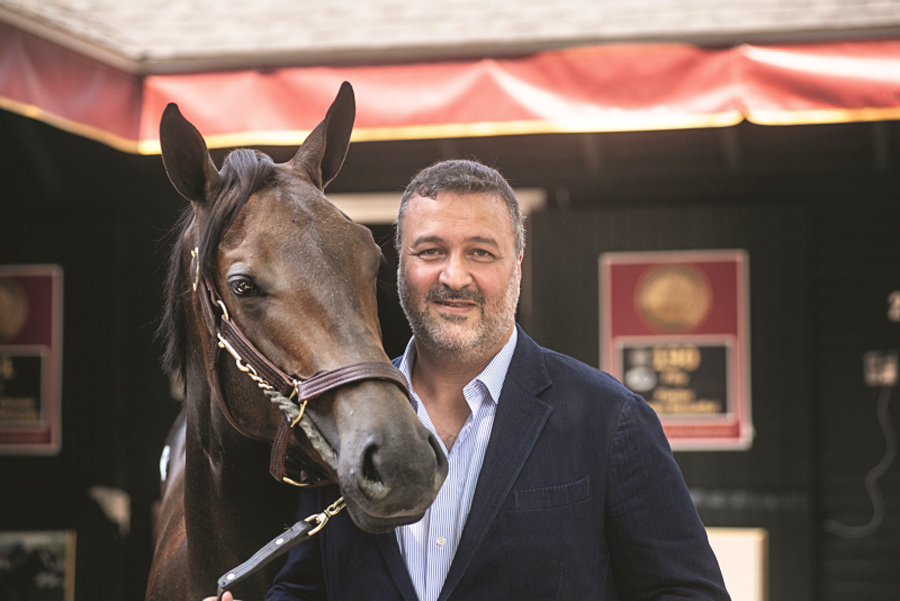
Prince Bandar bin Khalid Al-Faisal, chairman of the Jockey Club of Saudi Arabia, in Saratoga. (Supplied photo)
Prince Bandar’s connection to horses is an emotional one. Less than a century ago, his great grandfather King Abdul Aziz, a renowned rider and the founding father of modern Saudi Arabia, led his army into battle on horseback, earning himself the title “The Last Horseman.”
In 1932, King Abdul Aziz unified the kingdoms of Nejd and Hijaz, creating the sovereign state of Saudi Arabia. Horseracing soon became an important cultural event in the young nation.
Its status was enhanced in 2003 with the opening of King Abdul Aziz Racetrack, with a 2,000-meter circumference, a three-furlong (600-meter) chute and a state-of-the-art dirt racing surface.
Many of the world’s leading jockeys have ridden regularly at the racetrack over the past few years, and have been impressed with its facilities.
“I’ve been going to King Abdul Aziz Racetrack ever since it opened … Of all the dirt tracks I’ve ridden, it’s the one I like best as you can win from the front and you can win from behind — it’s a fair track,” said Europe’s jockey of the moment, Frankie Dettori.
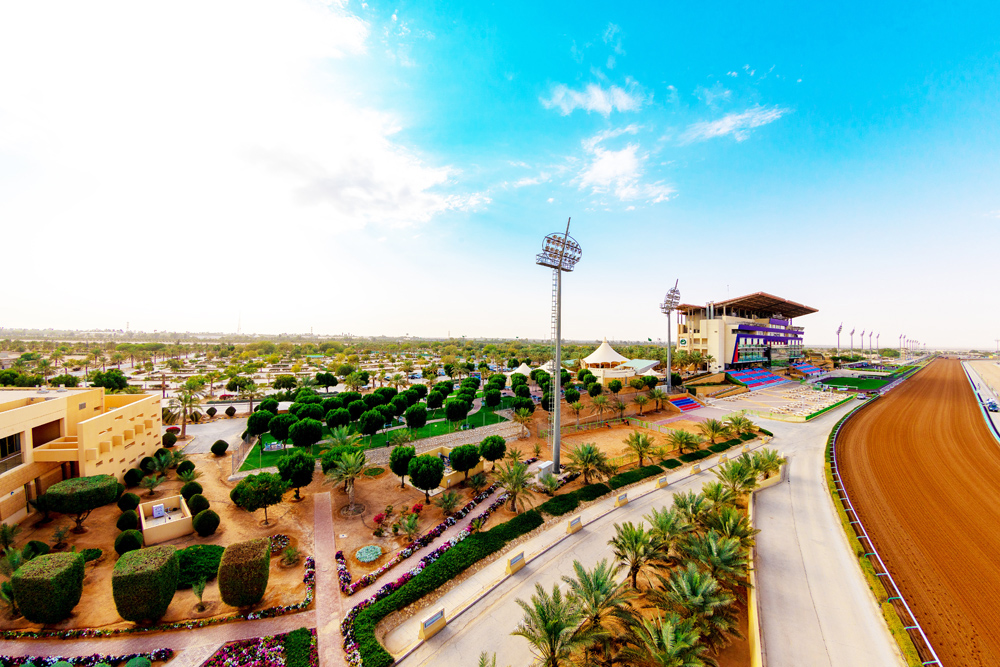
The King Abdullah Racetrack in Riyadh, the venue for the $20 million Saudi Cup, which will be the world's richest horse race. (Supplied photo)
“The other thing I like is that the kickback is so much less than on other dirt tracks. I don’t know why, but the sand seems finer and doesn’t stick. You only need a couple of pairs of goggles, where on other tracks you need four or five. It’s a kinder track that I can see turf horses handling.”
US jockey Edgar Prado said: “In my experience, all the time I rode at King Abdul Aziz Racetrack, I’ve found it good and safe with a nice stretch run. Horses handle it very well.”
France’s four-time champion jockey Olivier Peslier said: “King Abdul Aziz Racetrack is one of the best dirt tracks in the world — a wonderful track. And I know that the American jockeys like it very much because it really suits the American horses. It has a long straight, and there isn’t much kickback.”
The Jockey Club of Saudi Arabia will arrange and fund the shipment of all invited horses. It will also arrange and pay for the flights and hotel accommodation of the horses’ connections.
In addition to the Saudi Cup, there will be further international races on the undercard ahead of the showcase race.
Further details of these supporting races and the full race program will be announced at a later date.


