ISLAMABAD: Cash-strapped Pakistan, struggling to bolster depleted public finances, hopes to earn much-needed hard currency by selling UN-backed carbon offsets from a massive reforestation project named the Billion Tree Tsunami, the climate change ministry said on Tuesday.
If approved and registered by the United Nations, this would be the first project for Pakistan under a scheme called the Clean Development Mechanism that promotes investments in emission-reducing projects in the developing world by companies and governments in rich nations.
In return for building wind farms or other projects, such investments can earn valuable carbon offsets called certified emission reductions (CERs) that can be sold for profit or used to meet mandatory targets to cut emissions.
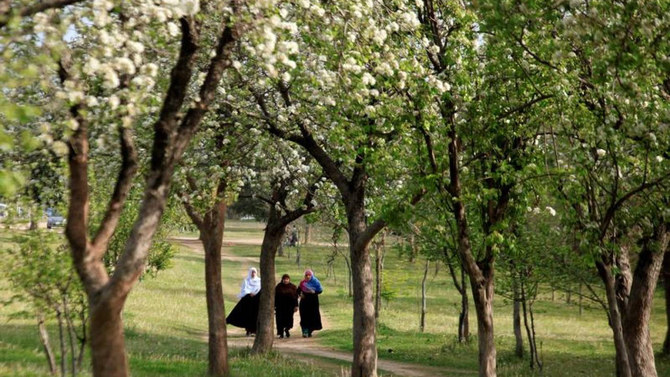
Cricket-star turned politician Imran Khan, whose Pakistan Tehreek-e-Insaf (PTI) party won the 2018 general election in Pakistan, spearheaded the Billion Tree Tsunami project, which started in 2014 and cost $169 million. Under the project, a total of 300 million trees of 42 different species were planted across the northwestern Khyber Pakhtunkhwa province, where the PTI headed the provincial government from 2013-2019.
Khan, now prime minister, has allocated $47 million in this year’s budget to expand the forestation project and plant 100 million trees in five years across the country.
Now, the government wants to be rewarded for the project that it says will go a long way in reducing carbon emissions.
“We have awarded consultancy to a reputable firm to examine the potential of carbon credits in Pakistan and their prospects of being sold in the international market,” Javed Shahzad, a spokesman for the Ministry of Climate Change, told Arab News, adding that the firm would complete its work within six months.
“Prices of carbon credits keep changing in the international market, but we are hopeful to at least recover the cost of our Billion Tree Tsunami project by selling the credits,” Shahzad said.
Inger Andersen, head of the International Union for Conservation of Nature (IUCN), the NGO in charge of administering the Bonn Challenge, has described the Pakistani project as “a true conservation success story.” Experts at World Wildlife Fund-Pakistan, which monitored and conducted an independent audit of the reforestation drive, have said the project has been an environmental, economic and social success.
Pakistan is the seventh most affected country by the adverse impacts of climate change, though it emits less than one percent of total annual global greenhouse gases. In a report submitted to the Economic and Social Council of the United Nations recently, Pakistan has sought compensation for its low carbon footprint to meet the estimated $10.7 billion per year needed for climate adaptation, and $8-17 billion for mitigation.
Under the Clean Development Mechanism, a carbon credit is issued for every ton of avoided greenhouse gases, and holders of the credits can then contribute the credits to their national targets, or sell them back on the market for money.
Government around the world raised approximately $33 billion in carbon pricing revenues in 2017 through allowance auctions, direct payments to meet compliance obligations and carbon tax receipts, said a World Bank report titled “State and Trends of Carbon Pricing 2018.” This amount represents an increase of nearly $11 billion compared to the $22 billion raised in 2016.
“The international market for selling and buying carbon credits is very small, and Pakistan should not expect to earn a huge amount based on its low-emission projects,” Dr. Pervaiz Amir, a climate expert said.
He suggested instead that the government should hire international experts and firms to develop low-emission and climate-resilient projects for which it could get grants from the World Bank and the Green Climate Fund, which have an allocation of $250 billion and $100 billion respectively to help developing countries cut greenhouse gas emissions.
“We should develop partnerships with industrial countries like Japan, Norway and Germany to help them meet their carbon emission targets and earn revenue,” Amir said.


![]()

Pakistan seeks to earn millions on carbon credits from ‘Billion Tree Tsunami’ project
Pakistan seeks to earn millions on carbon credits from ‘Billion Tree Tsunami’ project
- Consultancy hired to examine prospects of selling carbon credits in international market, climate ministry says
- UN Clean Development Mechanism promotes investments in emission-reducing projects in developing world by rich nations
Latest updates


Recommended


© 2026 SAUDI RESEARCH & PUBLISHING COMPANY, All Rights Reserved And subject to Terms of Use Agreement.