- 88 cyclists, including participants from Afghanistan, Sri Lanka, Spain and Switzerland, took part
- Tour starts at 1,500 meters above sea level and never stops climbing
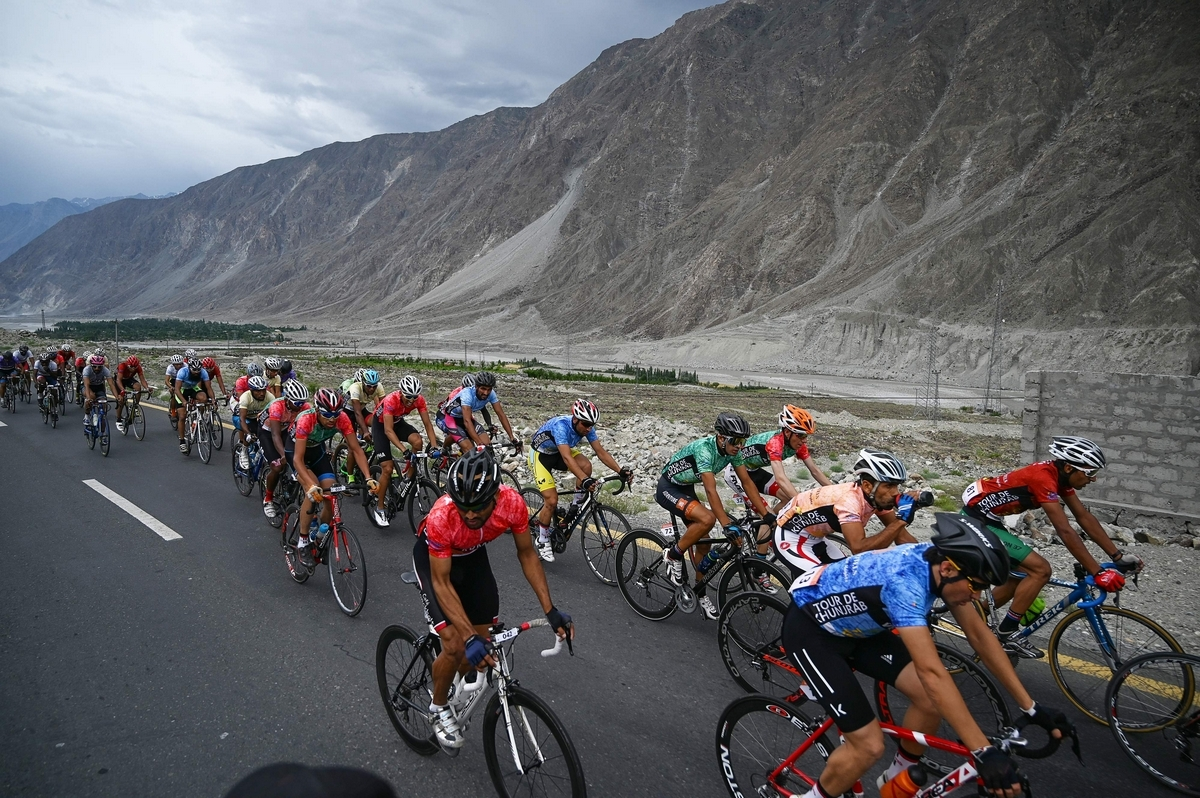
KHUNJERAB: Finishing nearly 5,000 meters above sea level after hundreds of kilometers winding past blackened glaciers and snow-capped peaks: a new Pakistani race presents a world-class challenge for cyclists — climbing toward the “Roof of the World.”
The Tour de Khunjerab — its name a homage to its more famous French counterpart, which began on Saturday — is still many years away from being another Big Loop, but with a solid claim to being the highest cycling race in the world, it has a lot to offer a certain type of athlete.
In the last week of June, some 88 cyclists, including two teams from Afghanistan and Sri Lanka as well as solo participants from Spain and Switzerland, took part in its second edition.
Less than half completed it within the allotted time.
The four stages — three ranging from 68 to 94 kilometers (42 to 58 miles) plus a shorter time trial — are much shorter than many other cycling events.
But there is one fundamental difference: the Pakistani Tour starts at 1,500 meters above sea level, and never stops climbing.
The final day of this year’s event sums up the challenge.
Starting at 2,800 meters — higher than the Iseran Pass, the summit of the Tour de France — it ends at 4,700 meters, just over 100 meters short of Mont Blanc, Europe’s highest mountain.
The Khunjerab Tour must become “an attraction... for the most daring and adventurous cyclists in the world,” said Usman Ahmed, the top official for the northern Gilgit region, home to some of the planet’s tallest peaks and where the race was held.
The cyclists’ tires swallow up the asphalt of the Karakoram Highway, one of the highest paved roads in the world.
Named after the Karakoram mountain range — just one of the ranges in Gilgit — the road passes through an extraordinary landscape.
Soaring, jagged peaks contrast with vertiginous ravines, glaciers driving a chill wind, and tumbling aquamarine rivers. Landslides are common.
Guardrails are a flimsy suggestion of protection from steep falls of hundreds of feet.
“There is no place in the world that offers all these things,” said Ahmed.
“No doubt it is the toughest cycle race in the world. We are aiming to make it our trademark,” said Haroon General, president of the Pakistan Cycling Federation.
“The most difficult part of the race is the final stage where cyclists face shortage of oxygen and there is risk of heart issues... At such an altitude a person falls down (faints) after running for 200 meters, but our cyclists traveled for almost 59 kilometers,” he said.
Five ambulances were on standby in case of emergencies in the final stage, he said, adding: “A majority of the cyclists made it but the support staff needed ambulances.”
The winner of the event, Najeeb Ullah — a Pakistani from a hilltop village in the southwestern province of Balochistan who won three of the four stages — told AFP that breathing was a “problem” for him in the final climb.
“I had to face a lot of difficulties while reaching the finishing line,” located at the Khunjerab Pass, the border between Pakistan and China, he said.
Especially since altitude was not the only obstacle: On the final day, fierce winds drove snowflakes into the cyclists’ faces, forcing some already struggling to catch their breath to dismount.
“Our entire training is reduced to nothing when we reach the final stage,” lamented Abdullah Aslam, a participant who could not finish the race.
“I could barely pedal and was feeling breathless,” he admitted.
Aslam, a runner from Islamabad, had already had to dismount and walk to the finish on the second day.
“The road was so steep that a majority of the cyclists had to get off their cycles because even a normal vehicle (two-wheel drive) faces issues,” he recalled.
Organizers said in some sections the competitors faced a gradient of 20 percent, an angle rarely seen in such competitions in around the world.
At each stage organizers wearing construction helmets scrutinized the surrounding mountains, peering closely for any sign of the rockfalls that periodically smash on to the road — a potential peril to the cyclists below.
The threat of danger was in stark contrast with the joyful welcome the cyclists received in villages along the route, with residents playing traditional instruments to cheer them on.
“On each mountain, each town, there were welcome signs,” said Ramon Antelo, a Spanish diplomat based in Pakistan, who called the race his “best cycling experience” and now hopes to pull together a team to compete next year.
He added: “A race like this is not in any other place. In Europe, Mont Blanc — you cannot ride it by bike.”