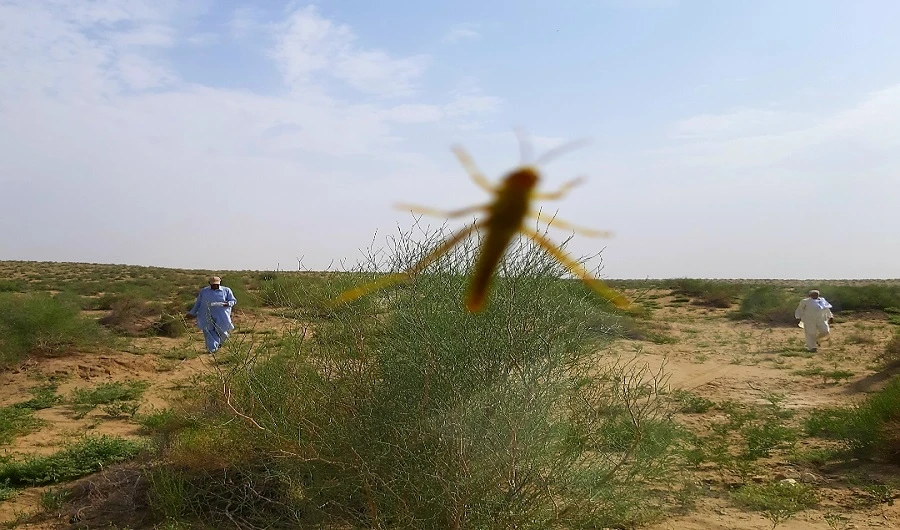
- The locust swarms migrated from the Red Sea and entered Pakistan through Iran
- Deployment of air and ground pesticide underway to control spread of infestation to Sindh’s cotton fields
KARACHI: Like a guard in a watchtower, Nisar Khaskheli, a cotton farmer in Pakistan’s southern province of Sindh, does not let his eyes leave the horizon for long.
He is keeping a lookout for a bright yellow swarm of millions of desert locusts who inch closer to Sindh’s 200,000 acres of cotton crop every day. According to him, they are now only four kilometers away from the irrigated lands of Pakistan’s second-largest cotton producing province, and the farmers are sleepless with worry, despite the government’s deployment of aircraft and pesticide-mounted vehicles to prevent an attack on the country’s prize crop.
The emergency pesticide deployment is not unwarranted: Home-grown cotton runs Pakistan’s textile industry which is its largest job provider and foreign exchange earner. As the country struggles to stave off a balance of payments’ crisis following a bailout package from the International Monetary Fund, it cannot afford to lose its cotton, which is already forecast to fall to a 17 year low this month according to official data.
“On 25th May, we spotted the locusts for the first time when they were about 18 km away from irrigated land in Sindh,” Khaskheli, who is also president of a local agriculture chamber, told Arab News.
But within days, he said, owing to favorable weather conditions for breeding and hatching, there was a huge growth in their numbers.
“It forced us to raise alarm bells and inform the authorities,” he said.
Desert locusts, swarming short-horned grasshoppers, have been destroying crops in Africa and Asia for centuries. Their ability to move in huge swarms with great speed has earned them notoriety as one of the most devastating agricultural plagues in the world.
From the Red Sea coast of Sudan and Eritria, the locusts first emerged in January this year. By February, they had hit Saudi Arabia and Iran before entering Pakistan’s southwestern Balochistan province in March.
“Saudi Arabia quickly launched a control operation, but the undetected and uncontrolled gregarious locusts moved toward Iran,” Muhammad Tariq Khan, director of the Department of Plant Protection (DPP) at Pakistan’s Ministry of National Food Security and Research, told Arab News.
Despite a massive control operation in Iran, Khan said some unrestrained and undetected locust swarms migrated to Balochistan.
“The conditions (for breeding) were conducive for them in Balochistan due to rainfall,” he said.
Though Balochistan is not a major cotton province like Sindh and Punjab, the huge swarms of locusts have destroyed pomegranate, watermelon, grain and cotton crops in their path according to locals, though the exact extent of the damage is not yet officially known.
According to Liaquat Shahwani, Balochistan government’s spokesperson, the damage in his province has been controlled.
“Despite a massive attack, the damage was not too high,” he said, but did not share specific estimates of crop damage.
Most farmers disagreed, and said the destruction was colossal.
“They haven’t even spared the trees,” said Naseer Baloch, a farmer in Kharan, an area infested by locusts in Balochistan, alongside districts Chaghi, Washuk, Pasni, Turbat, Uthal, Dalbandin, Panjgur and parts of Kechh.
“They attack like an army and when they advance, it looks like the earth is moving,” he said.
The last major locust infestations in Pakistan were back in 1993 and 1997, though the government lacks credible statistics to quantify the damage in both instances.
After the Balochistan outbreak, the DPP says it has moved its ground control teams to launch control operations in affected areas, but that some locust groups were now moving toward the Tharparkar and Nara deserts of Sindh, and also toward India’s Rajasthan desert.
Sindh’s agriculture minister, Muhammad Ismail Rahoo, said his department found out about the locust infestation on June 3rd and was making serious efforts to safeguard its cotton crop.
It is still unclear why news of the infestation has taken so long to reach Sindh, despite crops affected in Balochistan three months ago.
“We are not big landlords, and our crop is our only source of income,” Sindh farmer Khaskheli said. “The money we make from it helps pay our bills, pay for hospitals, our children’s schools, their weddings.”
“If the locusts are not controlled, they will not just damage our crops and deprive us of livelihood,” he said. “They will wipe out billions of rupees.”
Then he shielded his eyes from the sun, and turning away, continued to stand guard over his cotton fields.