ISLAMABAD: Pakistan Air Force (PAF) fighter jet JF-17 Thunder took to the skies for practice drills ahead of the week long 53rd Paris Air Show which begins on 17 June at the Le Bourget Airport, Paris, the PAF said in a statement.
The JF-17 Thunder is a joint project of Pakistan and China and began over a decade ago. The final assembly of the $40 million aircraft takes place at the Pakistan Aeronautical Complex in the country’s north-east with the engine, radar and some critical sub systems supplied by China.
On Friday, the Pakistan contingent comprising three JF-17 jets along with air and ground crew touched down in Paris, and the demo team began practice sessions for a series of aerobatic drills for their aerial display show which is considered one of the fair’s most anticipated attractions.
According to the PAF statement, one jet will be performing a flying display on all show days, while the other will be on static display showcasing its weaponry.
The first four days of the show are reserved for trade visitors, with the following three days open to the general public. After international sales success in Myanmar and Nigeria recently, the Pakistani-Chinese JF-17 fighter jet is now seeking new markets.
In February this year, the JF-17 Thunder received international attention after it shot down an Indian Air Force IAF MiG-21 during a military engagement.


Pakistani Fighter Jet JF-17 takes to Parisian skies seeking new markets

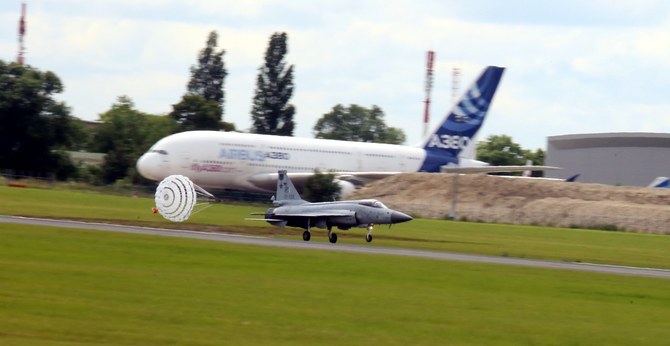
Pakistani Fighter Jet JF-17 takes to Parisian skies seeking new markets

- Three $40 million Pakistan-Chinese JF-17 thunder aircrafts are participating in the show
- The Paris air show is the largest air show for the aerospace and defense industry

Saudi Arabia leads Pakistan’s December remittances as inflows rise 16.5%
- Remittances reach $3.6bn in December, central bank says
- Flows from Gulf countries remain backbone of Pakistan’s external financing
KARACHI: Workers’ remittances to Pakistan rose sharply in December with inflows led by Saudi Arabia, according to State Bank of Pakistan data released on Friday, providing critical support to the country’s foreign exchange reserves and balance of payments.
Remittances, a key source of hard currency for Pakistan, have remained resilient despite global economic uncertainty, helping cushion the country’s current account, support the rupee and stabilize foreign exchange reserves at a time when Islamabad remains under an International Monetary Fund (IMF) bailout program.
According to the State Bank of Pakistan’s official data, workers’ remittances reached a record $38.3 billion in fiscal year 2024-25 (July 2024–June 2025), up from about $30.3 billion the year before, reflecting strong labor migration to Gulf countries and improved formal banking channels. Economists say remittances are especially vital for Pakistan because they finance imports, support household consumption and reduce reliance on external borrowing.
“Workers’ remittances recorded an inflow of $ 3.6 billion during December 2025,” the central bank said in a statement.
“In terms of growth, remittances increased by 16.5 and 12.6% on y/y and m/m basis respectively.”
On a cumulative basis, remittances also posted solid growth in the current fiscal year.
“Cumulatively, with an inflow of $ 19.7 billion, workers’ remittances increased by 10.6% during H1FY26 compared to $ 17.8 billion received during the same period last year,” the statement said.
Saudi Arabia remained the single largest source of inflows in December with $813.1 million, followed by the United Arab Emirates at $726.1 million, the United Kingdom at $559.7 million and the United States at $301.7 million, according to the central bank.
Millions of Pakistanis work abroad, particularly in Saudi Arabia and the United Arab Emirates, sending money home to support families and local economies. The government and central bank have encouraged the use of formal channels in recent years, helping improve transparency and sustain inflows.