Facebook says ‘fully committed’ to curbing anti-polio misinformation in Pakistan

1 / 6
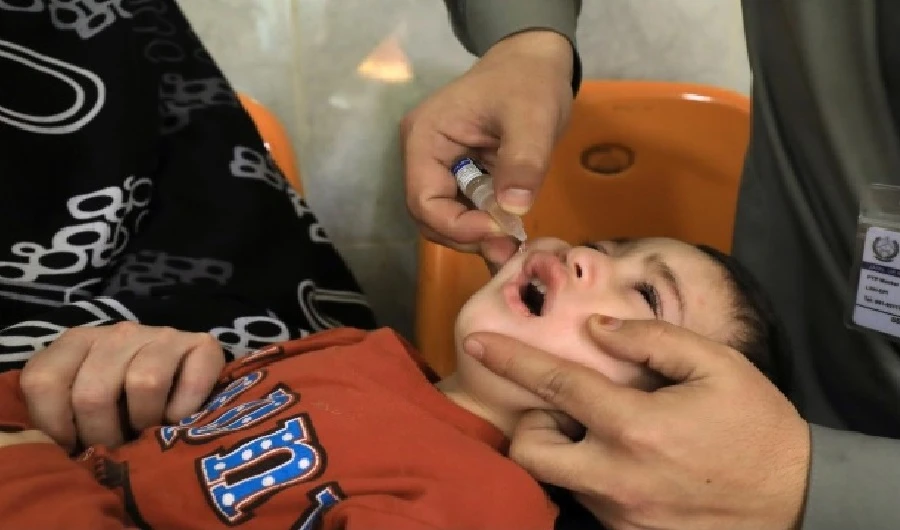
In this April 20, 2019 file photo, a boy receives polio vaccine drops by anti-polio vaccination workers at a booth outside a hospital in Peshawar, Pakistan.(Reuters)
2 / 6
In this April 9, 2018 file photo, a vaccinator with kit box waits for her colleagues to do an anti-polio campaign in a low-income neighborhood in Karachi. (Reuters)
3 / 6
In this file photo a polio vaccinator administers polio vaccine drops to a boy while a colleague takes notes nearby in Karachi, Pakistan, October 2014. (Reuters)
4 / 6
Prime Minister’s Focal Person on Polio Babar bin Atta and Pakistan country heads of the World Health Organisation and UNICEF in a video conference with the Facebook team on Thursday, May 9, 2019 – (Courtesy – Babar bin Atta Twitter)
5 / 6
Prime Minister’s Focal Person on Polio Babar bin Atta and Pakistan country heads of the World Health Organisation and UNICEF in a video conference with the Facebook team on Thursday, May 9, 2019 – (Courtesy – Babar bin Atta Twitter)
6 / 6
In this April 9, 2018 file photo, a boy receives polio vaccine drops, during an anti-polio campaign, in a low-income neighbourhood in Karachi. Pakistan said on Thursday that Facebook was ready to remove content on its platforms that spread misinformation about anti-polio campaigns and discouraged vaccination against the virus. (Reuters)
Updated 11 May 2019
Follow

Facebook says ‘fully committed’ to curbing anti-polio misinformation in Pakistan

  • Spokesperson says Facebook takes misinformation regarding vaccinations “very seriously”
  • Pakistan is one of the only three countries where complete polio eradication has not yet been achieved

ISLAMABAD: Social media giant Facebook Inc. said on Friday it was “fully committed” to the safety of Pakistani users of its platforms and was taking steps to reduce misinformation about anti-polio campaigns as Pakistan makes a final push to eradicate the disease. 
Along with Afghanistan and Nigeria, Pakistan is one of the only three countries where complete polio eradication has not yet been achieved, but case numbers are at the lowest level ever, with only 11 cases reported in 2019, compared to over 300 in 2014. 
The country’s success follows an intense program based around vaccinating vulnerable children. But challenges, such as misinformation about polio vaccines on social media platforms like Facebook, are undermining the government’s efforts to fully eradicate the disease. 
“We are fully committed to the safety of our community in Pakistan and take misinformation regarding vaccinations on our platform very seriously,” a Facebook spokesperson told Arab News. “We regularly review reports for vaccine misinformation, whether those reports come from our community or the government.”
Outlining steps to combat misinformation, the Facebook spokesperson said the company removed any content that violated Community Standards 
“If we find that the content does indeed contain misinformation about vaccinations, we reduce its distribution by reducing the News Feed and Search ranking of the Group/Page that shared it and by making sure we are not recommending this content on Facebook nor Instagram,” the Facebook spokesperson said. 
“We also rely on the work of leading global health organizations, such as the World Health Organization and the US Centers for Disease Control and Prevention, who have publicly identified verifiable vaccine hoaxes. We will continue to work with Pakistan’s government and world health organizations on this important issue,” the spokesperson added. 
Babar bin Atta, the Prime Minister’s Focal Person on Polio, told Arab News on Thursday that Facebook’s global regulatory and content management team had assured Pakistan of their cooperation in its fight against polio during a video conference in which the country heads of the World Health Organization and the United Nations Children’s Fund were also present.
“Facebook is ready to remove propaganda material including pages as per their rules and policy guidelines,” Atta said in an interview. “Very encouraging to see how Facebook is taking the subject of polio eradication so seriously.”
According to Facebook, the company has recently been working to reduce organic distribution on vaccine misinformation content and to substantially lower the distribution of Groups or Pages on Facebook that propagate misinformation.
This includes working to remove offending Groups and Pages from recommendation surfaces on the platform (such as “Groups You Should Join”) and from predictions for when users type into search, a Facebook official who declined to be named said. It also involves implementing changes so that Facebook doesn’t show or recommend content that contains misinformation about vaccinations on Instagram Explore or hashtag pages. Content from the offending Groups and Pages is also demoted in News Feed, using ranking systems and the Groups and Pages themselves are also reduced in search results.
The Facebook source also said the company was taking taking additional steps to address hoaxes related to vaccines in advertising, investing in systems to better ensure that ads that include misinformation about vaccines are rejected. The company is also removing a number of ad targeting options, such as “vaccine controversies,” that might have been used to help spread misinformation, the official said.

Pakistani student launches ‘Urdu ChatGPT’ AI model

Updated 18 January 2026
Follow

Pakistani student launches ‘Urdu ChatGPT’ AI model

  • Developer says “Qalb” is largest large language model built exclusively for Urdu
  • Project highlights push to localize artificial intelligence for non-English users

ISLAMABAD: A Pakistani student studying in the United States has launched an artificial intelligence model designed exclusively for the Urdu language, a development its creator says could help bridge longstanding gaps in access to advanced digital tools for millions of speakers worldwide.

The project, called Qalb, is positioned as an Urdu-first large language model at a time when most generative AI systems are primarily trained on English and other widely used global languages. Supporters of language-specific models argue they can improve accuracy, cultural relevance and accessibility for users in education, business and public services.

Urdu is spoken by more than 230 million people globally, including in Pakistan, India and diaspora communities, but remains under-represented in advanced AI systems. Efforts to localize artificial intelligence have increasingly been seen as critical for widening participation in digital economies, particularly in developing countries.

“Qalb is now recognized as the world’s largest Large Language Model created exclusively for the Urdu language,” Taimoor Hassan, the project’s developer, was quoted this month in a report in state-run news agency APP. 

“Trained on a massive dataset of 1.97 billion tokens and benchmarked across seven-plus international evaluation frameworks, Qalb outperforms existing Urdu-focused AI models on key real-world performance indicators, setting a new standard for natural language processing in Pakistan,” Hassan said.

“This is a development model and in the next phase we would soon launch App for mobile and web so that people could use and benefit from Qalb ChatGPT.”

Hassan completed his undergraduate degree in computer science at FAAST University’s Peshawar campus and is currently studying for a master’s degree in computer science and software engineering at Auburn University in the United States. According to APP, he is a serial entrepreneur who has previously launched and exited multiple startups and has represented Pakistan at international technology forums.

“I had the opportunity to contribute in a small way to a much bigger mission for the country,” Hassan said.

“Together with my undergraduate roommates and teammates, Jawad Ahmed and Muhammad Awais, we are committed to continuously fine-tuning localized models for niche industries, which we believe can become a major breakthrough for Pakistan.”

Both collaborators are also graduates of FAAST University Peshawar Campus and are currently studying in Germany, APP reported.

The team behind Qalb said the model is intended to support local businesses, startups, educational platforms and voice-based digital services, arguing that meaningful innovation is no longer limited to large technology firms.

“Technology is no longer locked behind big budgets or big teams. With the right mindset, even a small group can build products that educate, automate, and serve millions,” Hassan told APP.