Attack of the clones as Star Wars fans design own lightsabers

1 / 8
In this picture taken on April 22, 2019, Makoto Tsai, who handcrafts lightsabers for Star Wars fans, poses for a photograph at his workshop in New Taipei City. (AFP/Hsu Tsun-hsu)
2 / 8
Makoto Tsai, who handcrafts lightsabers for Star Wars fans, poses for a photograph at his workshop in New Taipei City. (AFP/Hsu Tsun-hsu)
3 / 8
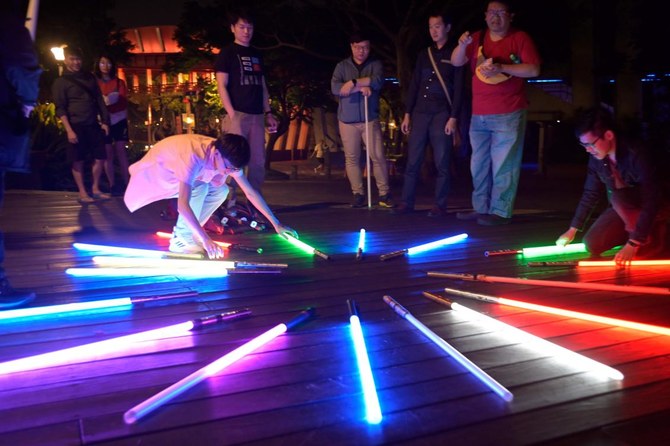
Fans arranging model lightsabers during an event to promote the upcoming unofficial Star Wars Day in Taipei. (AFP/Hsu Tsun-hsu)
4 / 8
Makoto Tsai, who handcrafts lightsabers for Star Wars fans, in his workshop in New Taipei City. (AFP/Hsu Tsun-hsu)
5 / 8
Makoto Tsai, who handcrafts lightsabers for Star Wars fans, poses for a photograph with a R2-D2 toy robot at his workshop in New Taipei City. (AFP/Hsu Tsun-hsu)
6 / 8
Fans posing for photographs with model lightsabers during an event to promote the upcoming unofficial Star Wars Day in Taipei. (AFP/Hsu Tsun-hsu)
7 / 8
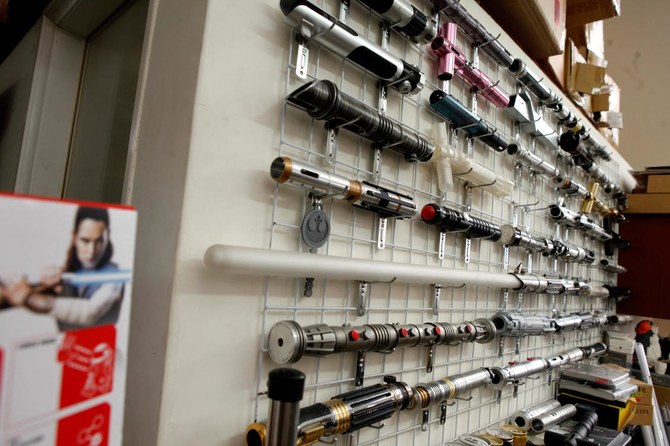
Replica Star Wars lightsabers at Makoto Tsai's workshop in New Taipei City. (AFP/Hsu Tsun-hsu)
8 / 8
Makoto Tsai posing for photographs with lightsabers during an event to promote the upcoming unofficial Star Wars Day in Taipei. (AFP/Hsu Tsun-hsu)
Updated 03 May 2019
Follow

Attack of the clones as Star Wars fans design own lightsabers

  • Star Wars may be a multi-billion dollar Hollywood franchise but fans have long complained that the official lightsabers on the market are flimsy and disappointing versions of the whizzing, crackling, swords seen in the films
  • Bright tubes of light and motion-linked audio cards similar to the film’s sound effects are now standard

TAIPEI: Frustrated by the lack of quality lightsabers in toy shops, Makoto Tsai did what any self-respecting hardcore Star Wars fan would do — he studied engineering at college and then spent years perfecting a replica.
The 36-year-old is part of a small group of artisans around the world who have forged successful careers hand-crafting remarkably realistic models of the movie saga’s famous energy swords.
As fans gather globally on May 4th for what has become the unofficial Star Wars Day — this year mourning the death of towering Chewbacca actor Peter Mayhew — many will be clutching one of Tsai’s lightsabers, made in his workshop near Taipei.
In the past decade he has shipped around 1,000 blades to some 40 countries as diverse as the United States, France and Cuba to Peru, Iceland and Tunisia. Prices start at $255 and around 80 percent of his orders come from abroad.
Local and ethnic Chinese fans are offered a half price discount, providing that they pass a written test “to prove they have enough passion for Star Wars.”
“I hand-make every piece of work so it’s very intimate to me. I only want those who really like it to own it,” he told AFP at his memorabilia filled workshop.
Star Wars may be a multi-billion dollar Hollywood franchise but fans have long complained that the official lightsabers on the market are flimsy and disappointing versions of the whizzing, crackling, swords seen in the films.
As a result a whole cottage industry has sprung up of replica manufacturers filling a gap that more established companies have uncharacteristically failed to fill.
Advances in battery, LED and computing technology have helped these artisans create increasingly sophisticated replicas, many of them choosing to avoid overt branding from the films to reduce their exposure on copyright issues.
Bright tubes of light and motion-linked audio cards similar to the film’s sound effects are now standard.

Among fans of the custom saber scene, California-based Michael Murphy is known as “Yoda.” His online shop and forum FXSabers.com is the go to place for those trading tips on where to buy and how to build the best lightsabers.
“As far as people doing installations like myself and Makoto, I’d say it’s grown from the original group of 25 back in the early years to well over 100 people out there in forums and on Facebook offering services for sabers in one way or another,” he told AFP.
The original lightsaber wielded by Luke Skywalker in the first 1977 instalment — a remarkably budget production compared to its lavish follow-ups — was little more than the handle of an old Graflex camera flash.
Those retro flashes have now become notoriously hard to source thanks to Star Wars fans. The most expensive fan-built lightsaber replicas which feature original Graflex handles have sold for as much as $15,000 on eBay.
Tsai first fell for Star Wars as a teenager and his quest for a realistic lightsaber prompted him to study electro-optical engineering and then work in that industry until he became a full-time lightsaber maker over a decade ago.
Tsai said he constantly researches to make his lightsabers “brighter, more durable and easier to manoeuver” so they can be used in fencing, which he has been promoting in Taiwan with regular duels.
The business also supports fan and charity gatherings he organizes free-of-charge.
“I spend two-thirds of my time organizing events. My mission is to promote Star Wars in Taiwan as hard as I can to draw out more fans,” he added.
One of Tsai’s proudest moments was an outing to Taiwan’s presidential office on last year’s Star Wars Day.
Darth Vader, Chewbacca and a motley crew of intergalactic characters chanted “May the force be with you” alongside Vice President Chen Chien-jen, while toy gun-toting stormtroopers joined military police to stand guard outside the landmark in downtown Taipei.
This year fans will gather near the renowned Taipei 101 skyscraper to mark the day, he said.
With plenty more Star Wars films planned by the Disney-owned franchise in the years ahead, Tsai is confident he’ll have new generations of fans flocking to buy his sabres.
“I am very optimistic that there will be more and more die-hard fans and we can definitely keep the momentum for at least another decade,” he said.
College student Kuo Shun-hao, 20, became a fan two years ago after watching the seventh instalment “Star Wars: The Force Awakens” — the JJ Abrams reboot that brought fresh critical acclaim to the franchise and a new windfall for Disney.
Kuo now regularly fences with his lightsabers.
“I like sparring and talking about Star War movies with other fans,” he said, adding: “I am making new friends as there are often new people coming to our fencing gatherings.”


Three-year heatwave bleached half the planet’s coral reefs: study

Updated 10 February 2026
Follow

Three-year heatwave bleached half the planet’s coral reefs: study

PARIS: A study published on Tuesday showed that more than half of the world’s coral reefs were bleached between 2014-2017 — a record-setting episode now being eclipsed by another series of devastating heatwaves.
The analysis concluded that 51 percent of the world’s reefs endured moderate or worse bleaching while 15 percent experienced significant mortality over the three-year period known as the “Third Global Bleaching Event.”
It was “by far the most severe and widespread coral bleaching event on record,” said Sean Connolly, one the study’s authors and a senior scientist at the Panama-based Smithsonian Tropical Research Institute.
“And yet, reefs are currently experiencing an even more severe Fourth Event, which started in early 2023,” Connolly said in a statement.
When the sea overheats, corals eject the microscopic algae that provides their distinct color and food source.
Unless ocean temperatures return to more tolerable levels, bleached corals are unable to recover and eventually die of starvation.
“Our findings demonstrate that the impacts of ocean warming on coral reefs are accelerating, with the near certainty that ongoing warming will cause large-scale, possibly irreversible, degradation of these essential ecosystems,” said the study in the journal Nature Communications.
An international team of scientists analyzed data from more than 15,000 in-water and aerial surveys of reefs around the world over the 2014-2017 period.
They combined the data with satellite-based heat stress measurements and used statistical models to estimate how much bleaching occurred around the world.

No time to recover

The two previous global bleaching events, in 1998 and 2010, had lasted one year.
“2014-17 was the first record of a global coral bleaching event lasting much beyond a single year,” the study said.
“Ocean warming is increasing the frequency, extent, and severity of tropical-coral bleaching and mortality.”
Australia’s Great Barrier Reef, for instance, saw peak heat stress increase each year between 2014 and 2017.
“We are seeing that reefs don’t have time to recover properly before the next bleaching event occurs,” said Scott Heron, professor of physics at James Cook University in Australia.
A major scientific report last year warned that the world’s tropical coral reefs have likely reached a “tipping point” — a shift that could trigger massive and often permanent changes in the natural world.
The global scientific consensus is that most coral reefs would perish at warming of 1.5C above preindustrial levels — the ambitious, long-term limit countries agreed to pursue under the 2015 Paris climate accord.
Global temperatures exceeded 1.5C on average between 2023-2025, the European Union’s climate monitoring service, Copernicus, said last month.
“We are only just beginning to analyze bleaching and mortality observations from the current bleaching event,” Connolly told AFP.
“However the overall level of heat stress was extraordinarily high, especially in 2023-2024, comparable to or higher than what was observed in 2014-2017, at least in some regions,” he said.
He said the Pacific coastline of Panama experienced “dramatically worse heat stress than they had ever experienced before, and we observed considerable coral mortality.”