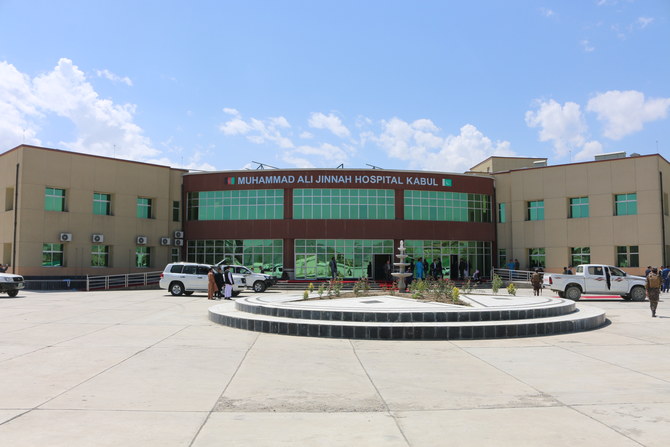
KABUL: A Kabul-based $24 million hospital funded by Pakistan was officially handed over to Afghan authorities on Saturday, according to a statement issued by the foreign office.
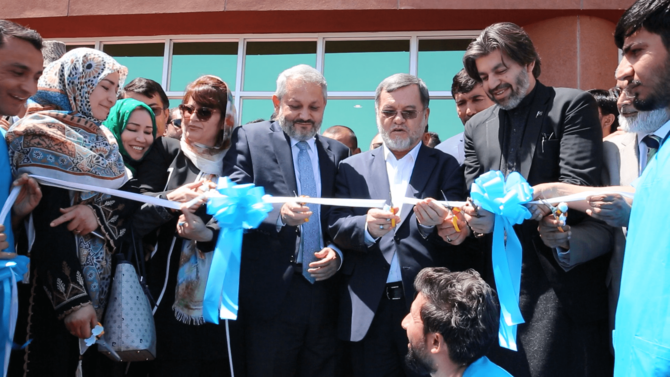
Afghan Vice President Sarwar Danish, Afghan Minister of Public Health Dr. Ferozuddin Feroz and Pakistani Minister of State for Parliamentary Affairs, Ali Muhammad Khan, jointly inaugurated the “200-bed state-of-the-art” hospital in a ceremony held in Kabul, the foreign office said.
Named ‘Jinnah Hospital’ to honor Pakistan’s founder, the hospital will focus on neurosurgery for the time being and in the future will also conduct kidney transplants, Waheed Mayar, spokesman of the Afghan public health ministry told Arab News.
Mayar said the new facility will bring much-needed relief to Afghans who spend over $300 million dollars annually on medical bills and often needed to travel to India, Pakistan and Iran due to the state of Afghanistan’s own hospitals.
According to the press release, Pakistan’s Ambassador to Afghanistan, Zahid Nasrullah Khan, said that the Jinnah Hospital was a “flagship project” of the nation’s $1 billion development assistance to Afghanistan. It is the second of three medical facilities built by Islamabad in Afghanistan with one kidney center in Jalalabad already complete and another 100-bed facility under-construction in Logar, in eastern Afghanistan.


Pakistan hands over $24 million Kabul hospital to Afghan authorities
Pakistan hands over $24 million Kabul hospital to Afghan authorities

- Named ‘Jinnah Hospital’ to honor Pakistan’s founder, the hospital will focus on neurosurgery at this stage
- It is the second of three medical facilities built by Islamabad in Afghanistan

Pakistan, China to sign multiple MoUs at major agriculture investment conference today
- Hundreds of Chinese and Pakistani firms to attend Islamabad event
- Conference seen as part of expanding CPEC ties into agriculture, trade
KARACHI: Islamabad and Beijing are set to sign multiple memorandums of understanding (MoUs) to boost agricultural investment and cooperation at a major conference taking place in the capital today, Monday, with hundreds of Chinese and Pakistani companies expected to participate.
The conference is being billed by Pakistan’s Ministry of National Food Security and Research as a platform for deepening bilateral agricultural ties and supporting broader economic engagement between the two countries.
“Multiple memorandums of understanding will be signed at the Pakistan–China Agricultural Conference,” the Ministry of National Food Security said in a statement. “115 Chinese and 165 Pakistani companies will participate.”
The conference reflects a growing emphasis on expanding Pakistan-China economic cooperation beyond the transport and energy foundations of the flagship China-Pakistan Economic Corridor (CPEC) into agriculture, industry and technology.
Under its first phase launched in 2015, CPEC, a core component of China’s Belt and Road Initiative, focused primarily on transportation infrastructure, energy generation and connectivity projects linking western China to the Arabian Sea via Pakistan. That phase included motorways, power plants and the development of the Gwadar Port in the country's southwest, aimed at helping Pakistan address chronic power shortages and enhance transport connectivity.
In recent years, both governments have formally moved toward a “CPEC 2.0” phase aimed at diversifying the corridor’s impact into areas such as special economic zones, innovation, digital cooperation and agriculture. Second-phase discussions have highlighted Pakistan’s goal of modernizing its agricultural sector, attracting Chinese technology and investment, and boosting export potential, with high-level talks taking place between planning officials and investors in Beijing.
Agri-sector cooperation has also seen practical collaboration, with joint initiatives examining technology transfer, export protocols and value-chain development, including partnerships in livestock, mechanization and horticulture.
Organizers say the Islamabad conference will bring together government policymakers, private sector investors, industry associations and multinational agribusiness firms from both nations. Discussions will center on investment opportunities, technology adoption, export expansion and building linkages with global buyers within the framework of Pakistan-China economic cooperation.


