King Abdullah’s first Pakistani doctor says bilateral ties in the pink of health

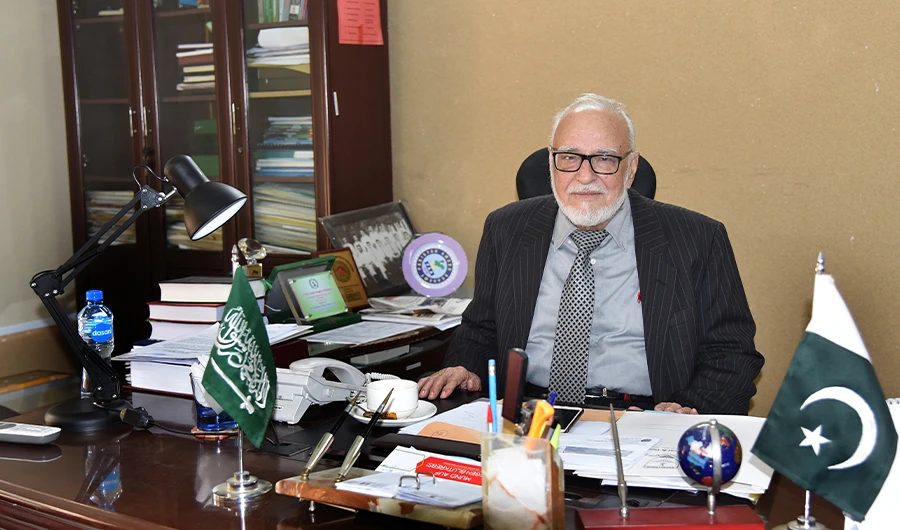
Dr. Ghulam Akbar Khan Niazi, who served as director of Saudi National Guards medical services western wing, says that Saudi Arabia has been a time tested friend of Pakistan and has played important role in progress of the Islamic Republic. (AN Photo)
Updated 17 February 2019
Follow

King Abdullah’s first Pakistani doctor says bilateral ties in the pink of health

  • Arab News interviews Dr. Niazi about his experience working in Saudi Arabia for over 30 years
  • Says crown prince’s visit will further strengthen economic and strategic relations

ISLAMABAD: In 1986, Dr. Ghulam Akbar Khan Niazi was serving as the head of the King Khalid National Guard Hospital in Jeddah when he had the honour of receiving Princess Diana and Prince Charles at the facility.

As Niazi toured the hospital with the royal couple and gave briefings and attended functions, many Saudi doctors and officials were miffed that a non-national was not just heading the prestigious institute but had also gotten the opportunity to host Diana and Charles.

The complaint, Niazi told Arab News in a wide-ranging interview in January, was forwarded to then Crown Prince Prince Abdullah Bin Abdul Aziz, who in 2005 would become King of Saudi Arabia and the Custodian of the Two Holy Mosques.

"One fine morning, Crown prince Abdullah summoned me in the royal court,” octogenarian Niazi said in an interview in his office on the outskirts of Islamabad. “I was frightened thinking that I may have committed a blunder.”

But to his surprise the crown prince asked: “You have been living here for so many years, why shouldn't I grant you nationality of Saudi Arabia?"

“This was indeed a pleasant surprise for me and I bowed my head to express consent,” Niazi said. “He granted me the nationality, saying ‘Go and serve my people as a Saudi citizen and nobody now will call you a foreigner or a non-Saudi national’.”

Niazi was hired as a doctor in Saudi Arabia, along with several other Pakistani doctors, on a two year-contract in 1963. Later, Prince Abdullah appointed him to the medical services team of the Saudi National Guards.

“I was the first ever Pakistani doctor to have the honour to serve with Prince Abdullah Bin Abdul Aziz in the National Guards,” Niazi said. “When Prince Abdullah was elevated to King, he took me along with him as a family doctor.”

Niazi returned to Pakistan in 1997 with King Abdullah’s permission and opened a private medical college, the Islamabad Medical and Dental College, on “the advice of King Abdullah”.

He described King Abdullah as a “kind-hearted” man who was deeply invested in the progress and unity of the Muslim world, as was visible in his efforts to develop education and healthcare across the Muslim world by giving generous grants and scholarships. 

“King Abdullah was one of the best friends and well-wishers of Pakistan,” Niazi said, adding that the Kingdom had always stood by Pakistan in difficult times, whether it was during wars with archrival India or natural disasters such as flash floods and earthquakes. The Kingdom, he said, had also granted financial support to Pakistan in the form of cash and oil on deferred payments after the United States imposed sanctions on the country after it tested nuclear weapons in May 1998.

“It is a historic fact that all kings and princes of Saudi Arabia have been well-wishers of Pakistan and contributed generously toward its prosperity and progress,” Niazi said.

Commenting on the upcoming visit of Saudi Crown Prince Mohammed Bin Salman, Niazi said the tour would further deepen strategic and economic ties between the two countries.

“Keeping in view the tradition of the Saudi rulers, I am sure the crown prince will announce some major investments in Pakistan to help the country’s fragile economy,” he said.
Pakistan opposition rallies in Khyber Pakhtunkhwa to demand release of Imran Khan

Updated 07 December 2025
Follow

Pakistan opposition rallies in Khyber Pakhtunkhwa to demand release of Imran Khan

  • PTI-led gathering calls the former PM a national hero and demands the release of all political prisoners
  • Government says the opposition failed to draw a large crowd and accuses PTI of damaging its own politics

ISLAMABAD: Pakistan’s opposition led by the Pakistan Tehreek-e-Insaf (PTI) party demanded the release of jailed former prime minister Imran Khan at a rally in the northwestern Khyber Pakhtunkhwa province on Sunday, describing him as a national hero who continues to command public support.

The gathering came days after a rare and strongly worded briefing by the military’s media chief, Lt. Gen. Ahmed Sharif Chaudhry, who dismissed Khan as “narcissistic” and “mentally ill” on Friday while responding to the former premier’s allegations that Pakistan’s chief of defense forces was responsible for undermining the constitution and rule of law.

He said that Khan was promoting an anti-state narrative which had become a national security threat.

The participants of the rally called for “civilian supremacy” and said elected representatives should be treated with respect.

“We, the people of Pakistan, regard Imran Khan as a national hero and the country’s genuinely elected prime minister, chosen by the public in the February 8, 2024 vote,” said a resolution presented at the rally in Peshawar. “We categorically reject and strongly condemn the notion that he or his colleagues pose any kind of threat to national security.”

“We demand immediate justice for Imran Khan, Bushra Bibi and all political prisoners, and call for their prompt release,” it added, referring to Khan’s wife who is also in prison. “No restrictions should be placed on Imran Khan’s meetings with his family, lawyers or political associates.”

Addressing the gathering, Sohail Afridi, the chief minister of Khyber Pakhtunkhwa, denied his administration was not serious about security issues amid increased militant activity. However, he maintained the people of his province had endured the worst of Pakistan’s conflict with militancy and urged a rethinking of long-running security policies.

The resolution asked the federal government to restore bilateral trade and diplomatic channels with Afghanistan, saying improved cross-border ties were essential for the economic stability of the region.

The trade between the two neighbors has suffered as Pakistan accuses the Taliban administration in Kabul of sheltering and facilitating armed groups that it says launch cross-border attacks to target its civilians and security forces. Afghan officials deny the claim.

The two countries have also had deadly border clashes in recent months that have killed dozens of people on both sides.

Some participants of the rally emphasized the restoration of democratic freedoms, judicial independence and space for political reconciliation, calling them necessary to stabilize the country after years of political confrontation.

Reacting to the opposition rally, Information Minister Attaullah Tarrar said the PTI and its allies could not gather enough people.

“In trying to build an anti-army narrative, they have ruined their own politics,” he said, adding that the rally’s reaction to the military’s media chief’s statement reflected “how deeply it had stung.”

“There was neither any argument nor any real response,” he added, referring to what was said by the participants of the rally.