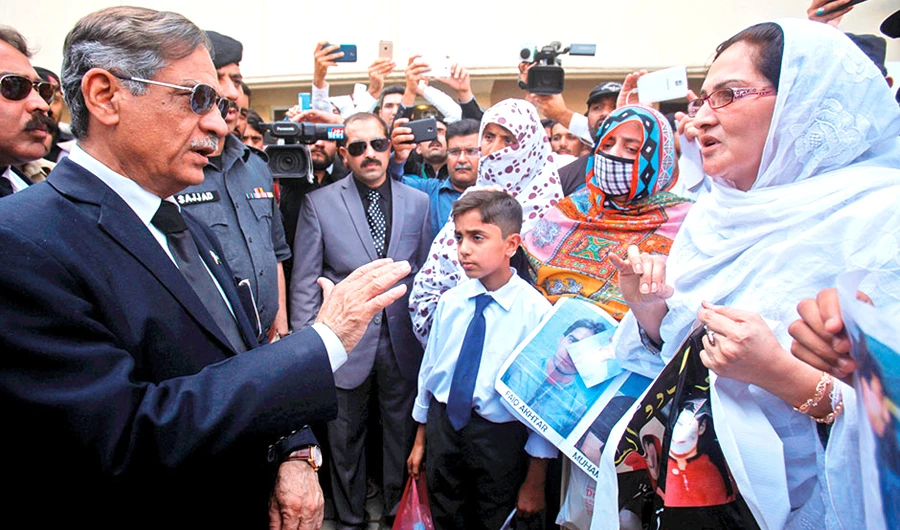
- Outgoing top judge criticized for failing to undertake judicial reforms
- Supporters see him as champion for rights of ordinary Pakistanis
ISLAMABAD: Over a two-year stint, Pakistan’s outgoing Chief Justice Mian Saqib Nisar has come to be seen as a hero for banning a three-time prime minister from politics for life over corruption charges, hauling a once-untouchable land tycoon before his court for land-grabbing and acquitting a poor Christian woman, on death row for eight years, in a landmark blasphemy case.
But his critics say Nisar’s high-octane brand of judicial activism has distracted him from his real job: reforming the country’s crisis-ridden, corrupt lower courts where almost two million cases are pending.
As he retired this week, the outgoing judge’s failures, as well as the larger problems of a sclerotic legal system, are all too obvious.
Chief among them is the singular failure to deliver on judicial reforms and address the structural weaknesses, corruption and delays that have long been a hallmark of Pakistan’s shambolic court system. Instead, Nisar used “suo motu” provisions in Pakistani law to open cases on his own initiative and passed orders on a dizzying range of public issues like water supplies, private school fees, the logo of the national airline and taxes on mobile phone plans.
“Nisar opted for populism and activism rather than reform, which has done lasting damage to law and politics in Pakistan,” legal commentator Babar Sattar said. “He wasn’t driven by judicial reform at all; he came in without any plan for much needed corrections in the system.”
Instead, Nisar largely focused his prosecutorial energies on lambasting the executive and meddling in issues usually considered the domain of government policy-making. In throwaway remarks in case after case, he lashed out at the then government of the Pakistan Muslim League-Nawaz, publicly chastising it for its inefficiency and corruption, and thunderously upbraiding senior ministers and bureaucrats on a daily basis, leading to what many officials describe as the paralysis of public-sector functioning. In actions considered deeply unbecoming of the country’s top judge, he routinely raided hospitals and prisons followed by television crews who delighted in the public humiliation he unleashed on officials. And while he fast-tracked corruption proceedings against members of the ruling party, in contrast he seemed to be more indulgent toward opposition politicians, leaving cases against them to gather dust or delivering favourable verdicts.
In 2017, Nisar made his boldest move yet by barring prime minister Nawaz Sharif, one of Pakistan’s most high-profile politicians, from holding public office for life in the outcome of a long-drawn out investigation into revelations that Sharif and his family had used offshore accounts to buy upmarket London flats.
These series of events, in the run up to a major general election, created the impression that the judiciary might once more be cutting certain politicians down to size to serve the interests of Pakistan’s all-powerful military.
For decades, malleable judges have rubber-stamped military coups in Pakistan, using what has come to be called the “doctrine of necessity” to legitimize the unconstitutional actions of dictators. But the refusal by then chief justice Iftikhar Muhammed Chaudhry to step down after he was fired by General Pervez Musharraf in 2007 unleashed a protest movement that led to Musharraf resigning as president of the country and transformed the image of the judiciary as the handmaiden of military rulers.
But under Nisar, Sattar argued, the perception that the judiciary was acting for and as an extension of the military establishment had once again resurfaced.
“The biggest disappointment of his term is that we are back to asking the question: is the judiciary in bed with the army again?” Sattar said.
For all populist grandstanding, there were some cases that the outgoing chief justice simply did not address, including a case accusing a powerful spy agency of rigging the 1990 general election by distributing millions of dollars to political parties, and hundreds of cases involving missing persons allegedly kidnapped and tortured by security agencies.
Where Nisar has focused his judicial energies has sometimes bordered on the bizarre. One of his most quixotic projects will certainly be his crowdfund drive to collect almost $17 billion from citizens, officials, businesses and celebrities to build two massive dams. Daily press releases from the Supreme Court announce different individuals and institutions, many with cases pending in court, meeting the chief justice to donate to his funds, raising suspicions they might be trying to buy influence. In one case, Nisar ordered a litigant to pay Rs.1 million into the dam fund to have his request for an adjournment granted and in another, disposed off a high-profile medical colleges case after the institutions deposited nearly Rs.17 million into the fund. Legal experts are near unanimously agreed that these action constitute misconduct.
In a recent suo motu case regarding the use of water resources by mineral water companies, Nisar ordered that a one rupee per litre tax be imposed on companies selling bottled water in a move that many observers say is a usurpation of the executive’s powers. What made the order even more legally suspect was the addendum that the tax collected go into the dam fund.
“The legacy of retired chief justice Saqib Nisar … can be encapsulated in one phrase: judicial overreach,” Pakistan’s leading Dawn newspaper wrote in an editorial on Friday, commenting on the judge’s eagerness to rewrite the rules.
But it is this very eagerness that has also has won Nisar support among ordinary Pakistanis who feel let down by self-serving political elites and see the judiciary as the only realistic hope of solving their problems.
“Saqib Nisar has set a precedent where on matters of public welfare, whether its population control or water scarcity, the Supreme Court has dared to intervene and intervened forcibly,” political analyst Muhammad Malick said. “We can endlessly debate whether the court should or should not do this but in a country where institutions don’t work, the common person needs relief and he or she doesn’t care if it comes from a judge or a politician."