- Riyadh plans to construct petrochemical complex which will house the facility
- Analysts say move will help develop downstream sector in the country
KARACHI: Pakistan and Saudi Arabia are expected to start working on a proposed oil refinery, worth more than $10 billion within the next 18 months, which would reduce the country’s dependency on expensive oil imports and boost its petrochemical sector, Saudi Energy Minister told journalists in Balochistan on Saturday.
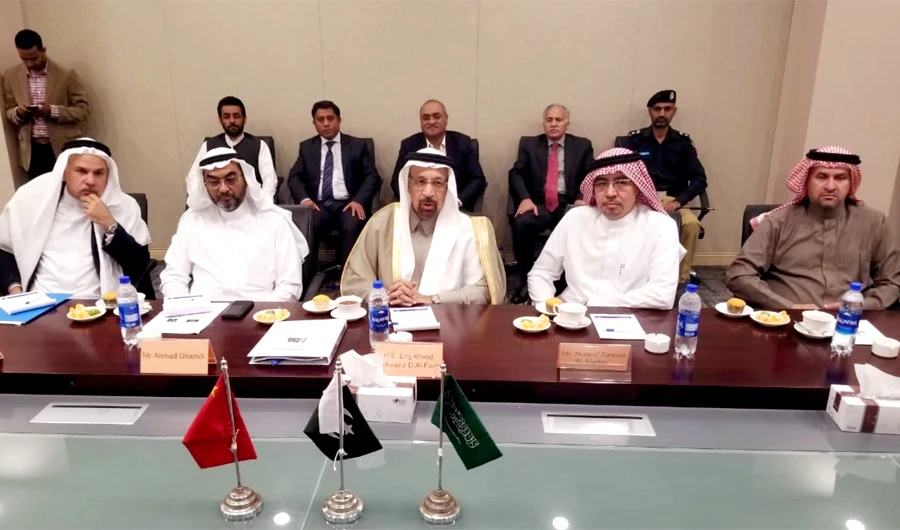
Khalid Al Falih, who led the Saudi delegation during a recent visit, said that representatives from both sides discussed a number of projects and opportunities for investment in Pakistan.
“It was continuation of discussions we had in Islamabad few months back with the honorable prime minister [Imran Khan],” Al Falih said during his visit to Gwadar on Satuday.
“We also discussed projects with Saudi Aramco, the feasibility of a big refinery and petrochemical projects here in Gwadar or elsewhere in Pakistan, but I prefer Gwadar because Gwadar is at a strategic location and is close to the Kingdom of Saudi Arabia. It will be connecting not only the urban centers of Pakistan but the region where petrochemicals are short in supply as well," he said.
During the meeting both sides also discussed investment opportunities in the renewable energy, power generation, and mining sectors.
"We discussed opportunities for product supply, refining products as well as fertilizer exports from the Kingdom as well as investing in the manufacturing sector in Pakistan,” Al Falih said, adding that "these kind of projects take time".
"It would be within 18 months that we actually move from studies and feasibilities, and frontal engineering to implementation. However, a lot of things have to happen from both sides including from the Pakistani government," he added.
On his arrival in the deepsea portcity of Gwadar on Saturday, Al Falih also inspected the site of the proposed oil city where Saudi Aramco is planning to build a petrochemical complex which will house the oil refinery at an expected investment of more than $10 billion.
“If we make the refinery work, it would be above $10 billion, especially if we integrate with petrochemical manufacturing for ethylene and propylene value chain...it will have the highest impact,” he said.
Earlier, Haroon Sharif, Chairman of Pakistan Board of Investment, had said that the "overall direction of the MoUs have been agreed upon and will be signed at the appropriate time”.
“I am expecting around $15 billion investment from Saudi Arabia in the next three years. The inflow of investments for the oil refinery and petrochemical complex in Pakistan is estimated to be between $6 billion to $10 billion,” Sharif said.
Al Falih added that: "We will have all reasonable and enabling terms to make this project profitable and bankable. Once we do that, Saudi Aramco and Saudi Arabia will push to accelerate”.
Considering the fact that it's a longterm project, experts say that the oil refinery would take eight to 10 years to materialize but, once ready, it will revolutionize Pakistan's energy industry.
“It would have a great impact. Pakistan needs these projects because the country imports a variety of finished products. Besides, it could resolve thr issue of furnace oil by deep conversion. This would be a good and positive step,” Asim Murtaza, Chief Executive Officer of Petroleum Institute Pakistan, told Arab News.
Pakistan imports around 60 percent of petroleum products from different countries which would be substituted with local production once the refinery is operational. “Pakistan would be able to save around $1.5-$2 billion foreign exchange on imports by only importing crude and making by-products in the country,” Samiullah Tariq, Head of research at Arif Habib Limited, told Arab News.
“This will happen when the refinery is operational," Tariq said, adding that the "proposed petrochemical complex would develop non-existent petrochemical industry in Pakistan with the production of polyethylene and polypropylene. This would boost the plastic and petrochemical industry in the country”.
Pakistan is hoping to attract more than $40 billion in foreign direct investment, in the next five years.
“We estimate that roughly around $40 billion investment will be made by these three countries (Saudi Arabia, the UAE, and China) during the next three to five years,” Sharif had said in a previous interview with Arab News.