

Holy smoke! Pakistan Twitter on fire over ‘sin tax’ on cigarettes

Electronic cries of rage and amusement are ringing across Pakistan’s Twitter community after the government announced on Wednesday its plans to impose a ‘sin tax’ on tobacco products ostensibly to make cigarettes more expensive. (REUTERS/file)
Updated 05 December 2018
Follow

Holy smoke! Pakistan Twitter on fire over ‘sin tax’ on cigarettes

  • Pakistan’s government plans to impose a sin tax on tobacco and sugary beverages
  • The fund collected from sin tax will be allocated to health budget, says Minister for National Health Services

ISLAMABAD: Electronic cries of rage and amusement are ringing across Pakistan’s Twitter community after the government announced on Wednesday its plans to impose a ‘sin tax’ on tobacco products ostensibly to make cigarettes more expensive and reduce the number of youngsters who take to smoking each year.

While sin tax is a commonly used term to mean excise or sales tax on products deemed harmful to society, the translation by Urdu-language media of the word sin as ‘gunnah,’ used to refer to activities that go against the commands of Allah, did not go down too well among Pakistan’s puff-chested, rambunctious Twitter users.

Journalists, cultural critics and members of the ruling Pakistan Tehreek-e-Insaaf party alike took to Twitter to blow off smoke.

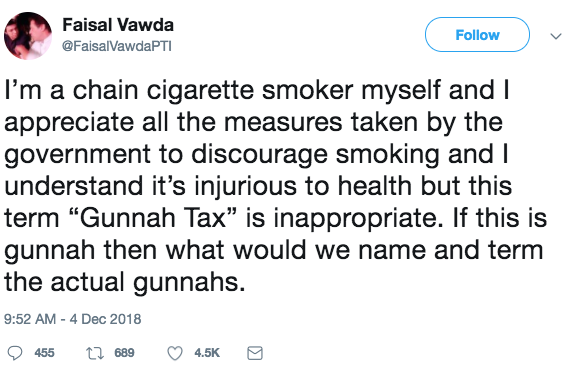
The gunslinging, motorbike-riding parliamentarian Faisal Vawda wouldn’t have any of it.   

‘I’m a chain cigarette smoker myself and I appreciate all the measures taken by the government to discourage smoking and I understand it’s injurious to health but this term “Gunnah Tax” is inappropriate,” he tweeted. “If this is gunnah then what would we name and term the actual gunnahs.”
Journalist Zarrar Khuhro, known for his sharp wit and merciless trolling, who is generally never on the same page as Vawda, responded that he was ‘with [Vawda] on this.’
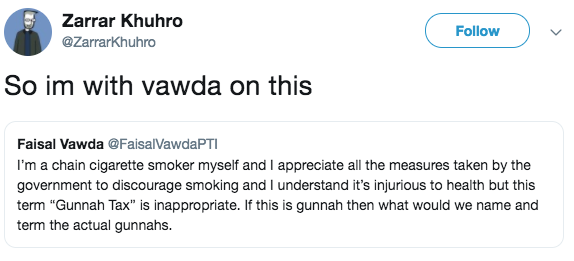
“It is a common term used internationally and is just a literal translation, not a big deal,” Khuhro told Arab News, adding that the outcry was “just another storm in a teacup.”

But Khuhro’s response to Vawda had already unleashed an army of economists (read: people adept at using google search) who proceeded to educate him about what sin tax actually meant and that the use of the word gunnah was merely a translation error. Indeed, the sheer number of people who suddenly emerged as experts on the origins and use of the sin tax since the beginning of time proved beyond a doubt that Pakistanis are capable of google searching a wide variety of topics other than just raunchy content. Ahem.

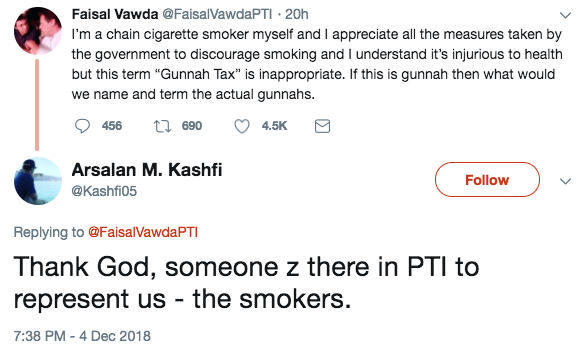
There were also those who welcomed Vawda’s stand.

“Thank God, someone z there in PTI to represent us - the smokers,” Twitter user Arsalan M Kashif said in response to Vawda’s post.
 

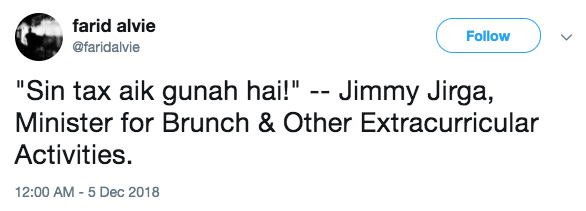
The searingly funny Farid Alvie ascribed the quote “sin tax is a sin” to a make-belief ministry:

"Sin tax aik gunah hai!’ -- Jimmy Jirga, Minister for Brunch & Other Extracurricular Activities,” Alvie posted.

One Twitter user directly addressed the prime minister for raining on his fun:

“Dude @ImranKhanPTI apni jawaani mein har mazzay kar ke abb hamarey time pe tumhen gunnah yaad aa gaya hai? Aesay nahi challega. #IStandWithMahiraKhan.’ (Oh Imran Khan, after having all the fun in your youth, now when it’s our turn you’ve remembered this is a sin? It’s not going to work like this.”
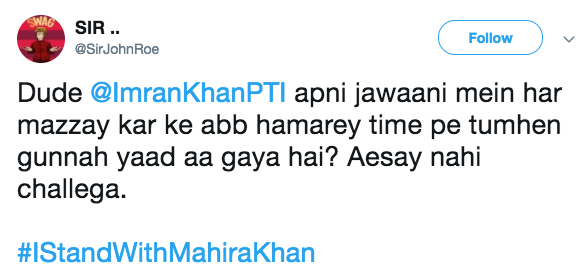

Others took an ever more dramatic approach. Hasan Aly tweeted that soon the government would tax citizens simply for being alive.
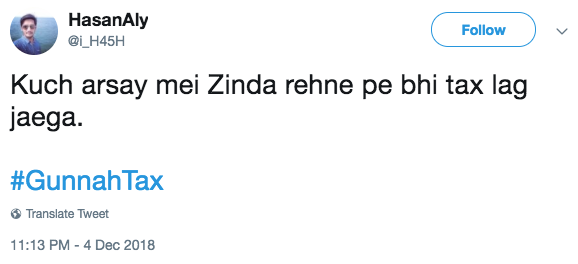
Many even revived the #IStandWithMahiraKhan hashtag from last year which was created to express solidarity with Pakistan actress Mahira Khan after she was shamed on social media over leaked photos that showed her smoking in a backless dress with Indian actor Ranbir Kapoor.

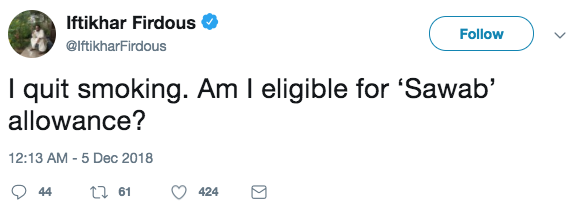
Then there was also those enterprising few who wondered if they could be rewarded for giving up smoking:

“I quit smoking. Am I eligible for ‘Sawab’ (reward) allowance?” Iftikhar Firdous, an editor at Samaa TV, said in a tongue-in-cheek post.
Author, columnist and cultural critic Nadeem Farooq Paracha had his own ideas.  

“I sure wish they could have called it something else,” Paracha told Arab News. “Like Indulgence Tax or Fun Tax Or Minor Sin tax or Chota Gunnah (small sin) Tax.” 


Review: Netflix’s ‘The New Yorker at 100’

Updated 14 December 2025
Follow

Review: Netflix’s ‘The New Yorker at 100’

  • Directed by Marshall Curry, the documentary opened the doors to the publication’s meticulous world, offering viewers a rare look inside the issues within the magazine’s issues

Out this month, Netflix’s “The New Yorker at 100” documentary marks the centennial of the weekly that has brought forth arguably some of the most compelling long-form journalism in my lifetime.

As a ferocious reader with an insatiable appetite for print, I vividly recall picking-up a copy of The New Yorker in Saudi Arabia after school as a teen, determined to read it cover-to-cover — only to find myself mentally, intellectually and physically exhausted after deciphering a single lyrical and Herculean-sized long-form piece.

Reading The New Yorker still makes one both feel smarter — and perhaps not smart enough — at the very same time. Just like the documentary.

Much like Vogue’s 2009 documentary, “The September Issue,” which followed (now retired) editor-in-chief Anna Wintour as she prepared for the September 2007 issue; this documentary largely centered on the making of the Feb. 17 & 24, 2025 multi-cover edition.

A quintessentially New York staple that readers either love or loathe — or both — the magazine has long been seen as a highbrow publication for the “elite.”

But The New Yorker is in on the joke. It never did take itself too seriously.

Directed by Marshall Curry, the documentary opened the doors to the publication’s meticulous world, offering viewers a rare look inside the issues within the magazine’s issues.

Narrated by actress Julianne Moore, it included sit-down interviews with famous figures, largely offering gushing testimonials.

It, of course, included many cameos from pop culture references such as from “Seinfeld,” “The Good Place” and others.

It also mentioned New Yorker’s famed late writers Anthony Bourdain and Truman Capote, and Ronan Farrow.

As a journalist myself, I enjoyed the behind-the-scenes peeks into staff meetings and editing discussions, including the line-by-line fact-checking process.

While lovingly headquartered in New York — and now based at One World Trade Center after decades in the heart of Times Square — the magazine has long published dispatches from elsewhere in the country and around the world.

I wish there had been more airtime dedicated to Jeanette “Jane” Cole Grant, who co-founded the magazine with her husband-at-the-time, Harold Ross, during the Roaring Twenties.

Ironically, neither founder hailed from New York — Grant arrived from Missouri at 16 to pursue singing before becoming a journalist on staff at The New York Times — and Ross came from a Colorado mining town.

Perhaps more bizarrely, Ross, who served as the first editor-in-chief of The New Yorker — known today for its intricate reporting and 11 Pulitzer Prizes — had dropped out of school at 13. He served as lead editor for 26 years until his death, guided by instinct and surrounded by talented writers he hired.

As the Pulitzer Prize-winning journalist and the magazine’s fifth editor-in-chief, David Remnick has held the role since 1998. “It is a place that publishes a 15,000-word profile of a musician one week, a 9,000-word account from Southern Lebanon, with gag cartoons interspersed in them,” he said in one scene.

It also offered a glimpse of the leadership of his predecessor, the vivacious and provocative Tina Brown, who served as editor-in-chief for six years starting in 1992.

No woman has held the top editor position before or since her tenure.

Some of the most compelling moments in the documentary, for me, showed journalists scribbling in reporter notebooks in darkened movie theaters, rocking-out in dingy punk shows, and reporting from political rallies while life unfolded around them.

These journalists were not sitting in diners, merely chasing the money or seated in corner offices; they were on the ground, focused on accuracy and texture, intent on portraying what it meant to be a New Yorker who cared about the world, both beyond the city’s borders and within them.

While Arab bylines remain limited, the insights from current marginalized writers and editors showed how the magazine has been trying to diversify and include more contributors of color. They are still working on it.

A century in, this documentary feels like an issue of The New Yorker — except perhaps easier to complete.