No talks on Uighurs with China envoy, Pakistan minister says

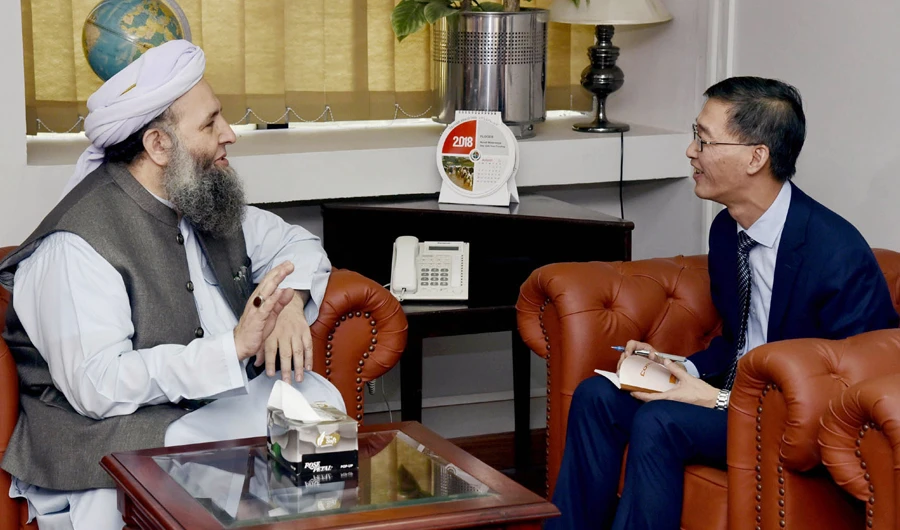
Pakistani Minister for Religious Affairs met with Chinese Ambassador Yao Jing on Sep. 19, 2018. (Press Information Department)
Updated 22 September 2018
Follow

No talks on Uighurs with China envoy, Pakistan minister says

  • Met to discuss exchange program for Muslim scholars from both countries, Qadri says
  • Beijing criticized for alleged rights abuses against ethnic Muslim minority

ISLAMABAD: Pakistan’s Minister for Religious Affairs and Interfaith Harmony, Noorul Haq Qadri, on Saturday denied media reports that he had voiced concerns about the Muslim Uighur community residing in China, during a meeting with Beijing’s top diplomat in Islamabad, earlier this week.

China has been widely criticized for alleged rights abuses against Muslims in the Xinjiang province, with reports saying that members of the community are detained, tortured and restricted from practicing their religion freely.

Despite international umbrage over the issue, Pakistan has so far avoided commenting on the matter due to its close proximity with China. “This [the Uighur issue] was not discussed,” Qadri told Arab News while discussing details about his interaction with Ambassador Yao Xing on Wednesday.

He added that, instead, the meeting focused on measures to institutionalize an exchange program for moderate Islamic scholars. “We will soon sign an MoU [Memorandum of Understanding] on the exchange of scholars,” he said, adding that the objective of the proposed program was “to promote moderation”.

So far, the Chinese Embassy in Islamabad hasn’t issued any official statement pertaining to the meeting. However, ministry spokesperson Imran Siddique – in comments made to Arab News earlier – had said that Qadri was interested in China’s curriculum for Muslim students and that the meeting also explored the possibility of development work in Pakistan’s northwestern region which was previously under the Federally Administered Tribal Areas.

Siddique denied reports that China was planning internment camps for Muslims, saying that the delegation of religious scholars would be able to judge if the Chinese Muslims actually faced serious challenges or not. “China’s enemy is Pakistan’s enemy,” he said, sharing excerpts of Qadri’s conversation with the Chinese envoy. “Pakistan has also taken a clear stance on the economic corridor and maintained that Islamabad will not compromise on the project.”

He added that ambassador Xing was more interested in discussing the deprivations of people in Pakistan’s former tribal territories and looking for ways to address them. He talked in detail about empowering women and girls by way of providing education, medical and health facilities in the area.

Qadri’s meeting with ambassador Xing was held against the backdrop of an interview which saw Prime Minister’s Advisor on Commerce Abdul Razak Dawood in attendance. Dawood, on his part, suggested that his country could suspend some of the projects under the China-Pakistan Economic Corridor (CPEC) for a year to “review or renegotiate agreements” under the arrangement and “get our act together”.

The talks coincided with a meeting between Army Chief Qamar Javed Bajwa and President Xi Jinping, in Beijing on Thursday, wherein they agreed not to compromise on the security for CPEC-related projects.

Chinese officials have always denied allegations that they mistreat the Muslim minority in Xinjiang, with one Bureau of Human Rights Affairs official saying that his country was only educating Muslims to avoid spreading extremism.
Imran Khan not a ‘national security threat,’ ex-PM’s party responds to Pakistan military

Updated 4 sec ago
Follow

Imran Khan not a ‘national security threat,’ ex-PM’s party responds to Pakistan military

  • Pakistan’s military spokesperson on Friday described Khan’s anti-army narrative as a “national security threat”
  • PTI Chairman Gohar Ali Khan says words used by military spokesperson for Khan were “not appropriate”

ISLAMABAD: Former prime minister Imran Khan’s Pakistan Tehreek-e-Insaf (PTI) party on Saturday responded to allegations by Pakistan military spokesperson Lt. Gen. Ahmed Sharif Chaudhry from a day earlier, saying that he was not a “national security threat.”

Chaudhry, who heads the military’s media wing as director general of the Inter-Services Public Relations (ISPR), spoke to journalists on Friday, in which he referred to Khan as a “mentally ill” person several times during the press interaction. Chaudhry described Khan’s anti-army narrative as a “national security threat.”

The military spokesperson was responding to Khan’s social media post this week in which he accused Chief of Defense Forces Field Marshal Asim Munir of being responsible for “the complete collapse of the constitution and rule of law in Pakistan.” 

“The people of Pakistan stand with Imran Khan, they stand with PTI,” the party’s secretary-general, Salman Akram Raja, told reporters during a news conference. 

“Imran Khan is not a national security threat. Imran Khan has kept the people of this country united.”

Raja said there were several narratives in the country, including those that created tensions along ethnic and sectarian lines, but Khan had rejected all of them and stood with one that the people of Pakistan supported. 

PTI Chairman Gohar Ali Khan, flanked by Raja, criticized the military spokesperson as well, saying his press talk on Thursday had “severely disappointed” him. 

“The words that were used [by the military spokesperson] were not appropriate,” Gohar said. “Those words were wrong.”

NATURAL OUTCOME’

Speaking to reporters earlier on Saturday, Pakistan’s Defense Minister Khawaja Asif defended the military spokesperson’s remarks against Khan.

“When this kind of language is used for individuals as well as for institutions, then a reaction is a natural outcome,” he said. 

“The same thing is happening on the Twitter accounts being run in his [Khan’s] name. If the DG ISPR has given any reaction to it, then I believe it was a very measured reaction.”

Khan, who was ousted after a parliamentary vote of confidence in April 2022, blames the country’s powerful military for removing him from power by colluding with his political opponents. Both deny the allegations. 

The former prime minister, who has been in prison since August 2023 on a slew of charges he says are politically motivated, also alleges his party was denied victory by the army and his political rivals in the 2024 general election through rigging. 

The army and the government both deny his allegations.