Pakistan invites Saudi to be CPEC partner

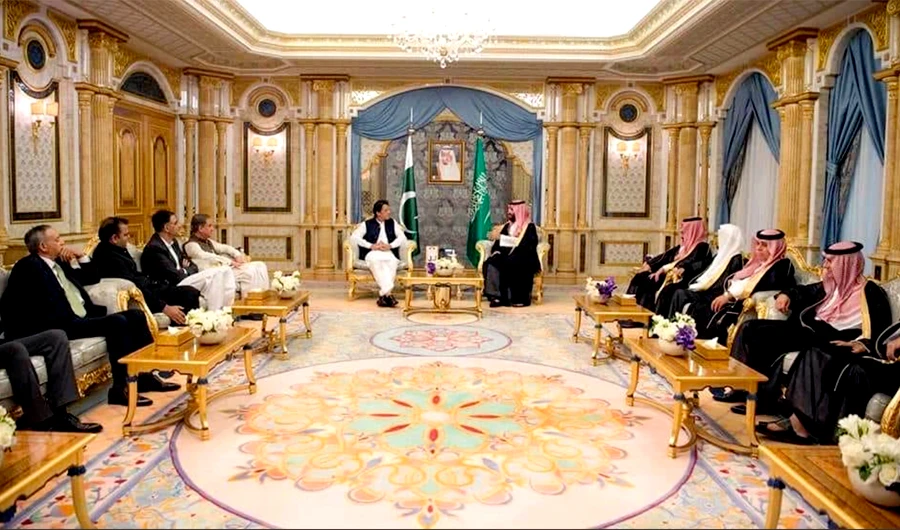
Prime Minister of Pakistan, Imran Khan meeting Crown Prince of Saudi Arabia, Mohammad bin Salman along with delegation of senior dignitaries from both countries on Wednesday. Pakistan on Thursday said that it had extended an invitation to Saudi Arabia to become a strategic partner in the China-Pakistan Economic Corridor (CPEC). (PTI twitter account)
Updated 20 September 2018
Follow

Pakistan invites Saudi to be CPEC partner

  • High-level delegation to visit Islamabad in first week of October
  • Acceptance of proposal would make Kingdom first to be part of $62bn project

ISLAMABAD: Pakistan on Thursday said that it had extended an invitation to Saudi Arabia to become a strategic partner in the China-Pakistan Economic Corridor (CPEC) -- a $62 billion project initiated by Beijing and Islamabad.  

Addressing a press conference in the capital, Information Minister Fawad Chaudhry said that Pakistan’s main interest lied in cooperation with Saudi Arabia and the United Arab Emirates on matters of trade and security. “A high-level coordination committee has been constituted [to look into matters of trade and commerce] and it has the complete backing of Saudi King Salman bin Abdul Aziz Al-Saud, Crown Prince Mohammad bin Salman and Prime Minister Imran Khan,” Chaudhry said. 

He added that a high-level delegation from Saudi Arabia and the UAE is expected to visit Pakistan in the first week of October. Saudi ministers of treasury and power along with several prominent business leaders will be part of the delegation. 

Adding that “our strategic cooperation has been revitalized”, Chaudhry said that prime among Islamabad’s priorities are plans to finalize an important economic partnership. “We expect major investments from Saudi Arabia. We have assured the Saudi leadership that we will continue to provide security and support to their country wherever needed,” Chaudhry said. 

The information minister added that the UAE will also be helping Pakistan in several projects, including in the provision of fresh water, especially in Karachi and other parts of Sindh. “Delegations from the UAE will also be coming to Pakistan in October to discuss these matters,” he said.
Pakistan business body writes to PM seeking ‘clear roadmap’ to spur investment

Updated 5 sec ago
Follow

Pakistan business body writes to PM seeking ‘clear roadmap’ to spur investment

  • Business confidence in Pakistan has fallen sharply amid rising inflation, high energy costs and unpredictable tax environment
  • In a letter written to PM Shehbaz Sharif, the Pakistan Business Forum president highlights challenges facing the business community

KARACHI: The Pakistan Business Forum (PBF), a representative body of traders and businesspersons in the country, on Monday urged Prime Minister Shehbaz Sharif’s intervention in outlining a “clear economic roadmap” to promote long-term investment in Pakistan.

Business confidence in Pakistan has fallen sharply amid rising inflation, high energy costs and an unpredictable tax environment. Currency volatility and slowing demand have prompted many firms to delay investments and scale back expansion plans.

In a letter to PM Sharif, PBF President Khawaja Mehboob-ur-Rehman highlighted the challenges facing the business community, including high input costs, soaring energy tariffs and an increasingly “uncompetitive” tax regime that weakens exports.

“Looking ahead to 2026, the Pakistan Business Forum urged the prime minister to provide the business community with a clear, credible, and forward-looking economic roadmap,” read a PBF statement.

“Such clarity... is essential to restore confidence, encourage investment, and enable long-term planning by businesses.”

The South Asian country of more than 241 million people is currently navigating a tricky path to economic recovery under a $7 billion International Monetary Fund (IMF) program since averting a default in 2023.

Besides introducing structural reforms relating to expansion of the country’s tax base and privatization of loss-making entities, the government of PM Sharif says it is taking various measures to boost foreign investment and trade.

The PBF highlighted the business community is ready to play its role in competing with regional markets, if provided with the “necessary competitive tools.” It outlined critical reforms relating to regionally competitive electricity tariffs and corporate tax rates.

An increase in electricity tariffs would put further strain on industries and could lead to widespread downsizing and the closure of industrial units, according to the PBF.

It urged the government to include business representatives in the policymaking process to ensure it understands “on-ground realities.”