- More than 40 percent of Tharparkar districts’ 1.6 million population comprises of Hindus, according to the 2017 census
- Muslim majority has always taken care of our sentiments so other countries, especially neighboring India, should take a lesson from it, says Hindu trader, Kaldeep Kumar
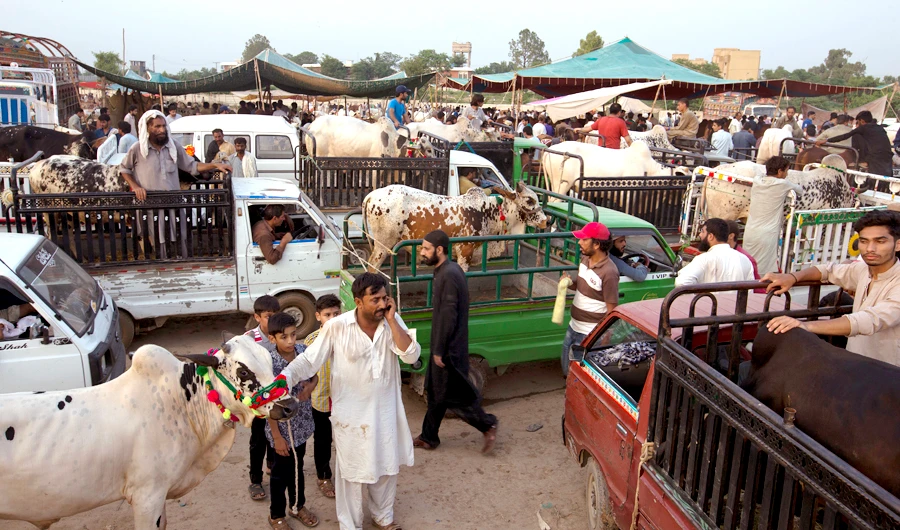
KARACHI: Tharo Khan, a resident of Islamkot town of Tharparkar, bought a goat for sacrifice on Eidul Adha. This cost him Rs. 18,000 ($146). He could get a share in a cow which would cost him less than Rs. 6,000 ($49) but he opted for goat. The reason is not “affordability” but “respect for the fellow citizens practicing another faith.”
“Sacrifice (slaughtering animal) is a religious obligation which I have to fulfil. However, at the same time I have a social obligation to take care of the sentiments of my Hindu friends, who make up 90 percent of our town,” Khan told Arab News.
While the slaughtering of cows and subsequent lynching of Muslims who are the minority faith in India often makes headlines, in the Pakistani border district of Tharparkar the majority of Muslims opt to not slaughter cows to avoid hurting the feelings of their Hindu fellows.
Tharparkar, situated at the India-Pakistan border, has the lowest Human Development Index of all the districts in Sindh. It has a 1,649,661 population (1.6 million), as per census of 2017. Of these 1.6 million, well over 40 percent are Hindus.
However, in urban areas, including its headquarter Mithi and Tehsil towns of Diplo, Islamkot, Chachro, Dahli, Nagarparkar and Kaloi, Hindus forms majority of the population. In Islamkot Hindus are more than 90 percent.
“We are faced with drought and have the lowest human development index but we are rich in terms of love, respect and brotherhood,” Kaldeep Kumar, 40, and president of the Islamkot traders’ association, told Arab News.
Kumar on Wednesday visited his Muslim friends to greet them at Eid; he ate sweets and grilled mutton, since his Muslim friends like other Tharis don’t slaughter the cow.
“Hindus of Thar arrange Iftar dinners for the Muslim friends in the fasting month of Ramadan. They (Muslims) attend our religious rituals and festivals,” said Kumar.
“Although not prohibited by law, there is an unannounced ban on the slaughter of cow, which is sacred to Hindus. This ban is however not forced but self-imposed and reflects the centuries-old interfaith harmony,” said Abdul Ghani Bajeer, a local journalist.
“This is not confined to Eid. You can’t find a single of a dozen of meat shops across the district which may be offering cow’s meat to its customers,” Bajeer told Arab News. “In the Muslim weddings, serving food of cow meat is being avoided as many Hindus also attend the wedding ceremonies.”
At Eid, the locals chose to slaughter goats but in some cases if they slaughter a cow, it’s done away from the eyes of Hindu fellow citizens out of respect for their religious feelings.
Bajeer said that over the past few years, different welfare organizations including Al-Khidmat Foundation, Human Relief Foundation, Darul Uloom Karachi, Al-Mustafa Trust, have started arranging sacrifices for the underprivileged local Muslim communities. “But local volunteers make sure that slaughtering process is being done in closed spaces and the meat doesn’t reach the Hindus,” he said.
Piaro Shawani, the 40-year-old Hindu owner of Café Thar in Mithi, said that Tharparkar is backward in resources but is wealthiest due to its interfaith harmony, brotherhood, respect and love. “In the rainy season, we celebrate the rain related festival together. We also attend each other’s religious festivals,” he said.
Abdul Rehman Otho, the 45-year-old principal of a private school in Diplo town of Thar, said that there is no prohibition on slaughtering cow. “No Hindu can stop us from slaughtering (the cow) but we have inherited this legacy of not hurting the feelings of our fellow Hindus from our forefathers,” Otho told Arab News. “Hindu-Muslim women are even more attached to each other.”
Advocate Faqir Sagir, general secretary of the Mithi Bar Association, said: “This interfaith harmony leads to a tolerant society where the crime rate is low. We have a zero crime ratio.”
Ghansham Das, the 60-year-old former chairman of Islamkot City union council, said: “If we are not asked by someone about it we even don’t remember about cow slaughtering.”
In our area, people of two different faiths live together but this is a blessing for us not a curse, unlike what we see in many places around the world. “We are not only an example for the rest of our country but for the entire world. We participate in their festivals and they (Muslims) in ours.”
Amar Guriro, who has reported about Thar Desert extensively, said that Thar Desert is a hub of religious coexistence and interfaith harmony. “People of Sindh are emotionally attached to their motherland, language and culture, more than their religion. For Sindhi people, one’s religion or faith is not important but someone who loves their motherland, speaks their language, and practices Sindhi culture is important,” Guriro said.
“The Muslim majority has always taken care of our sentiments so other countries, especially our neighboring India, should take a lesson from it as well,” Kaldeep Kumar said.