Strong quake rocks northern Venezuela coast; buildings evacuated in capital

1 / 2
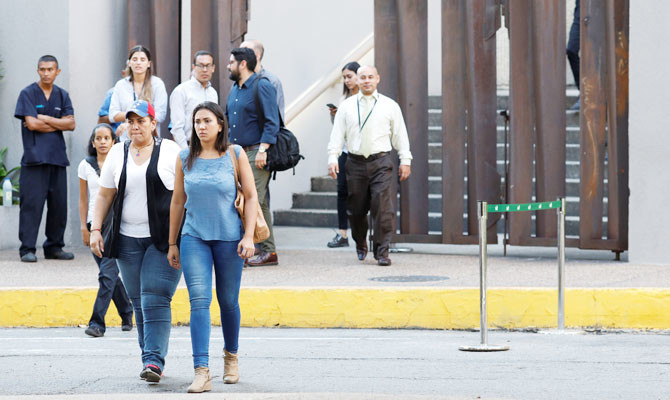
People evacuate an office building after an earthquake in Caracas, Venezuela August 21, 2018. (REUTERS)
2 / 2
A woman reacts after an earthquake in Caracas, Venezuela August 21, 2018. (REUTERS)
Updated 22 August 2018
Follow

Strong quake rocks northern Venezuela coast; buildings evacuated in capital

CARACAS: A major earthquake of magnitude 7.3 struck the northern coast of Venezuela on Tuesday and shook buildings as far away as the capital, Caracas, the US Geological Survey said.
The quake was centered near the town of Carupano, an area of poor fishing communities and was felt as far away as neighboring Colombia to the east and nearby island nations like Trinidad and Tobago, and St. Lucia, to the west and north.
There were no immediate reports of injuries or damage, Venezuelan Interior Minister Nestor Reverol said in an Internet broadcast on Tuesday.
The US Pacific Tsunami Center said the quake could cause small tsunami waves along the coast near the epicenter, 23 miles (37 km) southwest of the town of Carupano.
USGS Geophysicist Jessica Turner said the quake’s depth, 76.5 miles (123.11 km) below the surface, would dampen some of the shaking but not enough to prevent damage.
“A 7.3 magnitude quake is going to cause some damage particularly as in this area structures are vulnerable. The Earth is able to absorb some of the energy, but a 7.3 quake produces a lot of energy,” she said by telephone.
Turner said the quake’s depth caused the quake to be felt as far away such as in Caracas, where witnesses said buildings were shaken. “I feel like I’m about to faint. I’m shaking. It was long,” said telemarketing worker Sheny Fuentes, 22, speaking outside her work building in eastern Caracas. “I’m relieved that it doesn’t seem like damage was that bad. We would have been even more affected (given Venezuela’s economic crisis) — there are already people eating from the garbage and buildings aren’t well made,” she told Reuters. 


Philippines builds defense partnerships amid growing China aggression

Updated 4 sec ago
Follow

Philippines builds defense partnerships amid growing China aggression

  • Island country forged new pacts with Japan, the UAE, Canada, Germany in past year
  • Manila sees China’s maritime expansion as ‘quintessential security threat,’ expert says

MANILA: The Philippines and Japan have signed a new defense pact, adding to a growing list of security cooperation Manila has been forging with partner countries as it faces a growing Chinese presence in the disputed South China Sea.

Philippine-Japan security ties have strengthened in recent years over shared concerns in the region, with the two countries signing a landmark military pact in 2024, allowing the deployment of their forces on each other’s soil for joint military drills. It was Japan’s first such pact in Asia.

The new defense agreement — signed by Philippine Foreign Secretary Theresa Lazaro and Japanese Foreign Minister Toshimitsu Motegi in Manila on Thursday — is a follow-up to their 2024 pact, and would allow tax-free, reciprocal provision of ammunition, fuel, food and other necessities when their forces conduct joint training and disaster relief operations.

The security partnership is aimed at boosting deterrence against China, experts say.

“The latest defense pact with Japan is not only significant but also existential (as) a strong deterrence to China’s growing military size and ambition in the string of islands of the first island chain that includes Japan and the Philippines,” Chester Cabalza, founding president of the International Development and Security Cooperation think tank, told Arab News.

The Philippines, China and several other countries have overlapping claims in the disputed South China Sea, a strategic waterway through which billions of dollars worth of goods pass each year.

Beijing has maintained its expansive claims of the area, despite a 2016 international tribunal ruling that China’s historical assertion to it had no basis.

Japan has a longstanding territorial dispute with China over islands in the East China Sea, while Chinese and Philippine coast guard and navy ships have been involved in a series of tense incidents in the South China Sea in recent years.

“The imminent threat to maintain a status quo of peaceful co-existence in the region brings a shared responsibility for Manila and Tokyo to elevate strategic partnership to achieve this strategic equilibrium,” he said.

Motegi said he and Lazaro “concurred on continuing to oppose unilateral attempts to change the status quo by force or coercion in the East and South China seas,” in a clear rebuke of Beijing’s increasing assertiveness, without naming China.

The Philippines sees China’s maritime expansion as “the quintessential security threat,” said international studies expert Prof. Renato De Castro.

“So, of course, we rely on our efforts to build up our armed forces in terms of the comprehensive archipelagic defense operation,” he told Arab News.

The Philippines has a mutual defense treaty with the US, which the allies signed in 1951. While both governments have continued to deepen defense cooperation in recent years, Manila has also been building security partnerships with other countries.

The Philippines has signed two defense deals this month alone, including a Memorandum of Understanding on Defense Cooperation with the UAE, its first such deal with a Gulf country.

Last year, Manila signed military pacts with New Zealand and Canada, which sets the legal framework to allow military engagements, including joint drills, in each other’s territory. Both agreements still need to be ratified by the Philippine Senate to take effect.

The Philippines also signed a defense cooperation arrangement with Germany in May, aimed at boosting joint activities.