- Etisalat acquired the Pakistan Telecommunication Company Limited in 2005, bidding $2.6 billion for a 26 percent stake and management control
- The UAE company withheld the final payment of $800 million and the issue has remained unresolved for more than a decade
KARACHI: The issue of a long overdue payment of $800 million to Pakistan by UAE telecoms company Etisalat will be resolved when the new Pakistani government comes to power, according to Bakheet Ateeq Al-Romaithi, the acting consul general of the UAE in Karachi. The payment is related to the 2005 privatization of the Pakistan Telecommunication Company Limited (PTCL),
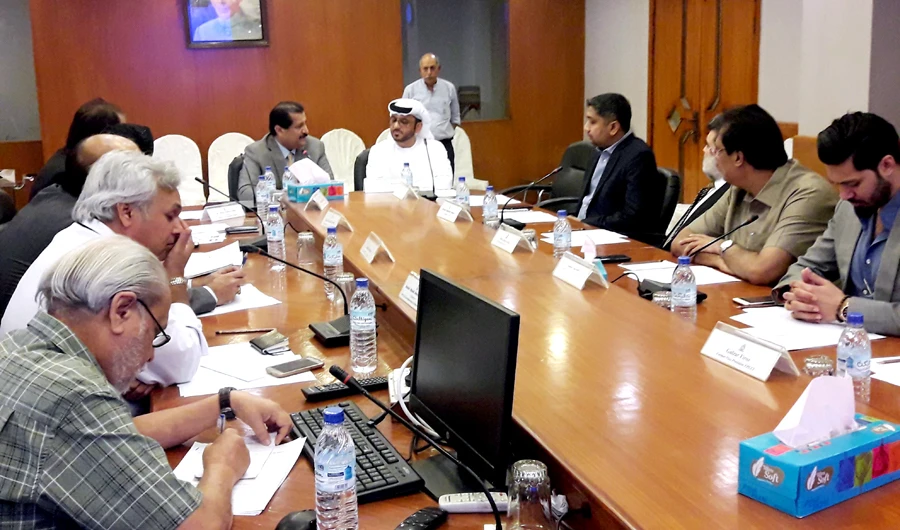
“I am honest with you, there is no issue at all and it is between two brothers. I am 100 percent sure the issue will be resolved after the new government takes up the matter”, Al-Romaithi said after the first meeting of the Pakistan-UAE Business Council on Tuesday at the headquarters of the Federation Of Pakistan Chambers Of Commerce & Industry in Karachi.
“It is between two brothers and can be amicably resolved”, he continued, adding that the amount is small, compared with how much the UAE has invested in infrastructure and education in Pakistan.
Privatization Secretary Irfan Ali recently told Arab News that his ministry was asking the federal government to raise with the UAE government the issue of settlement of the outstanding payment, and hinted at an approach to the International Court of Arbitration in London as a last resort.
Pakistan privatized PTCL, its national telecommunication company, in 2005 through a bidding process. Etisalat acquired a 26 percent stake and management control for $2.6 billion. However, the company withheld $800 million and the issue remains unresolved after more than a decade.
“Etisalat is delaying payments claiming that Pakistan has yet to alter 3,500 properties as part of an agreement made with the government of Pakistan,” said Ali. “That process, however, was completed in 2015, barring some 33 properties that were not transferable and were to be decided upon at a later stage, as per the agreement.”
After the sale to Etisalat, a further 12 percent of PTCL shares were sold to the general public in 2006 under an intensified privatization program during Prime Minister Shaukat Aziz’s time in power. The remaining 62 percent of shares remain under the control of state-owned corporations in Pakistan.
Pakistan Tehreek-e-Insaf, led by prime minister in-waiting Imran Khan, won a majority of seats in the general elections in Pakistan on July 25, 2018. The party is now in the process of forming a new government.
Earlier, Al-Romaithi announced that a new office in Karachi for processing visas and other documents will be ready in two months.
“In the new section of the building everything from visas to iqamas will be processed for the ease of those traveling to the UAE”, he said, adding that the relationship between the UAE and Pakistan is unique in the way that they are brotherly and friendly. “We have special instructions from our government to build good relations based on the interests of both nations,” he continued.
Dr. Mirza Ikhtiar Baig, chairman of the Pakistan-UAE Business Council, said that trade relations between the two countries are skewed highly in favor of the UAE.
“Bilateral trade between UAE and Pakistan stood at $8.3 billion, of which Pakistan exports to the UAE $869 million and imports $7.52 billion from the UAE,” he said.
Baig called for action to enhance exports to the UAE by addressing the reasons why they are so low.
“There are huge opportunities available for Pakistan: we could export textile apparel, iron, steel, machinery, leather, cereal, copper, edible fruits, vegetable, seafood, etcetera,” he said.
The Pakistan-UAE business council, which is made up of 10 members from each country, makes recommendations designed to enhance bilateral economic relations between the countries.