

India’s PM Modi congratulates Imran Khan on election victory

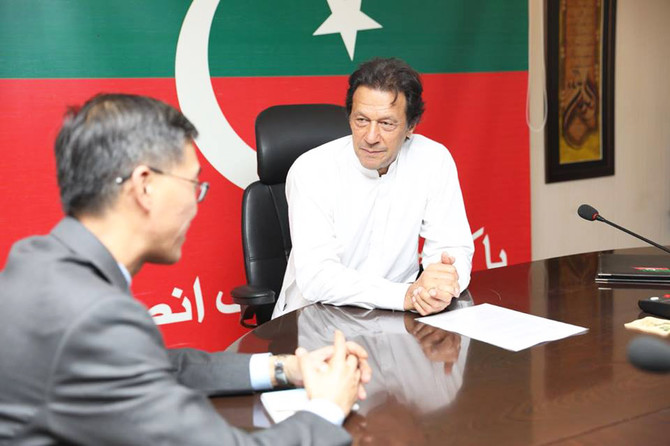
Chinese ambassador to Pakistan Yao Jing called on Imran Khan. (PTI Media)
Updated 31 July 2018
Follow

India’s PM Modi congratulates Imran Khan on election victory

  • Indian Prime Minister expressed hope that democracy will take deeper roots in Pakistan
  • Imran Khan had said in his victory speech that Pakistan is ready to improve ties with India

ISLAMABAD: Indian Prime Minister Narendra Modi, on Monday, spoke to Pakistan Tehreek-e-Insaf (PTI) chairman Imran Khan and congratulated him and his party for winning in the recently conducted general elections, Indian Ministry of External Affairs (MEA) said.

In a telephone conversation, “the Prime Minister expressed hope that democracy will take deeper roots in Pakistan,” MEA said in a statement.

It added: “Prime Minister also reiterated his vision of peace and development in the entire neighbourhood,” MEA spokesman said.

In his victory speech Imran Khan had said Pakistan is ready to improve ties with India. “If they (India) will take one step toward us, we will take two,” he said.

Meanwhile, Chinese ambassador to Pakistan Yao Jing called on Imran Khan in Islamabad on Monday.

“Chinese Ambassador to Pakistan accompanied by a delegation called on PM Designate Imran Khan at Banigala Islamabad, Congratulating him on his victory and discussing bilateral relations between the two countries,” PTI said in brief statement. 

The Ambassador on Iran in Islamabad, also sent a congratulations letter to Imran Khan. The Party published the letter on its official twitter page.


German spy chief warns of Russia threat to 2026 regional polls

Updated 3 sec ago
Follow

German spy chief warns of Russia threat to 2026 regional polls

  • Sinan Selen said hat Germany was especially in Moscow’s sights because it is a central logistics hub of the NATO alliance on the continent

BERLIN: Germany’s domestic spy chief warned Monday that Russia could step up sabotage, cyberattacks and disinformation campaigns next year when the EU’s top economy, a strong backer of Ukraine, holds several regional elections.
Sinan Selen, head of the BfV intelligence service, said in a Berlin speech that Germany was especially in Moscow’s sights because it is a central logistics hub of the NATO alliance on the continent.
Speaking later to AFP, Selen said about Russian disinformation campaigns that “we’ve repeatedly seen that elections play a very significant role here, and as you know we have several state elections in Germany next year.”
Russia is blamed by Western security services for a spate of drone flights, acts of sabotage, cyberattacks and online disinformation campaigns in Europe, which have escalated since its 2022 full-scale invasion of Ukraine.
“We are being attacked here and now in Europe,” Selen said in a speech marking 75 years since the founding of the BfV, the Federal Office for the Protection of the Constitution.
“In its role as a logistics hub for collective defense and support of Ukraine, Germany is more heavily targeted by Russian intelligence services than other countries,” he said.
“Above all Russia, as a hybrid actor, is undoubtedly aggressive, offensive and escalating. Its intelligence services employ a wide range of attack vectors from its toolbox.
“A clear sign of a highly dangerous escalation is the preparation and execution of sabotage attacks in Germany and other European countries, for which the Kremlin is considered the primary instigator. There is no sign of any relief in sight.”
Germany next year holds five regional elections, including in the ex-communist east, where the far-right and Moscow-friendly Alternative for Germany (AfD) party hopes to make further strong gains.
Selen, speaking about hybrid threats, said that “every sector of society can be affected, and this will be especially true in the coming year.”
The course of the Ukraine war would also strongly influence the actions of Russia, which Selen said “can scale the intensity of its sabotage operations at will.”
Selen added that “this war of aggression is more than a struggle for Ukrainian territory, it is a litmus test in the ongoing systemic conflict between authoritarianism and democracy in a multipolar and complex world.”