

Beirut beggar who died with $1 million in the bank

1 / 2
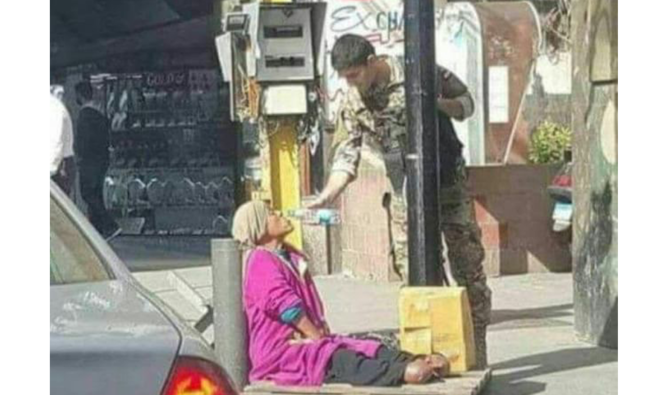
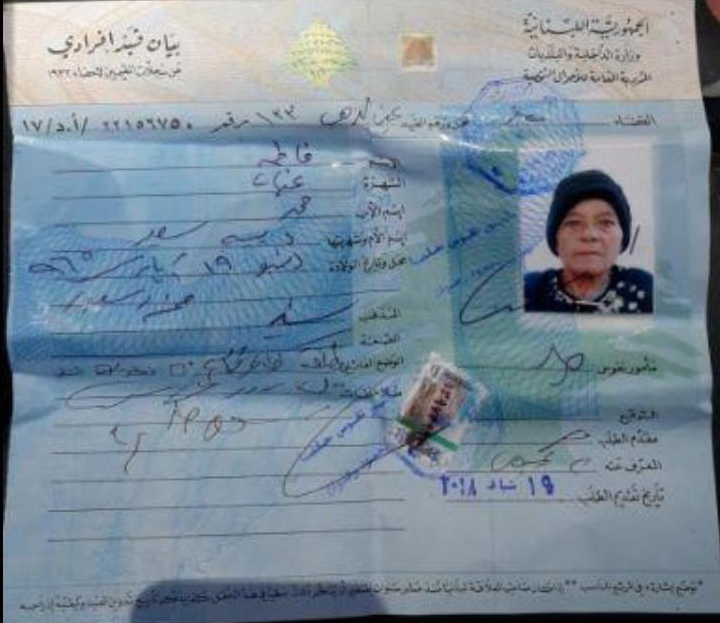
Combo image showing Fatima Othman at rest and the alms recovered among her belongings.
2 / 2
File photo showing a soldier offering water to Fatima Othman during a hot summer day.
Updated 17 May 2018
Follow

Beirut beggar who died with $1 million in the bank

  • Unlike other beggars who could be pushy, Fatima Othman did not talk or beg. She just looked with eyes full of sorrow at passing people.
  • Othman had a family of eight and not one of them knew about her money, and her savings proved that nobody was exploiting her by forcing her to beg.

BEIRUT: When Fatima Othman, a disabled street beggar, was found dead in an abandoned car in Beirut’s Barbir district on Tuesday night, investigators thought it was simply another tragic death among the city’s poor and homeless.

But internal security forces called to the scene were astonished to find Othman had been carrying bags holding 5 million Lebanese ounds ($3,400) in cash and — even more surprising — a deposit book from a nearby bank that showed she had more than $1 million in savings.

Brig. Gen. Joseph Musallem, director of the Internal Security Forces public relations division, told Arab News that 52-year-old Othman had died of a heart attack.

“Finding the money and the savings book was a big surprise,” he said.

Othman was a well-known figure in the Barbir district. A photograph of the street beggar had won praise with its portrayal of a Lebanese soldier stationed at the nearby Barbir hospital helping her drink because she was unable to use her hands or feet. The soldier was later commended by an army commander for his “compassion and humanity.”

Many on social media mocked begging in Lebanon and derided it as a lucrative profession. But nobody knew Othman as I knew her.
On the pavement where the handicapped beggar used to sit — unable to move her hands due to a birth defect — she had the sympathy of people for decades.

Othman did not talk or beg. She just looked with eyes full of sorrow at passing people.

I used to live in the Ras Al-Nab’a district, and would cross the Barbir district daily on my way to school and, later, to university. Othman used to sit on a newspaper on the pavement near a coffee mill in summer and winter. She would look at me and nod her head, and I would ask how she was. “Alhamdulillah” (“Praise be to God“), she would answer.

The Barbir district was close to the front lines during Lebanon’s civil war and was targeted by artillery, especially during periods of calm when its gold market was crowded with people.

Othman was hit once with shrapnel, but returned to the pavement wearing a bandage. She kept watching us grow up, and we kept watching her grow older.

A week ago, I saw her sitting on the side of the road near the market. Her hair was white and her face full of wrinkles. Her smile had disappeared. I put a coin in her lap as I used to always do, and she held it with her teeth and dropped it inside an open black bag.

After Othman’s death, security forces discovered she was from the town of Ain Al-Zahab in Akkar, northern Lebanon. They contacted her family, and a number of relatives came and took her body to her village. She was buried on Wednesday. 

Othman had a family of eight — a mother, two brothers and five sisters.

The family knew nothing about the money, and her savings proved that nobody was exploiting Othman by forcing her to beg.

After daring not tell anyone about her money for fear of being killed, she died without enjoying the benefits of people’s compassion.

Egypt reveals restored colossal statues of pharaoh in Luxor

Updated 14 December 2025
Follow

Egypt reveals restored colossal statues of pharaoh in Luxor

  • Amenhotep III, one of the most prominent pharaohs, ruled during the 500 years of the New Kingdom, which was the most prosperous time for ancient Egypt

LUXOR: Egypt on Sunday revealed the revamp of two colossal statues of a prominent pharaoh in the southern city of Luxor, the latest in the government’s archeological events that aim at drawing more tourists to the country.
The giant alabaster statues, known as the Colossi of Memnon, were reassembled in a renovation project that lasted about two decades. They represent Amenhotep III, who ruled ancient Egypt about 3,400 years ago.
“Today we are celebrating, actually, the finishing and the erecting of these two colossal statues,” Mohamed Ismail, secretary-general of the Supreme Council of Antiquities, said ahead of the ceremony.
Ismail said the colossi are of great significance to Luxor, a city known for its ancient temples and other antiquities. They’re also an attempt to “revive how this funerary temple of King Amenhotep III looked like a long time ago,” Ismail said.
Amenhotep III, one of the most prominent pharaohs, ruled during the 500 years of the New Kingdom, which was the most prosperous time for ancient Egypt. The pharaoh, whose mummy is showcased at a Cairo museum, ruled between 1390–1353 BC, a peaceful period known for its prosperity and great construction, including his mortuary temple, where the Colossi of Memnon are located, and another temple, Soleb, in Nubia.
The colossi were toppled by a strong earthquake in about 1200 BC that also destroyed Amenhotep III’s funerary temple, said Ismail.
They were fragmented and partly quarried away, with their pedestals dispersed. Some of their blocks were reused in the Karnak temple, but archeologists brought them back to rebuild the colossi, according to the Antiquities Ministry.
In late 1990s, an Egyptian German mission, chaired by German Egyptologist Hourig Sourouzian, began working in the temple area, including the assembly and renovation of the colossi.
“This project has in mind … to save the last remains of a once-prestigious temple,” she said.
The statues show Amenhotep III seated with hands resting on his thighs, with their faces looking eastward toward the Nile and the rising sun. They wear the nemes headdress surmounted by the double crowns and the pleated royal kilt, which symbolizes the pharaoh’s rule.
Two other small statues on the pharaoh’s feet depict his wife, Tiye.
The colossi — 14.5 meters and 13.6 meters respectively — preside over the entrance of the king’s temple on the western bank of the Nile. The 35-hectare complex is believed to be the largest and richest temple in Egypt and is usually compared to the temple of Karnak, also in Luxor.
The colossi were hewn in Egyptian alabaster from the quarries of Hatnub, in Middle Egypt. They were fixed on large pedestals with inscriptions showing the name of the temple, as well as the quarry.
Unlike other monumental sculptures of ancient Egypt, the colossi were partly compiled with pieces sculpted separately, which were fixed into each statue’s main monolithic alabaster core, the ministry said.
Sunday’s unveiling in Luxor came just six weeks after the inauguration of the long-delayed Grand Egyptian Museum, the centerpiece of the government’s bid to boost the country’s tourism industry. The mega project is located near the famed Giza Pyramids and the Sphinx.
In recent years, the sector has started to recover after the coronavirus pandemic and amid Russia’s war on Ukraine — both countries are major sources of tourists visiting Egypt.
“This site is going to be a point of interest for years to come,” said Tourism and Antiquities Minister Sherif Fathy, who attended the unveiling ceremony. “There are always new things happening in Luxor.”
A record number of about 15.7 million tourists visited Egypt in 2024, contributing about 8 percent of the country’s GDP, according to official figures.
Fathy, the minister, has said about 18 million tourists are expected to visit the country this year, with authorities hoping for 30 million visitors annually by 2032.