JEDDAH: UNICEF has welcomed the KSA’s contribution to support children’s health in Yemen, the Saudi Press Agency reported.
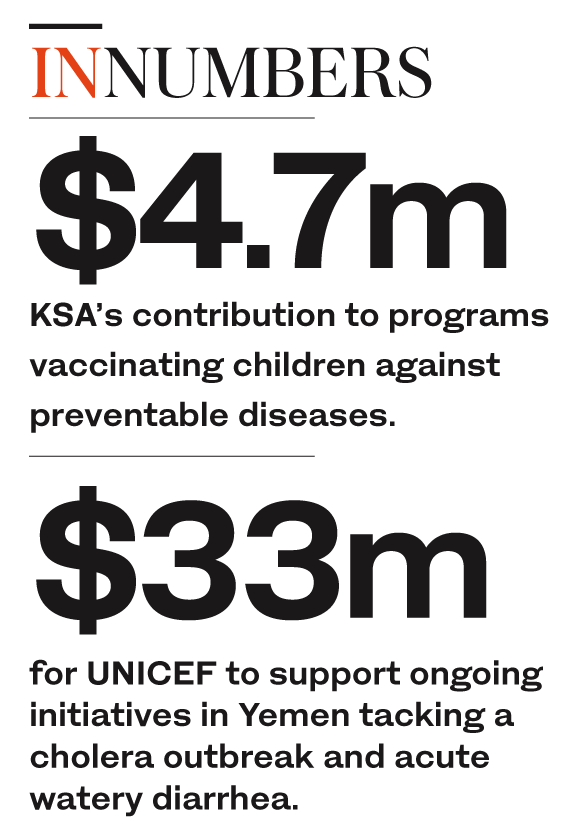
In a press statement published on UNICEF’s official website, Geert Cappelaere, UNICEF’s regional director for the Middle East and North Africa, welcomed the Kingdom’s contribution of $4.7 million (SR17.6 million) for programs to vaccinate children against preventable diseases.
UNICEF also received $33 million to support ongoing initiatives in Yemen tacking a cholera outbreak and acute watery diarrhea, he said.
 This contribution comes under directives from Crown Prince Mohammed bin Salman to the King Salman Humanitarian Aid and Relief Center (KSRelief) to allocate $66.7 million in response to funding appeals from the World Health Organization and UNICEF to help them to fight the cholera epidemic, including support for the water and sanitation sectors in Yemen.
Earlier, the President of Cardiac Disease and Surgery Charitable Foundation, Supervisor General of Nabd Al-Hayat Cardiac Disease and Surgery Center Mohammed Awadh Ba Shoaib thanked the Kingdom of Saudi Arabia for assisting the Yemeni people.
He said: “It is not the first time that medical cadres have come to us from the Kingdom, and large numbers of doctors have been visiting us for more than six years to alleviate the sufferings of the Yemeni people in various provinces.” He added that many cardiac patients in Yemen have recovered, thanks to the support of the Kingdom.
Moreover, medics from Al-Balsam International Organization have expressed deep thanks to King Salman and Crown Prince Mohammed bin Salman for the urgent response from Arab Coalition for Supporting the Legitimacy in Yemen, led by the Kingdom.
The team said that logistical support had been provided that helps its humanitarian mission to treat urgent cases, at the request of the Yemeni Ministry of Health and Nabd Al-Hayat Center, in the port city of Mukalla.
Medics from Al-Balsam International Organization arrived in Mukalla, in Hadramout province, last Sunday, and were received by Hadramout Gov. Maj. Gen. Faraj Salmin Al-Bahssani and Coalition forces officials.
Once the team arrived had arrived, medics began examining patients’ cases from all Yemeni provinces. The team carried out five open heart operations and 42 heart operations in total.
Al-Balsam International Organization’s team aims to treat 300 Yemenis, including about 10 open heart operations, in addition to examining and treating outpatients at the Department of Cardiac Radiology at Nabd Al-Hayat Center of the Charitable Foundation of Cardiology in Mukalla. The team will also be training local doctors on how to carry out these operations.