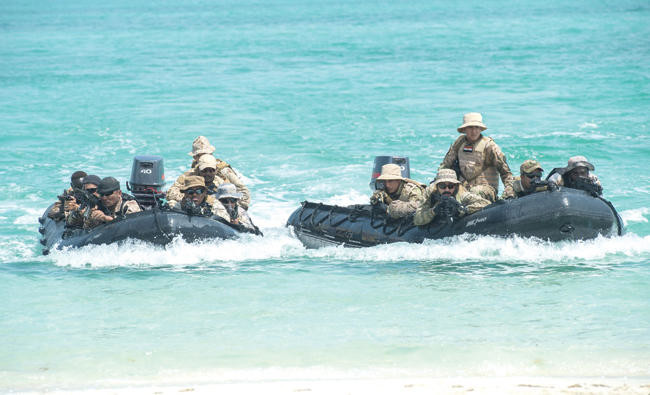
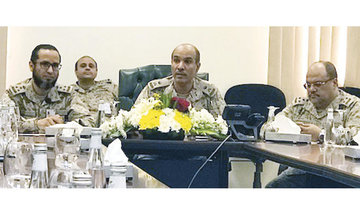
RIYADH: A massive military exercise to support security, stability and cooperation in the region begins on Sunday when the Joint Gulf Shield-1 drill gets underway after leaders of the participating forces completed the command center exercises.
“The field exercise lasts for four consecutive days,” said the spokesman for the Joint Gulf Shield 1, Brig. Gen. Al-Subaie, a live-fire exercise involving participating countries’ forces (ground, air, naval, air defense and special forces).
Al-Subaie said the exercise aims to raise the competencies of the participating forces to face the challenges and threats within a joint operation environment, in order to achieve the concept of joint action, where many modern and sophisticated weapons are used.
The Gulf Shield 1 drill, organized by the Ministry of Defense in Saudi Arabia, is attended by 23 brotherly countries. Last week, one of the largest military action plans in the world concentrated on field training.
The Gulf Shield 1 drill is a turning point in terms of the techniques used in accordance with the most modern military systems in the world.
Tens of thousands of soldiers have arrived in the Kingdom to join the military exercise, which is considered the largest in the region in terms of the number of participating countries and the equipment used.
Various activities involving joint operational planning, training, demonstrations, seminars on professional topics, and cultural events will be conducted in the harbor phase of the exercise, with the aim of mutually benefiting the participants and generating goodwill.
Irregular warfare, coastal defense, combat search and rescue, naval warfare exercises and extensive flying operations will also be conducted during the sea phase of the exercise.
Observers from various participating countries will board Pakistan Navy ships during the sea phase. Warships from Bahrain, Egypt, Kuwait, Jordan, Saudi Arabia, Sudan, the UAE and US will also participate.
Pakistan is the leading contributor to Joint Gulf Shield-1, both in terms of personnel and assets, which is reflective of the strong bilateral defense relations between Islamabad and Riyadh.
According to strategic experts, the month-long military drill in the Eastern Province of Saudi Arabia is important for preparing to address any causes of instability and threats to the region.
The exercise reflects the conviction of these countries that joint cooperation on the basis of integrated military understanding and coordination, both regionally and globally, is the cornerstone of confronting the threats and dangers that face the world.

23 countries take part in Gulf Shield-1 military drills in Saudi Arabia
Jeddah masterclass explores power of sound in cinema with leading industry experts
- The event offered an intimate look into cinematic sound design, attracting aspiring filmmakers and composers eager to learn from one of the industry’s leading voices
JEDDAH: The Alliance Francaise of Jeddah, in collaboration with the French Consulate, recently hosted an exclusive masterclass on Sound and Cinema led by Fanny Lamothe, CEO of Cercle Rouge Productions, along with composers Fabien and Mike Kourtzer.
The event offered an intimate look into cinematic sound design, attracting aspiring filmmakers and composers eager to learn from one of the industry’s leading voices.
Cercle Rouge Productions has contributed to internationally acclaimed films such as “John Wick 4” and “Emilia Perez,” as well as notable Saudi productions including “Mandoob” by Ali Kalthami, “Al Zarfa” by Abdullah Majed, and “Sayfi” by Wael Abumansur.
Lamothe, who also heads the music department at Why Not Productions, oversees all aspects of sound in film — from composition and recording to editing, foley, and legal clearances — bringing extensive experience to both international and regional projects.
During the masterclass, Lamothe and the Kourtzers highlighted two key areas for participants: understanding the precise process of creating original music for a film and establishing clear communication between composers and directors to ensure a shared understanding of the film’s deeper meaning. “This allows us to express our own point of view and add an extra dimension to the story,” they said.
Discussing her approach to composing for films with strong cultural identities, Lamothe added: “It’s a process of back-and-forth with the director, along with many researches that allow us to immerse ourselves in the context and universe of the film and to perceive different cultural threads that resonate with it.
“Each city, for instance, has its own rhythm, its own sound. Music in itself is a universal language, and emotions can be transmitted to audiences worldwide when expressed with a clear artistic direction and a confident musical discourse.”
Fabien Kourtzer said: “Working with international directors broadens our perspective. What has particularly enriched our film scores from the Arab world is the ancient aspect of these civilizations, which is a powerful influence even when we work on films from other parts of the world.
Mike Kourtzer said: “The growth of Saudi cinema is explosive. It stems from a very strong desire among industry players to share stories that showcase this cultural heritage to the rest of the world. This dynamic will give birth to major works that will stand out on the global audiovisual landscape.”
Lamothe offered advice to young Saudi composers and filmmakers aiming to enter film scoring: “Seek to deeply understand the film you are working on and take the necessary time to achieve the best result.
“Start by understanding the director — what they want to express through communication and building a human relationship. Then, understand yourself and your musical identity. Your own point of view and artistic vision are what set you apart.”
Larry Lamartiniere, managing director of Alliance Francaise in Jeddah, highlighted the significance of the event. “It was an honor to host this masterclass on music and cinema with Cercle Rouge Productions. We organized it in partnership with the French Consulate of Jeddah as a closing event of a very intense and productive sequence for France at the Red Sea International Film Festival.
“This evening highlighted the vital role of sound in storytelling and celebrated the creative exchange between France and Saudi Arabia. Supporting such conversations not only strengthens our cultural ties but also nurtures the next generation of filmmakers and sound artists in the region,” he said.
With Saudi cinema experiencing rapid growth and a surge in international collaborations, events like this masterclass provide a platform for emerging talent to learn from industry leaders and shape the Kingdom’s filmmaking future.
All three confirmed their ongoing commitment, saying: “We have already worked on eight Saudi films, and these experiences have been more than enriching. We have had fantastic encounters, and we have a very strong desire for this adventure to continue.”