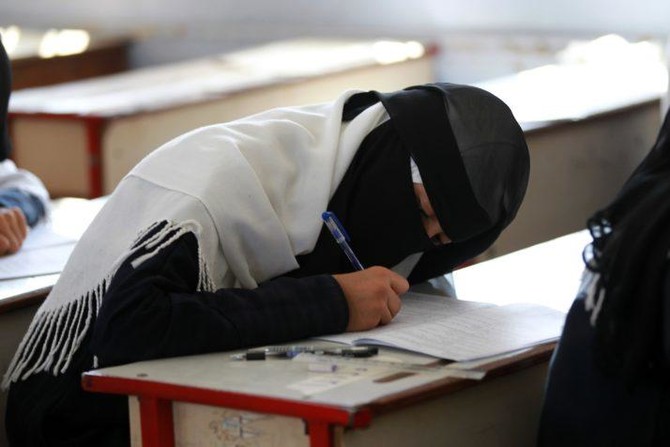
OSLO: The Norwegian government proposed on Friday a nationwide ban on the wearing of full-face veils, such as the burqa and the niqab, in universities, schools, and kindergartens.
France, the Netherlands, Belgium, Bulgaria and the German state of Bavaria have all imposed restrictions on wearing full-face veils in public places.
If passes by parliament, Norway could become the first Nordic country to introduce such ban in the education sector, Finance Minister Siv Jensen said in a statement. Denmark plans to fine people who cover their face in public.
Jensen, who is also the leader of the anti-immigrant right-wing Progress Party, said the ban would send a strong signal that Norway is “an open society where we are going to see the face of each other.”
The government amended an initial proposal, first presented in June, to allow the wearing of full-face veils during breaks and staff meetings in schools and universities, but it would have to apply throughout working hours at kindergartens.
“A ban on face-covering garments will ensure open communication with children, students and newly arrived immigrants in educational situations,” Jan Tore Sanner, minister of knowledge and integration said in the statement. Sanner belongs to the center-right Conservatives.
Full and partial face veils such as burqas and niqabs divide opinion across Europe, setting advocates of religious freedom against secularists and those who argue that such garments are culturally alien or a symbol of the oppression of women.
The niqab covers everything but the eyes, while the burqa also covers the eyes with a transparent veil.
Under the Norwegian proposal, employees who broke the rule several times would risk losing their jobs, and students would face expulsion, the government said. The ban would not apply to headgear like the hijab or hats.
Local bans on wearing burqa and niqab have been already introduced in some upper secondary schools in Norway.
Norway’s minority government, a coalition of the Conservatives, the Progress Party and the centrist Liberals, said in June it was confident it would find enough support for the move in parliament. If it does, the ban would start in August.
Separately, Oslo police said in a report that the capital had seen the highest reported number of hate crimes last year, with 198 incidents considered, against 175 in 2016.
“The biggest increase we see among are women insulted in the category of religion, and more specifically Islam,” said the police in a statement.


Norway proposes bill to ban full-face veils in education
Norway proposes bill to ban full-face veils in education


Venezuela aims to boost oil output but sanctions stand in the way, VP says
- Sanchez called the recent capture of Nicolas Maduro a “dark day” for the country
DUBAI: Venezuela’s Vice President for Economy Calixto Ortega Sanchez said on Wednesday that his country needed vast foreign investment and sanctions relief to tap its huge oil reserves and restart its ailing economy.
“We know that the reference for Venezuela is that (it is) the country with the biggest oil reserves, and we want to stop being known for this, and we want to be known as one of the countries with the highest production levels,” Sanchez said.
Responding to questions by American journalist Tucker Carlson, Sanchez called the recent capture of Nicolas Maduro a “dark day” for the country but said Venezuela was working to reestablish a relationship with the US, which he described as a “natural partner” for the country.
“The Venezuelan people and authorities have shown that they are ready to peacefully move forward and to build opportunities,” he said during a session at the World Government Summit.
Sanchez, who headed Venezuela’s central bank, said the most pertinent issue facing his country is continued US sanctions.
Despite failing to result in regime change, the sanctions had effectively stifled the economy from growing, he added.
He said the Venezuelan government was now working to reform its laws to allow foreign investment and hoped the US would ease sanctions to aid their work.
“The first decisions that interim President Rodriguez took was to go to the National Assembly and ask for reform to the hydrocarbon law … this law will allow international investors to go to Venezuela with favorable conditions, with legal assurance of their investments,” he added.
“The economy is ready for investment. The economy is ready for the private sector; it is ready to build up a better future for the Venezuelan people.”
Sanchez played down inferences by Carlson that his government had been taken over, insisting that the regime still held authority in the country. He said the country had set up two funds to receive money from oil production that would fund better welfare and social conditions for Venezuelans.
“Allow us to have access to our own assets … we don’t have access to our own money,” he added.
“If you allow us to function like a regular country, Venezuela will show extraordinary improvement and growth.”


