WASHINGTON: Donald Trump and Crown Prince Mohammed bin Salman discussed ways of putting pressure on Russia in opposition to what the US sees as its destabilizing role in the Middle East.
Ahead of talks between the two leaders, in Washington on Tuesday, a senior US administration official said Russia posed a threat to Saudi Arabia’s secuy by aiding Riyadh’s opponents, particularly in Yemen and Syria, and by backing Iran.
“Ultimately, the discussions will center on how can we find joint ways to make Russia pay a price for its activities in Syria and its support for Iran’s missile proliferation into Yemen — all of which risks deepening this crisis and leading to major regional catastrophe,” the official said.
The official, who made the remarks in a briefing to journalists, cited “reckless missile attacks against Saudi Arabia and the Emirates” and attacks on shipping in the Red Sea, as examples of Tehran targeting Riyadh, then being protected from US punitive economic sanctions by Russian vetoes at the UN Security Council.
Trump spoke to Russian President Vladimir Putin on Tuesday, to congratulate him on his re-election to another six year term of office.
He said the two leaders would “probably be meeting in the not-too-distant future to discuss the arms race, which is getting out of control”. They also needed to talk about Syria, Ukraine and North Korea, Trump said.
Russian-Saudi ties have remained strong, including the first visit by a Saudi leader when King Salman visited Moscow in October.
As a result of that trip, Riyadh agreed to purchase an advanced anti-aircraft missile system from Russia, and made deals on oil production.
Washington has made little secret of the fact that it sees Russia as playing the role of both arsonist and fire fighter in its dealings with Saudi Arabia — aiding Tehran and its proxies to shoot increasingly advanced missiles at Riyadh, and then selling defense systems to counter the threat.
“The Russians are helpful on one hand but, behind the scenes, have ratcheted up the prices and ultimately posed greater threats to the Kingdom in ways that are subtly deigned to undermine the US-Saudi relationship,” the administration official said.
The official said the US president would also remind the Saudi crown prince that Russia had pledged to supply Iran with advanced tanks and attack aircraft, when prohibitions against conventional weapon supplies to Iran, put in place as part of the nuclear program deal, come to an end.
Saudi Arabia, its regional allies and the US have taken an increasingly hawkish stance toward Iran, which they see as a growing threat in the region, with an overbearing influence in Baghdad, Sanaa, Beirut and Damascus.
Russian political and military backing has been central in allowing Iran, Syria and Iranian-backed groups in Lebanon and Iraq to form such a powerful bloc. Ranged against them are the US and its Middle Eastern allies, including Saudi Arabia.
Last month, Russia drew condemnation from the US and its allies after it vetoed a UN Security Council resolution that would have pressured Iran over the transfer of weapons to Houthi militias in Yemen.
The decision by the Trump administration to directly address Moscow’s role in talks with Saudi Arabia touches on a difficult subject for the White House.
A special investigation is currently under way into Russian interference in the US election, including efforts by Moscow to promote Trump’s candidacy and block Hillary Clinton’s election.
The probe has infuriated Trump, who insists there has been no collusion between his campaign and Russia.
Special counsel Robert Mueller, a former FBI director who is heading the investigation, has so far secured a guilty plea for giving false testimony to federal agents from Trump’s former national security adviser, Michael Flynn. He has also filed charges against Paul Manafort, Mr.Trump’s former campaign manager, and his deputy Richard Gates, and indicted 13 Russians.
The investigation, which has transfixed Washington and hamstrung the US president during his first year in office, appears to be edging ever closer to Trump himself.


![]()
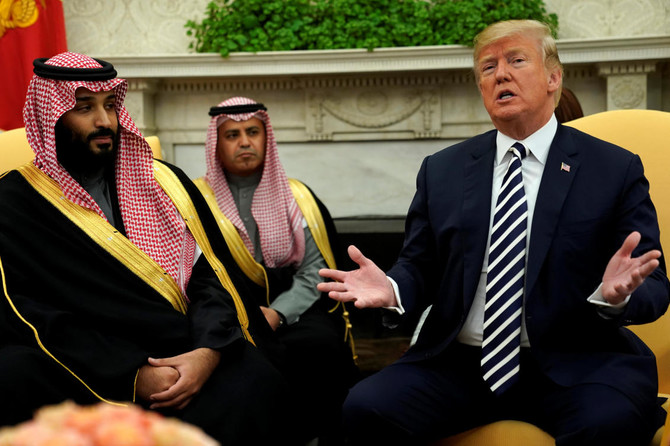
Trump administration says Moscow poses a threat by aiding Saudi Arabia’s opponents
Trump administration says Moscow poses a threat by aiding Saudi Arabia’s opponents

Latest updates


Recommended


© 2026 SAUDI RESEARCH & PUBLISHING COMPANY, All Rights Reserved And subject to Terms of Use Agreement.