LONDON: International cricket has become so uncharitable that success at the World Cup Qualifier currently being played in Zimbabwe was always going to be bittersweet.
It is also relative.
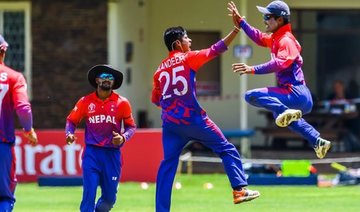
Nepal and Papua New Guinea both failed to make it out of the group stage, but when they met on March 15 at the Old Hararians Ground, what was at stake was in some ways far more important than a World Cup spot.
Cricket is one of the few sports that insists on downgrading teams, and without One-Day International (ODI) status, teams struggle to get matches against anyone other than their fellow strugglers. Papua New Guinea had ODI status, Nepal did not. But after a match that Nepal won easily, roles were reversed. Nepal will get at least a handful of games against the big boys until 2022, while Papua New Guinea and Hong Kong – who lost to the Netherlands the same evening – are now once again left seeking scraps from the top table.
Nepal may not have a World Cup to dream of soon, but ODI status is another upward step in what has been a rollercoaster journey. It was Roy Dias, one of Sri Lanka’s batting stars in their early years of international cricket, who did the coaching groundwork. The under-19s have beaten the likes of South Africa and Pakistan down the years, and as recently last year, they beat an India U-19 side that would romp to World Cup glory a few months later.
But each forward step has usually been followed by a couple of furlongs in reverse gear. And in common with many Asian nations, the administration is a complete mess. The Cricket Association of Nepal (CAN) was suspended by the International Cricket Council (ICC) in April 2016 because of government interference in its affairs.
“There was a whole lot of confusion regarding legitimacy among the stakeholders,” says Bhawana Ghimire, who was the chief executive for two years from 2014. “We had a situation where the Supreme Court of Nepal was not able to give a verdict, and we ran the show out of our own pockets for a time.
“I saw lots of vested groups within the association who didn’t want change or progress. Board members were aware of the possible suspension because the ICC had warned CAN frequently to follow the guidelines.”
This, mind you, was soon after Nepal’s biggest achievement to date, qualification for the World Twenty20 in Bangladesh in 2014. Once there, they beat Afghanistan and Hong Kong, just missing out on a place in the main group stage only on net run rate. But the administrative mess back home eventually had its effect on the team as well, and they were well off the pace in the 2015 qualifiers for the World Twenty20.
India, with whom Nepalis enjoy a conflicted relationship at the best of times, could do far more to help. However, Ghimire says that Anurag Thakur, during his time at the helm of the Indian board, did his best to arrange a few tours. Cricket Australia was also supportive, with Michael Clarke taking a special interest in the progress of Sandeep Lamichhane, the leg-spin prodigy.
Ghimire was also a woman with a vision. In her mission statement as part of a five-year plan she put together, she spoke of attaining ODI status by 2018. “I have seen many talented young players and real passion for cricket during my tenure,” she says. “When it comes to cricket in Nepal, it has something to do with pride and nationality, uniting all Nepalese.”
Despite poor performances in the World Cricket League Championship between 2015 and 2017 — Nepal won just four of their 14 matches — they were able to lift their game when it mattered. In the World Cricket League Division 2 held in February this year, Nepal and Canada were tussling for a place in the World Cup Qualifier.
Chasing 195 for victory, Nepal lost Paras Khadka, their captain and talisman, for a first-ball duck. At 144 for 9, the gig looked up. But then, Karan KC (42 not out off just 31 balls) and Lamichhane (5*) took them home. Lamichhane, just 17, has now gone where even Khadka could not and earned a contract in the Indian Premier League with the Delhi Daredevils.
Games in the Everest Premier League, the local Twenty20 competition, were played to packed crowds and you only have to watch video footage online of international games watched by thousands waving their mobile phone lights to see interest has grown exponentially. Academies have mushroomed, as have local tournaments. The media covers the game in some depth and cricket is the talk of the town on most street corners.
Ghimire sees Lamichhane’s IPL deal as a “great leap.” “It has changed the attitude of parents by 360 degrees,” she says. “He’s become an idol for millions. Parents no longer object to their kids playing cricket these days. He has inspired both kids and players, who can now see cricket as a professional career.”


![]()

Future looks bright for Nepal’s cricket despite World Cup Qualifier setback
Future looks bright for Nepal’s cricket despite World Cup Qualifier setback

Latest updates


© 2026 SAUDI RESEARCH & PUBLISHING COMPANY, All Rights Reserved And subject to Terms of Use Agreement.