Interior minister rejects reports of Pakistan’s inclusion on FATF watch list

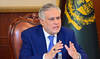
In this file photo, Ahsan Iqbal Pakistan’s Minister of Planning and Development speaks with a Reuters correspondent during an interview in Islamabad, Pakistan June 12, 2017. (REUTERS)
Updated 23 February 2018
Follow

Interior minister rejects reports of Pakistan’s inclusion on FATF watch list

ISLAMABAD: Pakistan’s Interior Minister Ahsan Iqbal has said in a Twitter message that there had been “no official intimation of a FATF decision yet” and requested that the media not speculate until a statement was released.

It followed reports that the Financial Action Task Force (FATF) had placed Pakistan back on its list of non-compliant countries, days after the country’s Foreign Minister Khawaja Muhammad Asif announced a victory against the US co-sponsored resolution.
Reuters on Friday, citing Indian media and an unnamed non-Indian diplomatic source from one of the FATF countries, reported that the anti-money laundering and terror-financing watchdog had decided Pakistan would be put back on the watch list.
“The decision was taken yesterday,” the diplomat told Reuters.
He added that the financial consequences would not kick in until June, which, in theory, could allow Pakistan wriggle room to solve terrorist-financing issues. “But the odds of that, particularly in an election year, seem slim,” he said.
The Foreign Office rejected Indian media reports of FATF including Pakistan on the “grey list,” Pakistan’s English daily The News reported.
Foreign Office spokesman Dr. Mohammed Faisal said at a press briefing: “So far, the outcome of the ICRG (International Country Risk Guide) /FATF meeting in Paris is awaited.”
“Pakistan has serious concerns over, and objections to, the introduction of this new ‘nomination’ procedure, which is unprecedented and in clear violation of established rules/practices of FATF,” he said. “Most of the concerns raised by the US side regarding deficiencies in our CFT (combating financing of terrorism) and AML (anti-money laundering) regime had already been addressed in 2015 when Pakistan got an exit from the “grey list.”
The resolution to put Pakistan on FATF’s high-risk and non-compliant list has been spearheaded by US with the support of Britain, France and Germany.
Earlier this week, Pakistan’s foreign minister said that there was “no consensus for nominating Pakistan” at the FATF plenary session, which began its six-day meeting on Sunday after members of the regulatory body failed to reach an agreement on placing the country on its grey list.
Officials at the Ministry of Finance and Ministry of Foreign Affairs declined to comment to Arab News until the conclusion of the Paris meeting.
A three-month reprieve was extended by FATF to Pakistan and its Asian Pacific Group subsidiary is scheduled to review “another report” for consideration.
Senior economist Dr. Syed Nazre Hyder described the potential impact if Pakistan was included on the watch list as “near lethal.”
The cost to banks’ customers would rise, investors in the international capital market would request a much higher rate of return from Pakistan and multilateral financing organizations would add risk premiums on any money borrowed, he said.
Financial experts fear that the International Monetary Fund may also reject any loan extension Pakistan might request as a bailout to curb its widening trade deficit, or offer a new deal with stricter guidelines dictated by the US and EU.
“Pakistan will need a loan to pay off its debt burden,” Hyder told Arab News. “If it’s included on the list, the country will face a serious challenge sourcing funds for repayment, leading to the possibility of default. This would cripple Pakistan economically.”


China’s top diplomat to visit Somalia on Africa tour

Updated 6 sec ago
Follow

China’s top diplomat to visit Somalia on Africa tour

  • Stop in Mogadishu provides diplomatic boost after Israel became the first country to formally recognize breakaway Somaliland
  • Tour focusses on Beijing's strategic trade ​access across eastern and southern Africa
BEIJING: China’s top diplomat began his annual New Year tour of Africa on Wednesday, focusing on strategic trade ​access across eastern and southern Africa as Beijing seeks to secure key shipping routes and resource supply lines.
Foreign Minister Wang Yi will travel to Ethiopia, Africa’s fastest-growing large economy; Somalia, a Horn of Africa state offering access to key global shipping lanes; Tanzania, a logistics hub linking minerals-rich central Africa to the Indian Ocean; and Lesotho, a small southern African economy squeezed by US trade measures. His trip this year runs until January 12.
Beijing aims to highlight countries it views as model partners of President Xi Jinping’s flagship “Belt and Road” infrastructure program and to expand export markets, particularly in young, increasingly ‌affluent economies such ‌as Ethiopia, where the IMF forecasts growth of 7.2 percent this year.
China, ‌the ⁠world’s ​largest bilateral ‌lender, faces growing competition from the European Union to finance African infrastructure, as countries hit by pandemic-era debt strains now seek investment over loans.
“The real litmus test for 2026 isn’t just the arrival of Chinese investment, but the ‘Africanization’ of that investment. As Wang Yi visits hubs like Ethiopia and Tanzania, the conversation must move beyond just building roads to building factories,” said Judith Mwai, policy analyst at Development Reimagined, an Africa-focussed consultancy.
“For African leaders, this tour is an opportunity to demand that China’s ‘small yet beautiful’ projects specifically target our industrial gaps, ⁠turning African raw materials into finished products on African soil, rather than just facilitating their exit,” she added.
On his start-of-year trip in 2025, ‌Wang visited Namibia, the Republic of Congo, Chad and Nigeria.
His visit ‍to Somalia will be the first by a Chinese foreign minister since the 1980s and is ‍expected to provide Mogadishu with a diplomatic boost after Israel became the first country to formally recognize the breakaway Republic of Somaliland, a northern region that declared itself independent in 1991.
Beijing, which reiterated its support for Somalia after the Israeli announcement in December, is keen to reinforce its influence around the Gulf of Aden, the entrance ​to the Red Sea and a vital corridor for Chinese trade transiting the Suez Canal to Europe.
Further south, Tanzania is central to Beijing’s plan to secure access to Africa’s ⁠vast copper deposits. Chinese firms are refurbishing the Tazara Railway that runs through the country into Zambia. Li Qiang made a landmark trip to Zambia in November, the first visit by a Chinese premier in 28 years.
The railway is widely seen as a counterweight to the US and European Union-backed Lobito Corridor, which connects Zambia to Atlantic ports via Angola and the Democratic Republic of the Congo.
By visiting the southern African kingdom of Lesotho, Wang aims to highlight Beijing’s push to position itself as a champion of free trade. Last year, China offered tariff-free market access to its $19 trillion economy for the world’s poorest nations, fulfilling a pledge by Chinese President Xi Jinping at the 2024 China-Africa Cooperation summit in Beijing.
Lesotho, one of the world’s poorest nations with a gross domestic product of just over $2 billion, ‌was among the countries hardest hit by US President Donald Trump’s sweeping tariffs last year, facing duties of up to 50 percent on its exports to the United States.