ISLAMABAD: Chief of Army Staff General Qamar Javed Bajwa highlighted Pakistan’s efforts for regional peace and stability while participating in the Munich Security Council on Saturday.
General Bajwa pointed out that his country had launched several security operations against terrorist networks operating in the region, adding that there were no organized militant training camps or sanctuaries in Pakistan anymore.
The army chief said that his country has done everything to ensure proper management of its western border and was unilaterally building a fence and hundreds of surveillance forts for that purpose.
He added that these steps were taken not only to curb militant movement, but also to facilitate Afghan nationals who visit his country for legitimate reasons.
General Bajwa also noted that there were several ungoverned spaces in Afghanistan that were exploited by militant factions in that country.
He maintained that there were nearly 2.7 million Afghan refugees in his country and their settlements were routinely used by the Haqqani network and Tehreek-e-Taliban Pakistan to recruit, morph and melt.
The army chief noted that Pakistan was fully committed to the international consensus that political reconciliation was the only solution to the Afghan issue.
“While we are actively supporting the new US strategy in the region, primarily based on a kinetic approach, we are not leaving any stone unturned to try and do our best in bringing the parties of the conflict on the negotiation table,” he added.


No terrorist sanctuaries in Pakistan, Gen Bajwa assures international conference
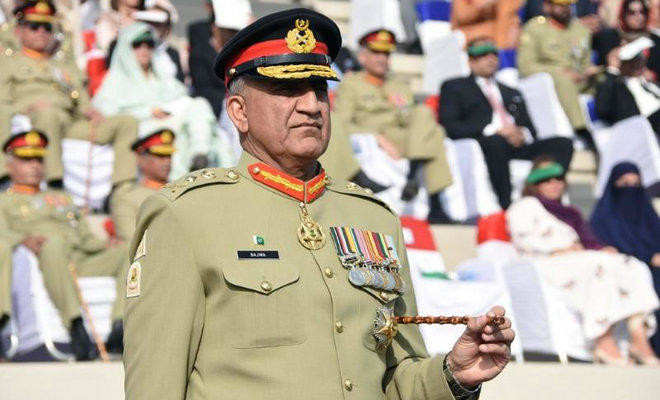
No terrorist sanctuaries in Pakistan, Gen Bajwa assures international conference

Firefighter dies battling Pakistan mall blaze raising death toll to six
- The fire gutted several shops at Gul Plaza in Karachi’s Saddar business district late Saturday
- Police say an investigation into the cause of fire will be launched once the blaze is doused
ISLAMABAD: A firefighter was killed while battling a blaze at a shopping mall in Pakistan’s southern port city of Karachi, officials said on Sunday, raising the death toll from the incident to six.
The fire, which erupted at Gul Plaza in Karachi’s Saddar business district late Saturday, gutted several shops, according to a Rescue 1122 spokesman.
Television footage showed several fire trucks using ladders, water cannons and hoses to douse the building’s floors, where flames shot out of windows and balconies.
Around 20 injured persons were shifted to hospital, where a firefighter among six individuals succumbed to burn injuries.
“The entire team and machinery are busy extinguishing the fire,” Karachi Mayor Murtaza Wahab said. “Firefighters are carrying out the rescue operation risking their own lives.”
The cause of the fire was not immediately known. Police said an investigation would be launched once the blaze was extinguished. However, most structures in Karachi, and other parts of the country, lack fire prevention and firefighting systems, which often result in damages and casualties.
Karachi is the capital of southern Sindh province, where such incidents are common. In November 2023, a fire tore through a shopping mall in the city, killing 10 people and injuring 22 others.
Sindh Chief Minister directed the Karachi commissioner to probe the incident and submit an inquiry report.
“Fire safety arrangements in the building must be checked,” he said. “Action be taken against those responsible in case negligence or carelessness is proven.”
In his message, Prime Minister Shehbaz Sharif expressed sorrow over the loss of lives in the Karachi fire incident, urging all necessary action to protect lives and property of people.
“Relevant agencies should work together in the rescue operation,” he said. “All possible assistance should be provided to the affected traders and other people.”