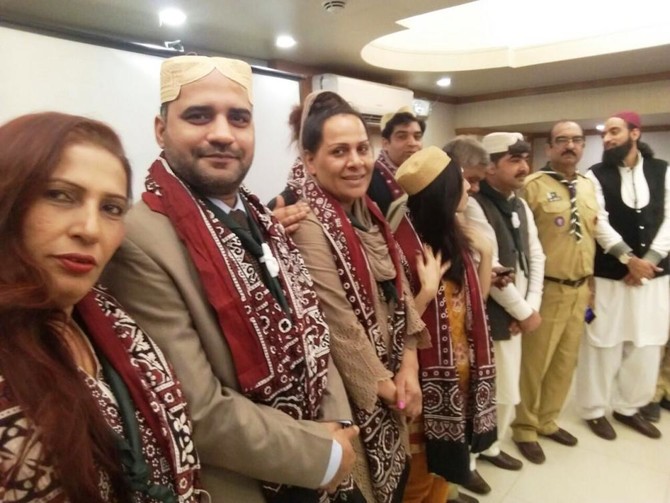
Transgender persons chosen as scouts

1 / 2
Transgender community scouts. (AN photo by Bindiya Rana Latif)
2 / 2
Transgender community scouts. (AN photo by Bindiya Rana Latif)
Updated 17 February 2018
Follow

Transgender persons chosen as scouts

KARACHI: Around 40 transgender persons have been selected as the members of Pakistan Boy Scouts Association (PBSA), a national scouting organization and one of the largest volunteer forces in the country, during a ceremony held in a local hotel.
PBSA was founded in 1947 and aims to train young boys in first aid, civil defense, camping and hiking, community development projects and emergency response and holds regular camps, hikes, speech contests and other activities such as tree planting camps and peace camps.
It became a member of the World Organization of the Scout Movement in April 1948.Today, there are more than 700,000 members in the PBSA.
The young transgenders, wearing scout scarfs, took the oath at the welcome ceremony. They were briefed about the responsibilities as PBSA members.
“Such opportunities are very rare. This will give us help us to show the community that we are normal people doing normal things and this may make them comfortable hiring us for actual jobs,” said Bindiya Rana, who is the president of the Gender Interactive Alliance in Sindh “We feel we are finally being recognized as equal citizens of Pakistan and are glad to see that the level of our acceptance is increasing,” said TransAction Alliance president Farzana Jan, addressing a ceremony in Karachi. She said that the transgender community is extremely happy to be welcomed into the scouting community. Farzana is also the only transgender person who has been selected as a scout from Khyber-Pakhtunkhawa province.
Chairman of the Petarian Human Rights Organization, Ihsan Khosa said the ceremony as a defining moment for the transgender community.
“PBSA is open to all, without distinction of origin, race or creed,” said Atif Amin Hussain, Commissioner IPC Sindh Boys Scouts.
The Sindh and Pakistan boys scout association is not a gender-specific organization, said Akhter Mir, secretary of the Sindh Boys Scout Association, told the Arab News.
“Our association is primarily aimed at youth development and motivation. Transgender people are also youth, and we don’t discriminate on the basis of gender,” he said.


Pakistan reviews austerity measures amid Middle East crisis, urges strict nationwide implementation

Updated 11 March 2026
Follow

Pakistan reviews austerity measures amid Middle East crisis, urges strict nationwide implementation

  • Deputy Prime Minister Ishaq Dar chairs review meeting of austerity steps
  • Officials briefed on salary cuts, school closures, four‑day week, petrol conservation

ISLAMABAD: Pakistan’s government on Wednesday assessed progress on a sweeping set of austerity measures introduced to mitigate the country’s economic strain from sharply rising global oil prices and supply disruptions linked to the ongoing war in the Middle East.

Prime Minister Shehbaz Sharif this week announced a series of austerity steps, including a four‑day work week for government offices, requiring 50  percent of staff to work from home, cutting fuel allowances for official vehicles by half, grounding up to 60  percent of the government fleet and closing all schools for two weeks to conserve fuel amid the global oil crisis.

The measures were unveiled in response to global oil market volatility triggered by the conflict involving the United States, Israel and Iran, which has disrupted supply routes such as the Strait of Hormuz and pushed crude prices sharply higher, straining Pakistan’s heavily import‑dependent energy sector.

“The meeting stressed the importance of strict and transparent adherence to the austerity measures, promoting fiscal responsibility and prudent use of public resources,” Deputy Prime Minister and Foreign Minister Senator Mohammad Ishaq Dar said in a statement.

He was chairing a meeting of the Committee for Monitoring and Implementation of Conservation and Additional Austerity Measures, constituted under the directions of the PM, bringing together federal and provincial officials to review execution of the broad cost‑cutting plan. 

Dar emphasized the government’s commitment to enforcing the PM’s austerity steps nationwide. The committee’s review also covered reductions in departmental expenditure, deductions from salaries of senior officials earning over Rs. 300,000 ($1,120), and coordination with provincial administrations to ensure uniform implementation of the plan.

Participants at the meeting reiterated that all ministries and divisions must continue strict monitoring and reporting, with transparent oversight mechanisms, as Pakistan navigates the economic pressures from the prolonged Middle East crisis and its fallout on global energy and trade markets.