YANBU: Like many Saudi women, Amani dreamt of becoming a mother, but was unable to have children of her own after many years of marriage. Therefore, she decided to spend her time taking care of orphans with special circumstances in Makkah.
However, things took a turn for the worse when she came across seemingly unfair difficulties in adopting one of the children she had been caring for at the orphanage.
Since her very first visit to the center, Amani spent her days nursing orphan babies. When the time came for her to try and adopt a child for her and her husband, she was asked to present personal identification papers and a salary slip for herself and her husband, and did just that. A committee came to the house to double-check her circumstances, and after six months she obtained approval to foster a boy named Rami.
Shortly after this, she tried to foster another girl, called Raneem. Amani prepared herself and her home to receive Raneem. She bought her new clothes to join her foster brother, Rami, but she was surprised when the center refused to assign her the girl. She then complained to the Ministry of Social Affairs.
Amani said that before she adopted Rami, she saw Raneem and asked to nurse her at the center with the intention of adopting her eventually, but said that the staff told her to nurse Rami first and to then begin with Raneem. Nonetheless, Amani said: "I was able to feed the girl five times with the presence of witnesses, and with the proper breast feeding technique. I filed for her custody with the social office in Makkah, and after the application, the society prevented me from nursing Raneem, and instead told me to continue with my application to adopt Rami, first. Subsequently, the society decided to give Raneem to another family at this time, but the family brought her back to the society anyway."
"After the family brought Raneem back, I breastfed her upon the society's request again. I stayed in the society from eight in the morning until midnight to finish feeding her. I got ready for Raneem's arrival in my home, only to discover that she had been given to a single woman," she added.
Amani received specialists in her house to follow up on Rami's progress, who was only 15 months old. "I remember them telling me at the time that they would follow up on awarding Raneem to me, and I called the administration. They told me they were waiting for the ministry's response to my case," she said.
Amani demanded the return of Raneem, especially after she found out that the girl had been given to a single woman, and requested that the ministry review her case in addition to looking into her breastfeeding history with the child, which was undertaken according to Shariah procedures.
Amani's complaint was filed to the chairman of the board, Hussein Saeed Hussein Bahri, who confirmed that according to the Ministry of Social Affairs, giving two children to one family in less than two years violates their regulations. He confirmed that Amani already has custody of a boy who isn’t yet two years old, and therefore recommended the awarding of the girl to a family that did not yet have a child. He further said that Raneem will not be awarded to another family until Amani is fully aware of the ministry's rules in this regard.
He added that the society deals with an independent center that is supervised by Modi Baterjee, called "Bidaya (beginning)" that specializes in stimulating barren women to breast feed when they wish to adopt a child. This is done in one of two ways: the first is by natural means such as herbs, and the second is done by using mechanical tools to stimulate milk. The second method was approved according to a recent fatwa, which means that the child can grow in a family environment and can become a son or daughter to new parents. He added that the society has awarded 40 children in this manner so far.


Saudi woman denied custody of breastfed orphan
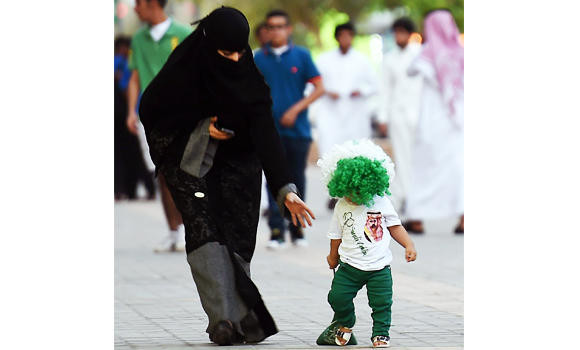
Saudi woman denied custody of breastfed orphan

Talks held on opportunities for sustainable EU-Saudi business cooperation
- Leading companies from both the EU and the Kingdom attended the event to discuss objectives and challenges
- Dubravka Suica: All our pipelines (are) hydrogen-ready, which means gas pipelines, new modern gas pipelines, were built to be also hydrogen-ready
RIYADH: A high-level roundtable consultation on sustainable business was held on Tuesday in Riyadh to explore collaboration between the EU and Saudi Arabia’s private sectors.
Leading companies from both the EU and the Kingdom attended the event to discuss objectives and challenges.
Dubravka Suica, European commissioner in charge of EU relations with the Mediterranean and the Gulf, was in attendance. The meeting was held under the auspices of the Delegation of the European Union to the Kingdom of Saudi Arabia and was organized by the EU–GCC Cooperation on Green Transition Project in collaboration with the European Chamber of Commerce in Saudi Arabia.
The meeting brought together senior representatives from leading companies active in the circular economy, water technologies, clean energy, sustainable manufacturing, environmental innovation, and advanced materials, including Danfoss and ACWA Power.
Suica told Arab News that the EU is ready to seize future opportunities across various sectors, given Europe’s rich history of green development.
“All our pipelines (are) hydrogen-ready, which means gas pipelines, new modern gas pipelines, were built to be also hydrogen-ready. So, they can also be useful for the supply of hydrogen,” she said.
She added: “The only problem is that we are a market economy … We cannot guarantee anything because it is as it is, as you know.”
When asked about the EU plan to support European companies seeking to participate in sustainability-related projects, the commissioner commented that “EU Green Deal is something which we would like to make happen by 2050 to have Europe as a CO2-neutral continent.”
Presently, however, simplifying the process is a strategy that would benefit both sides of the equation, she added.
“There is a lot of burden to our companies and to your companies who want to work in Europe … We are now trying not to deregulate. We cannot do it, but we are trying a little bit to simplify,” Suica told Arab News.
During the meeting, participants discussed essential opportunities for collaboration in investment and technology deployment, reflecting serious intentions from both sides to support joint initiatives across the region.
Suica also highlighted the relevance of the Pact for the Mediterranean, launched in Barcelona last month, emphasizing its role in opening additional avenues for companies to expand further across the Middle East and North Africa region.
“Today’s consultation reaffirms our shared commitment to accelerating the green transition through meaningful partnerships between EU and Saudi companies, connecting our regions and bringing our peoples closer,” said Suica.
“The EU and the Kingdom of Saudi Arabia are committed to stepping up our partnership.
“Under the EU–Saudi Arabia Strategic Partnership Agreement and the Pact for the Mediterranean, we will have a broader regional framework to expand cooperation between EU and Saudi companies across the Middle East and North Africa.
“I am encouraged by the strong engagement we have seen today.”
Christophe Farnaud, ambassador of the EU to Saudi Arabia, Bahrain, and Oman, also commented on the subject during the meeting and supported the partnership talks.
He said: “Saudi Arabia and Europe are charting a new path for global cooperation in sustainable development. By bringing together leading companies from both sides, we aim to transform strategic dialogue into tangible opportunities that support innovation, diversification, and long-term sustainable growth.”


