

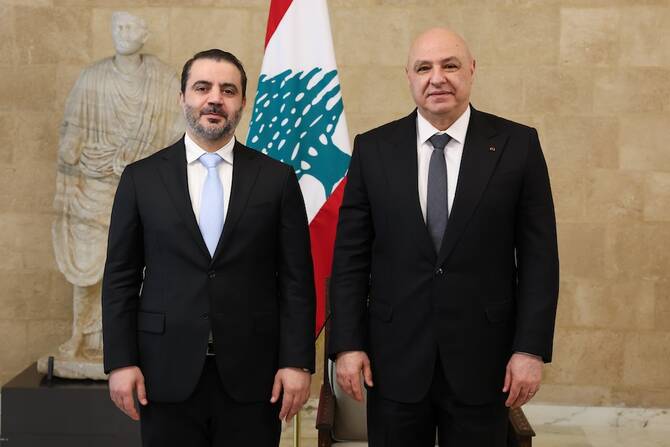

BEIRUT: Lebanese President Joseph Aoun on Friday told Syrian Foreign Minister Asaad Hassan Al-Shaibani that Lebanon was awaiting the appointment of a new Syrian ambassador to Beirut to facilitate bilateral relations through official diplomatic channels.
This follows Syria’s decision to suspend the Lebanese-Syrian Higher Council, shifting all communications to embassies and formal state contacts.
Al-Shaibani emphasized to Aoun the need to deepen and correct the historical relationship between the two countries, particularly on issues that have tarnished Syria’s image.
President Aoun told Al-Shaibani that deepening and developing bilateral relations required the formation of joint committees to address all issues, including a comprehensive review of existing agreements.
“Lebanon is looking forward to strengthening relations between the two brotherly countries on the basis of mutual respect and non-interference in internal affairs, and activating cooperation to achieve stability in both Lebanon and Syria,” the president said.
Al-Shaibani’s visit, the first by a senior Syrian official to Lebanon since the fall of the Assad regime, marks a turning point as both sides seek a new framework for relations after decades of tension and shifting regional dynamics.
The two nations have begun addressing pressing concerns through committee meetings, including border demarcation, the return of Syrian refugees and the status of detainees.
In 1991, Lebanon and Syria signed the Treaty of Brotherhood, Cooperation and Coordination, establishing the highest official framework for bilateral relations after the Lebanese Civil War.
The treaty formalized Syria’s military presence in Lebanon and set up the Lebanese-Syrian Higher Council, signed by Lebanese President Elias Hrawi and Syrian President Hafez Assad.
Throughout the 1990s and early 2000s, the council served as the primary channel for sensitive coordination between Beirut and Damascus, overseeing security, economic affairs and the implementation of bilateral agreements.
Its decisions, binding on both states, were enforced within the framework of the constitutional systems of Lebanon and Syria.
“There is much work to be done, but when intentions are sincere, the interests of our two brotherly countries will take precedence over all else,” President Aoun told Al-Shaibani, according to the presidential palace media office.
“We have no choice but to reach an agreement that respects these interests,” he said.
Acknowledging improvements along the Lebanese-Syrian border, President Aoun underscored the urgency of resolving key outstanding issues previously discussed with Syrian President Ahmad Al-Sharaa at summits in Cairo and Doha.
These include land and maritime border demarcation, agreements on the gas pipeline and the fate of detainees — all to be addressed with a shared focus on mutual interests.
The Syrian foreign minister headed a large delegation, which included Justice Minister Mazhar Al-Wais, Head of the Intelligence Service Hussein Al-Salama, and Assistant Minister of Interior for Security Affairs Major General Abdul Qader Tahan.
Al-Shaibani called for expanded cooperation in economic and trade sectors, highlighting new opportunities for Lebanon after the lifting of some sanctions on Syria.
“We look forward to turning the page on the past because we want to build the future. Syria is ready to discuss any pending issues, whether economic or security-related. Our people have suffered from wars and tragedies, so let us strive for peace,” he said.
He also delivered an official invitation from President Ahmad Al-Sharaa for Aoun to visit Syria.
The Syrian delegation held a series of meetings in Beirut, including with Lebanese Prime Minister Nawaf Salam, as well as direct sessions between Maj. Gen. Hassan Choukeir, head of Lebanese General Security, and Maj. Gen. Abdel Qader Tahan, Syria’s assistant minister of interior for security affairs.

Syrian delegation held a series of meetings in Beirut, including with Lebanese Prime Minister Nawaf Salam (right). (Supplied)
Army intelligence chiefs Brig. Gen. Tony Kahwaji of Lebanon and Hussein Al-Salama of Syria also met to discuss coordination.
The prime minister’s media office noted that Salam’s talks with Al-Shaibani reflected a “mutual affirmation of the desire to open a new chapter based on mutual respect, good neighborliness and the preservation of the sovereignty and national independence of both countries.”
The topics addressed included border management, anti-smuggling efforts, safe and dignified repatriation of Syrian refugees — with UN and international coordination — as well as the cases of Syrian detainees in Lebanon and Lebanese missing persons in Syria. Both sides agreed to review bilateral agreements in light of recent developments.
“Lebanon is committed to establishing sound and balanced relations with Syrian, grounded in cooperation between two independent states united by geography and history,” Salam said.
“Openness and sincere dialogue constitute the only path to achieving stability in both counties and the region.”
Deputy Prime Minister Tarek Mitri, present at the meeting, emphasized that the process would tackle every issue “in a spirit of goodwill and urgency,” eschewing “red lines” and bartering.
Al-Shaibani reported progress on expediting the case of Syrian detainees in Roumieh prison and highlighted new gains in joint security and intelligence coordination.
Lebanese Foreign Minister Youssef Rajji, speaking at a joint press conference with Al-Shaibani, welcomed Syria’s new approach. “What distinguishes this stage is the new Syrian administration’s respect for Lebanon’s sovereignty and independence and its non-interference in its internal affairs,” Rajji said, which he called “a very important and positive development.”

Syrian Foreign Minister Asaad Al-Shaibani speaks with Lebanese Foreign Minister Youssef Rajji before a briefing for journalists following their meeting in Beirut, Lebanon. (AP)
Al-Shaibani expressed gratitude for Lebanon hosting Syrian refugees, saying he expected this issue “to be resolved gradually.”
“There are plans currently under discussions, with international support, to ensure a dignified and sustainable return and to address the postwar situation in Syria through infrastructure development, reconstruction and other measures.”
He added: “We in Syria have the utmost respect and appreciation for Lebanon and seek to overcome the mistakes of the past, from which we, too, were also victims as a result of the mismanagement of relations between the two countries.”
One of the most pressing unresolved issues between Lebanon and Syria is Damascus’ demand for the extradition of Syrian detainees held in Lebanon.
These detainees fall into three groups — those convicted of crimes, including security-related offenses committed on Lebanese soil or combat against the Lebanese army; those convicted of misdemeanors; and those detained without trial.
Another contentious point is the extradition of former regime officers who fled to Lebanon following the Assad regime’s collapse.
In return, Lebanon insists that Syria address the fate of Lebanese missing persons in Syria and provide files or information related to individuals accused of crimes in Lebanon, including assassinations of political figures.


