

Saudi Arabia’s Breastfeeding Association hosts second international conference in Riyadh

1 / 3
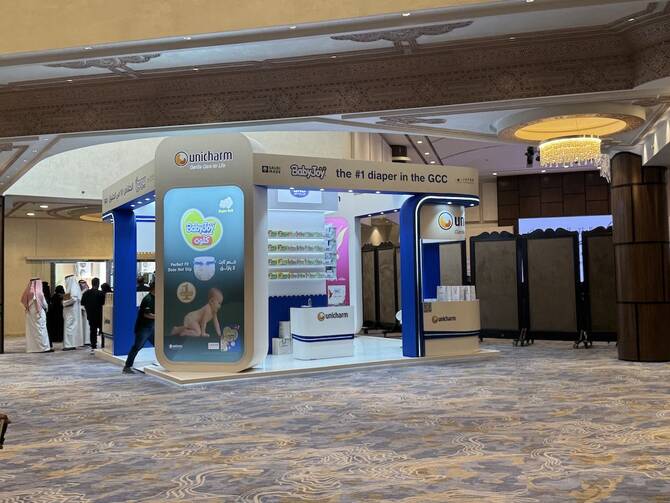
Saudi Arabia’s Breastfeeding Association hosted its second international conference on Sunday in Riyadh. (AN photo)
2 / 3
Saudi Arabia’s Breastfeeding Association hosted its second international conference on Sunday in Riyadh. (AN photo)
3 / 3
Saudi Arabia’s Breastfeeding Association hosted its second international conference on Sunday in Riyadh. (AN photo)
Short Url
Updated 05 October 2025
Follow

Saudi Arabia’s Breastfeeding Association hosts second international conference in Riyadh

  • Running from Oct. 5-7, the conference aims to educate the public on breastfeeding practices, emphasizing the health and well-being of mothers and children worldwide

RIYADH: Saudi Arabia’s Breastfeeding Association hosted its second international conference on Sunday in Riyadh, bringing together global lactation medicine specialists and industry experts for the three-day event.

Running from Oct. 5-7, the conference aims to educate the public on breastfeeding practices, emphasizing the health and well-being of mothers and children worldwide.

Experts from across the world are participating in the forum.

“We strive diligently to achieve the targets of Saudi Vision 2030 by reaching 70 percent of breastfeeding mothers, because the right support at the first moment makes a difference that lasts a lifetime, so that we hope this continues with healthier and safer steps,” Dr. Fatima Yousef Al-Juwan, chair of the board of directors and founding member of the Breastfeeding Association, said.

During the opening ceremony of the conference, a video played, highlighting the mission of the association: “Our mission is for every mother to receive the support she deserves and for every child to start their life with the best possible care because supporting the mother is not a secondary option; rather, it is the foundation for long-term health and for the community.”

The association operates on multiple levels, raising public awareness for mothers, offering professional training for health workers, and promoting institutional development for research and financial stability.

In her remarks, Al-Juwan stated that the association also trains mothers to become experts in breastfeeding and provides licensing in breastfeeding mentoring.

“This is a program accredited by the World Health Organization and UNICEF and is applied in countries worldwide. The number of mentors has reached more than 500,” Al-Juwan said.

During her opening remarks, she said: “One of the central focuses of the association is offering training and qualification programs for workers in the health sector and accompanying mothers from pregnancy until weaning with practical and distinguished supportive guidance.”

The initiatives of the association also align with the global sustainable development goals: zero poverty and hunger, good health and well-being, reduced inequalities, and responsible consumption.

The opening ceremony of the conference also featured an awards ceremony celebrating partners and supporters of the association, and it will hold a specialized award ceremony to honor mothers.

The conference welcomed multiple booths offering products focusing on infants and mothers, including Birth Kuwait, Lansinoh, Enaya Health Society, and more.

Trump designates Saudi Arabia as Major Non-NATO Ally

Updated 19 November 2025
Follow

Trump designates Saudi Arabia as Major Non-NATO Ally

  • Announcement came during a black-tie White House dinner honoring Crown Prince Mohamed Bin Salman
  • The Crown Prince stressed that today marks a new phase in bilateral cooperation, with economic ties expanding across unprecedented sectors

WASHINGTON: US President Donald Trump has on Tuesday announced that the US will formally designate Saudi Arabia as a Major Non-NATO Ally, marking a significant elevation in defense ties between Washington and the Kingdom.
He revealed the decision during a black-tie White House dinner honoring Crown Prince Mohammed bin Salman.
“Tonight, I’m pleased to announce that we’re taking our military cooperation to even greater heights by formally designating Saudi Arabia as a major non-NATO ally — something that is very important to them,” Trump said. 
“And I’m telling you now for the first time, because they wanted to keep a little secret for tonight,” he added.
The new status paves the way for deeper military cooperation and carries strong symbolic weight, with Trump saying it will advance U.S.–Saudi defense coordination “to even greater heights.”
Crown Prince Mohammed bin Salman thanked Trump for a “warm and great welcome,” adding, “We feel home.” 
He referenced the historic foundations of the U.S.–Saudi relationship, noting that the partnership dates back nearly nine decades to the meeting between President Franklin D. Roosevelt and King Abdulaziz, the founder of modern Saudi Arabia.


He also pointed to upcoming milestones for both nations, America approaching its 250th anniversary and Saudi Arabia nearing its 300th year, saying these celebrations underscore the long arc of shared cooperation.
Reviewing the history of the alliance, the Crown Prince highlighted joint efforts across World War II, the Cold War, and the long fight against extremism and terrorism. Yet he stressed that today marks a new phase in bilateral cooperation, with economic ties expanding across unprecedented sectors.
“Today is a special day,” the Crown Prince said. “We think the horizon of economic cooperation between Saudi Arabia and America is bigger and wider in many areas. We’ve been signing a lot of agreements that can open the door to develop the relationship deeper in many areas, and we’re going to work on it.”
He emphasized that the opportunities ahead are substantial, adding, “We believe the opportunities are huge, so we have to focus on implementation and keep increasing the opportunities between our two countries.”
Trump repeatedly expressed appreciation for the Crown Prince’s partnership and leadership, highlighting major agreements signed during the visit, including deals on civil nuclear energy, critical minerals, and artificial intelligence, describing the scale of investment as unprecedented.
Trump emphasized that Saudi Arabia is undertaking a major expansion of its defense capabilities, referencing the Kingdom’s plans for nearly $142 billion in purchases of U.S. military equipment and services, which he called “the largest arms purchase in history.”
He framed the acquisition as part of a broader strategy to enhance Middle East security and reinforce the Kingdom’s role as a stabilizing force.
In addition to the Major Non-NATO Ally designation, Trump announced that the U.S. and Saudi Arabia had signed a historic strategic defense agreement. 
He said the pact would create “a stronger and more capable alliance” and support what he called the closest the Middle East has ever come to “truly everlasting peace.”
Trump thanked the Crown Prince for “for all the help” in shaping what he described as a historic moment for regional peace and U.S.–Saudi cooperation, and for playing a central role in recent diplomatic breakthroughs, including steps that contributed to ending the war in Gaza. 
“Even the great experts… are calling it a miracle,” he said of recent regional shifts.
Both leaders framed the moment as the beginning of a new chapter.