The UN refugee agency said Wednesday that governments around the world, especially that of the United States and countries in Europe, are increasingly undermining the global convention on refugees and asylum seekers — even threatening its very existence.
The stark warning by the UNHCR came on the 75th anniversary of the UN Refugee Convention, a 1951 document that defines who refugees are and outlines the responsibilities of countries hosting them.
Many have moved to suspend applications for asylum — requests for international protection by those who say they face war or persecution for their religion, race, nationality, sexuality or for their political beliefs if they were to return home.
“I am not exaggerating when I say that the institution of the asylum worldwide is under more threat now than it has ever been,” Ruvendrini Menikdiwela, assistant high commissioner for protection at UNHCR in Geneva, told reporters during an online briefing from the Swiss city.
A piece of paper that saves lives
The US under the Trump administration, and some European nations have increasingly restricted asylum and sought bilateral deals with third countries, especially in Africa, to deport migrants and, in some cases, transfer asylum responsibilities altogether.
Others, like Greece, which has seen a surge in Sudanese refugees arriving to the island of Crete, have temporarily suspended asylum processing.
“Those two pieces of paper have saved millions of lives in the past and will save millions of lives in the future,” she added, referring to the 1951 Convention relating to the Status of Refugees adopted in the wake of World War II and the ensuing 1967 Protocol, which expanded protections to refugees worldwide.
A cash crisis world over
A global funding crisis in the humanitarian sector has impacted more than 122 million people displaced from their homes, fleeing conflict or persecution. A growing anti-asylum and anti-migration sentiment has added to their woes.
And though the arrivals of refugees in the global north “dominate the headlines,” Menikdiwela said, some “75 percent of the world’s 43 million plus refugees are actually being hosted in low-income and middle-income countries.”
She cited the example of Chad, an East African nation that currently hosts 1.5 million refugees, the vast majority of them Sudanese who fled the brutal and ongoing civil war.
Menikdiwela, who recently visited a refugee camp in Chad, said the agency’s programs there are vastly underfunded and unable to support urgent needs of the arriving refugees.
“There are people, men, women and children, wandering around with bullet wounds and shrapnel wounds,” she said. Women and girls in particular have been subjected to unprecedented levels of sexual violence, Menikdiwela said, highlighting the case of an 80-year-old woman who reported being raped multiple times.
And yet, despite their dire situation, she insisted the refugees she met would not be alive if Chad hadn’t respected the refugee convention and allowed them across its borders.
Without support, refugees will keep moving
Menikdiwela urged leaders to step up donations and support, saying that many of the refugees in Chad would continue to move north through Libya and eventually Europe if their needs weren’t met in the East African nation.
She did, however, acknowledge abuse in asylum applications by migrants who have moved for economic or other reasons, not because they were fleeing war or persecution. The UN refugee agency has supported the concept of return hubs, a euphemism for deportation centers, which is increasingly gaining support in the US and Europe.


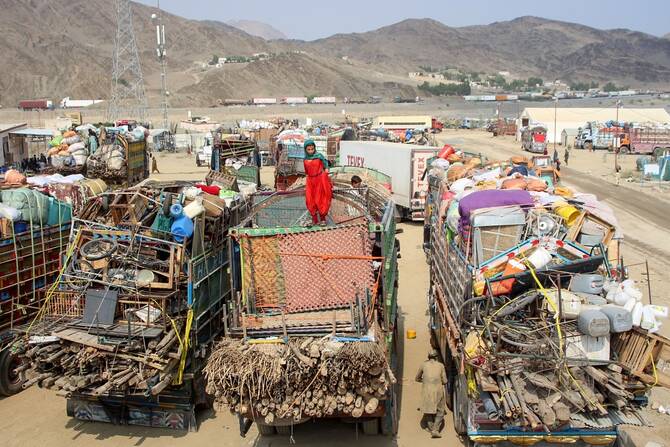
UNHCR says that US and European governments increasingly undermine the global refugee convention
https://arab.news/4cgqm
UNHCR says that US and European governments increasingly undermine the global refugee convention

- The US under the Trump administration, and some European nations have increasingly restricted asylum and sought bilateral deals with third countries, especially in Africa, to deport migrants and, in some cases, transfer asylum responsibilities altogether


Macron vows stronger cooperation with Nigeria after mass kidnappings
- Macron wrote on X that France “will strengthen our partnership with the authorities and our support for the affected populations”
PARIS: French President Emmanuel Macron said Sunday that France will step up cooperation with Nigeria after speaking with his counterpart, as the West African country faces a surge in abductions.
Nigeria has been wracked by a wave of kidnappings in recent weeks, including the capture of over 300 school children two weeks ago that shook Africa’s most populous country, already weary from chronic violence.
Macron wrote on X that the move came at Nigerian President Bola Tinubu’s request, saying France “will strengthen our partnership with the authorities and our support for the affected populations,” while urging other countries to “step up their engagement.”
“No one can remain a spectator” to what is happening in Nigeria, the French president said.
Nigeria has drawn heightened attention from Washington in recent weeks, after US President Donald Trump said in November that the United States was prepared to take military action there to counter the killing of Christians.
US officials, while not contradicting Trump, have since instead emphasized other US actions on Nigeria including security cooperation with the government and the prospect of targeted sanctions.
Kidnappings for ransom by armed groups have plagued Nigeria since the 2014 abduction of 276 school girls in the town of Chibok by Boko Haram militants.
The religiously diverse country is the scene of a number of long-brewing conflicts that have killed both Christians and Muslims, often indiscriminately.
Many scholars say the reality is more nuanced, with conflicts rooted in struggles for scarce resources rather than directly related to religion.


