

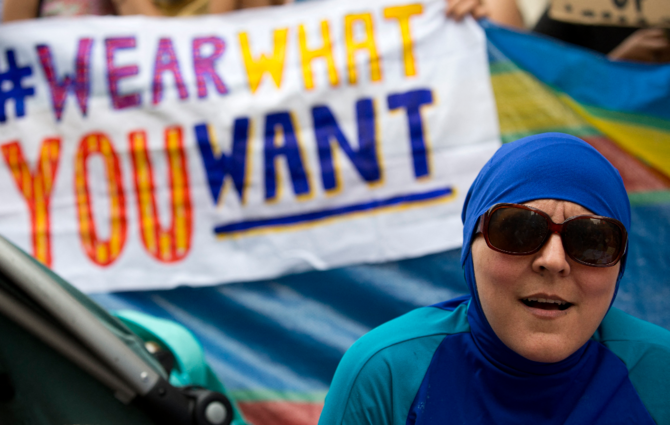
French court overturns town’s burkini ban after woman threatened with fines

In 2004, France banned Muslim headscarves in schools after MPs decided that the garment violates the secular values of the state education system. (FILE/AFP)
Short Url
Updated 17 July 2025
Follow

French court overturns town’s burkini ban after woman threatened with fines

  • The seaside town of Carry-le-Rouet had implemented the ban in June 2024
  • The ban was largely irrelevant until July 2, when an 18-year-old Muslim woman from the city of Marseille went to the town’s beach

LONDON: The Marseilles administrative court has reversed a burkini ban on a French Riviera beach after police threatened fines against a teenager and her family for wearing the Muslim swimsuit, The Times reported on Thursday.

The seaside town of Carry-le-Rouet had implemented the ban in June 2024, but it was found by the court to be a “serious and illegal breach of fundamental freedoms” following the incident.

The ban was largely irrelevant until July 2, when an 18-year-old Muslim woman from the city of Marseille went to the town’s beach.

Two municipal officers spotted her in the sea and ordered her out using whistles. Her family asked what she had done wrong, and the officers said the woman’s garment was “not acceptable,” according to her brother Islan.

The police called for reinforcements. Five gendarmes who arrived later threatened the 18-year-old with fines unless she and her family left the beach.

Islan said the family then left the area. “My sister has taken it badly,” he added. “She is afraid to go out now, does not communicate with other people and avoids talking about what happened.”

The incident led to the Human Rights League seeking a court order overturning the town’s burkini ban.

Over the past decade, about 20 towns and cities on the French coast, including Cannes, have tried to ban the Muslim swimsuit on secular grounds, though almost all the bans were denied or later overturned.

In 2004, France banned Muslim headscarves in schools after MPs decided that the garment violates the secular values of the state education system.

Niqabs and burqas were outlawed in public in 2011 based on concerns that criminals could conceal their identities using the religious garbs.


Bangladesh begins exhuming mass grave from 2024 uprising

Updated 55 min 35 sec ago
Follow

Bangladesh begins exhuming mass grave from 2024 uprising

  • The United Nations says up to 1,400 people were killed in crackdowns as Hasina attempted to cling to power — deaths that formed part of her conviction last month for crimes against humanity

DHAKA: Bangladeshi police began exhuming on Sunday a mass grave believed to contain around 114 unidentified victims of a mass uprising that toppled autocratic former prime minister Sheikh Hasina last year.
The UN-supported effort is being advised by Argentine forensic anthropologist Luis Fondebrider, who has led recovery and identification missions at mass graves worldwide for decades.
The bodies were buried at the Rayerbazar Graveyard in Dhaka by the volunteer group Anjuman Mufidul Islam, which said it handled 80 unclaimed bodies in July and another 34 in August 2024 — all people reported to have been killed during weeks of deadly protests.
The United Nations says up to 1,400 people were killed in crackdowns as Hasina attempted to cling to power — deaths that formed part of her conviction last month for crimes against humanity.
Criminal Investigation Department (CID) chief Md Sibgat Ullah said investigators believed the mass grave held roughly 114 bodies, but the exact number would only be known once exhumations were complete.
“We can only confirm once we dig the graves and exhume the bodies,” Ullah told reporters.

- ‘Searched for him’ -

Among those hoping for answers is Mohammed Nabil, who is searching for the remains of his brother Sohel Rana, 28, who vanished in July 2024.
“We searched for him everywhere,” Nabil told AFP.
He said his family first suspected Rana’s death after seeing a Facebook video, then recognized his clothing — a blue T-shirt and black trousers — in a photograph taken by burial volunteers.
Exhumed bodies will be given post-mortem examinations and DNA testing. The process is expected to take several weeks to complete.
“It’s been more than a year, so it won’t be possible to extract DNA from the soft tissues,” senior police officer Abu Taleb told AFP. “Working with bones would be more time-consuming.”
Forensic experts from four Dhaka medical colleges are part of the team, with Fondebrider brought in to offer support as part of an agreement with the UN rights body the OHCHR.
“The process is complex and unique,” Fondebrider told reporters. “We will guarantee that international standards will be followed.”
Fondebrider previously headed the Argentine Forensic Anthropology Team, founded in 1984 to investigate the tens of thousands who disappeared during Argentina’s former military dictatorship.
Authorities say the exhumed bodies will be reburied in accordance with religious rites and their families’ wishes.
Hasina, convicted in absentia last month and sentenced to death, remains in self-imposed exile in India.