BAGHDAD: Iraq’s parliament passed into law on Tuesday a revised bill that had sparked outrage over fears it rolled back women’s rights and permitted underage marriage.
The parliament said on its website that it had adopted “the proposal to amend the Personal Status Law,” as well as “the second amendment of the general amnesty law.”
The amendment to the 1959 Personal Status Law allows people to choose between religious or civil regulations for family matters such as marriage, inheritance, divorce and child custody.
An earlier version of the amendments faced a backlash from feminists and civil society groups over fears it would lower the minimum age for Muslim girls to marry to as young as nine years old.
But a revised version reinstated clauses of the old law that set the age of marriage at 18 — or 15 with the consent of legal guardians and a judge, MP Mohamed Anouz told AFP.
Under the new amendment, couples can opt for Shiite Muslim or Sunni Muslim rules, and clerics and lawyers will have four months to establish community-specific regulations.
In October, Amnesty International warned the amendments could strip women and girls of protections regarding divorce and inheritance.
The parliament also passed a general amnesty law that had sparked disagreements between political blocs. The law grants retrials to those convicted of a number of crimes.
The Taqadom party, the most influential Sunni bloc, welcomed the adoption of the amnesty law.
Iraq’s Sunni community has been the main proponent of revisiting the law, pushing for it to include a full review of all convictions on terror charges.
The law excludes convictions for “terrorist crimes” that resulted in the death of a person or “permanent disability,” or that involved fighting the Iraqi security forces or “sabotage of institutions,” according to Anouz.
But it does allow the judiciary to reopen investigations and start new trials for those who say they confessed “under torture” or were convicted based on “information provided by a secret informer,” Anouz explained.
In recent years, Iraqi courts have ordered hundreds of executions in terror cases, proceedings that rights groups say often lack due process or in which confessions suspected to have been extracted through torture are admissible.
In a country plagued by endemic corruption, those accused of embezzling public funds can also benefit from the amnesty law if they repay the stolen money, Anouz said.
A previous 2016 amnesty reportedly covered 150,000 people.
The new amnesty law excludes rape, incest and human trafficking.
The laws passed Tuesday, each endorsed by the Shiite, Sunni and Kurdish communities, were adopted in one package, with political parties agreeing to avoid any blockage.
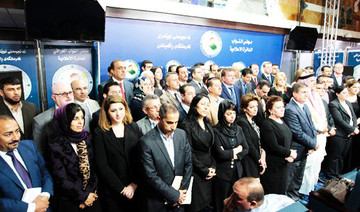
But several lawmakers denounced irregularities in the voting process, with some threatening to go to court to have Tuesday’s session invalidated.
MP Nour Nafe claimed the parliament passed the personal status law and the general amnesty “without a vote.”
The MPs “did not raise their hands,” she said on X, adding that some lawmakers had left the room in response to the “farce.”


Iraq parliament adopts revised bill after outcry over underage marriage

https://arab.news/ruxsq
Iraq parliament adopts revised bill after outcry over underage marriage

- The amendment to the 1959 Personal Status Law allows people to choose between religious or civil regulations for family matters
- An earlier version of the amendments faced a backlash from feminists and civil society groups


Soleimani warned Al-Assad about ‘spy’ Luna Al-Shibl: Al-Majalla
LONDON: The late Iranian General Qassem Soleimani confronted Syria’s National Security Bureau chief Ali Mamlouk in late 2019 after seeing Luna Al-Shibl leaving his office. Al-Majalla magazine claims its reporters reviewed a document containing the full Arabic transcript of their exchange.
Soleimani reportedly asked, “Who is this?” and Mamlouk replied, “She is Louna Al-Shibl, the president’s adviser.”
The Quds Force commander pressed further: “I know, I know… but who is she really? Where did she work?”
According to Al-Majalla, a sister publication of Arab News, he said her former salary was “ten thousand dollars,” compared with her current salary of “five hundred thousand Syrian pounds,” before asking: “Does it make sense for someone to leave ten thousand dollars for five hundred thousand pounds? She is a spy.”
Both Soleimani and Maher Al-Assad, commander of the Syrian army’s powerful Fourth Division, had warned the ousted president’s inner circle about Al-Shibl, Al-Majalla reported.
‘Suspicious’ car crash
On July 2, 2024, Al-Shibl was involved in what officials described as a traffic accident on the Damascus-Dimas highway. She was hospitalized and died four days later.
But Al-Majalla reported that photos of her armored BMW showed only minor damage, raising immediate questions among those close to the case.
Eyewitnesses told the magazine that the crash was intentional. One said, “a car approached and rammed her vehicle,” and before her bodyguard could exit, “a man attacked her and struck her on the back of the head,” causing paralysis that led to her death.
She was first taken to Al-Saboura clinic, then transferred to Al-Shami Hospital. Several senior regime-linked figures, including businessman Mohammed Hamsho and an aide to Maher Al-Assad, were present when her condition deteriorated. One witness told Al-Majalla that when her bodyguard tried to explain what had happened, “he was arrested immediately in front of the others.”
The presidency later issued a brief statement announcing her death. Her funeral was attended only by a handful of officials. Then president Al-Assad did not attend.


