

Syria central bank says depositors’ funds at local banks ‘safe’

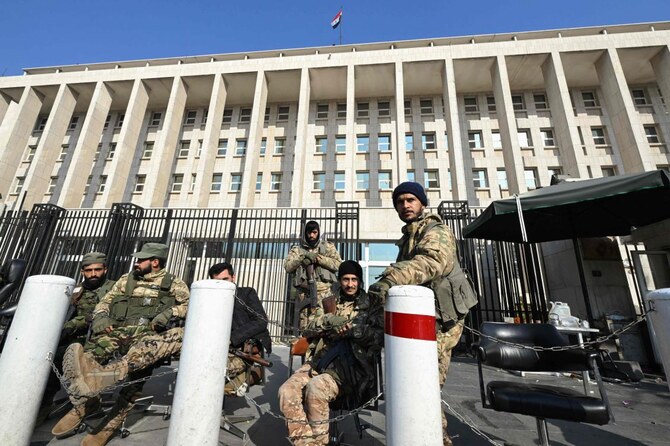
Anti government forces stand guard in front of Syria’s Central Bank in Damascus, on December 9, 2024. (AFP)
Short Url
Updated 09 December 2024
Follow

Syria central bank says depositors’ funds at local banks ‘safe’

  • Footage taken on Sunday showed fighters rushing to stop looters at the central bank after the capital fell

DAMASCUS: Syria’s central bank said Monday depositors’ funds in the country’s lenders were “safe” after militants took the capital, and following chaotic scenes near some official institutions.

“We assure our fellow citizens dealing with all operating banks that their deposits and funds at these banks are safe and have not been and will not be exposed to any harm,” said a statement on the central bank’s official Facebook page.

AFP footage taken on Sunday showed fighters rushing to stop looters at the central bank after the capital fell, firing into the air to disperse people and sending them away from the building.

On Sunday, the militants issued a statement saying “we emphasize the need to safeguard public and private property in the capital Damascus and the need to protect it.”

Violators risk “heavy penalties that could include imprisonment or a fine,” the statement added.


Muslim nations criticise Israel for Al-Aqsa Mosque Ramadan closure

Updated 5 sec ago
Follow

Muslim nations criticise Israel for Al-Aqsa Mosque Ramadan closure

  • Israel shut all holy sites in east Jerusalem's Old City for security reasons

ISLAMABAD: Eight Islamic and Arab countries on Thursday condemned Israel for keeping the Al-Aqsa Mosque in Jerusalem closed during the Muslim holy month of Ramadan.
Israel shut all holy sites in east Jerusalem's Old City for security reasons, but the foreign ministers of Pakistan, Egypt, Jordan, the United Arab Emirates, Indonesia, Turkey, Saudi Arabia and Qatar called it "illegal and unjustified".
In a joint statement, they said the continued closure of the mosque was "a flagrant violation to international law... and the principle of unrestricted access to places of worship".