TRIPOLI: Libya’s lifeline oil and gas exports raised revenues of more than $21.5 billion in 2021, the highest level in five years, the National Oil Corporation announced Saturday.
Total net revenues for oil and gas exports last year amounted to $21.5 billion as well as 30 million euros in non-dollar sales, the state-run NOC said in a statement.
It said record levels were achieved in November and December, raising a combined $4.3 billion in the two last months of 2021.
“The end of the year 2021 recorded a recovery, and oil prices achieved their largest annual gains since 2016, driven by the recovery of the global economy from the state of stagnation” due to the coronavirus epidemic, NOC chief Mustafa Sanalla said.
Since the 1970s, Libya which sits on the largest known oil reserves in Africa has been heavily dependent on revenues from its hydrocarbon exports.
But in a decade of violence since the 2011 revolt that overthrew and killed dictator Muammar Qaddafi, armed groups have frequently blockaded or damaged oil installations.
The shutdowns have forced the NOC to declare force majeure, a legal move allowing it to free itself from contractual obligations in light of factors beyond its control.
Oil production has recovered to 1.2 million barrels per day, as opposed to between 1.5 million and 1.6 million bpd before the NATO-backed uprising of 2011.
But Sanalla warned “the ability of the oil sector in Libya to invest and advance the process of infrastructure modernization will remain weak in the foreseeable future, especially in light of the scarcity of budgets.”
“What we need more than ever is to think outside the box and create initiatives to save the infrastructure,” he stressed.


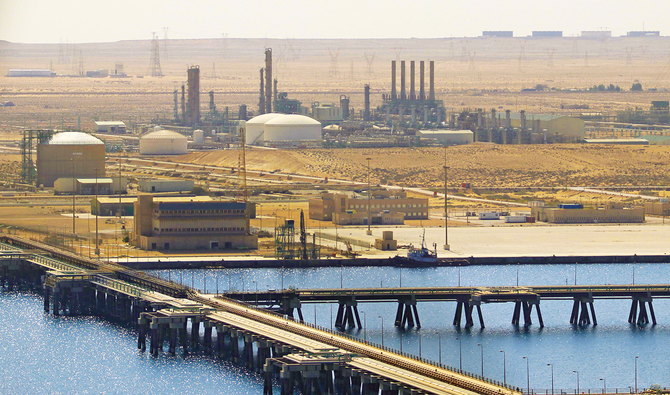
Libya oil, gas exports hit 5-year high of $21.5 bn
https://arab.news/rubx6
Libya oil, gas exports hit 5-year high of $21.5 bn

- Total net revenues for oil and gas exports last year amounted to $21.5 billion
- Record levels were achieved in November and December, raising a combined $4.3 billion in the two last months of 2021


SPARK inaugurates Smart Mobility plant for manufacturing EV chargers
RIYADH: King Salman Energy Park, known as SPARK, has inaugurated the Smart Mobility plant, specializing in manufacturing electric vehicle chargers, along with the first electric vehicle charging station within SPARK.
The launch was attended by SPARK CEO Mishal Al-Zughaibi and Smart Mobility CEO Prince Fahad bin Nawaf at SPARK headquarters in Abqaiq.
The project represents an important step in advancing the Kingdom’s industrial localization strategy, supporting the Made in Saudi Program under local-content policies overseen by the Local Content and Government Procurement Authority.
Al-Zughaibi affirmed that SPARK is positioned to become the region’s central platform for advanced industrial and energy technologies, indicating that SPARK’s proximity to the Kingdom’s core energy infrastructure and its access to ports on the Arabian Gulf are designed to create an integrated manufacturing and export corridor for the region.
SPARK’s mandate is to enable investors to build long-term industrial capabilities within the Kingdom, he noted.
Meanwhile, Prince Fahad said the decision to establish the plant at SPARK was deliberate and strategically planned, stressing that EV charging should be treated as national infrastructure and developed in parallel with Saudi Arabia’s broader energy system.
The CEO added that SPARK serves as the Kingdom’s primary hub for energy, logistics, and industrial innovation.
For the EV-charging network to expand reliably, he said it must be integrated with Saudi Arabia’s key national energy assets.
Moreover, he noted the global shift underway in the mobility sector and said discussions at the recent EV Auto Show in Riyadh underscored the importance of moving toward EVs.


