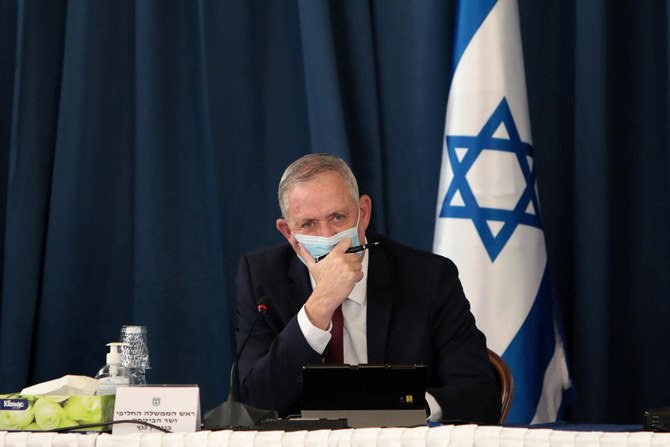
JERUSALEM: Israel launched a new reconnaissance satellite early Monday, the defense ministry said, its latest asset to be deployed against arch-enemy Iran.
“The Israel Ministry of Defense and Israel Aerospace Industries have successfully launched the ‘Ofek 16’ reconnaissance satellite” at 4:00 am local time (0100 GMT), the ministry said in a statement.
The “electro-optical reconnaissance satellite with advanced capabilities... will undergo a series of tests,” it added.
Minister of Defense and Alternate Prime Minister Benny Gantz hailed the development.
“The successful launch of the ‘Ofek 16’ satellite overnight is yet another extraordinary achievement” for Israel’s defense sector, he said.
“Technological superiority and intelligence capabilities are essential to the security of the State of Israel... We will continue to strengthen and maintain Israel’s capabilities on every front, in every place.”
Neither statement gave further details on the satellite’s mission, but Israeli public radio said it would be used to monitor Iran’s nuclear activities.
Israel has long sworn to prevent its nemesis from obtaining atomic weapons.
The Islamic republic denies its nuclear program has any military dimension.


Israel launches new spy satellite

https://arab.news/vnvd4
Israel launches new spy satellite
- Israel has long sworn to prevent its nemesis from obtaining atomic weapons
- Its latest asset to be deployed against arch-enemy Iran
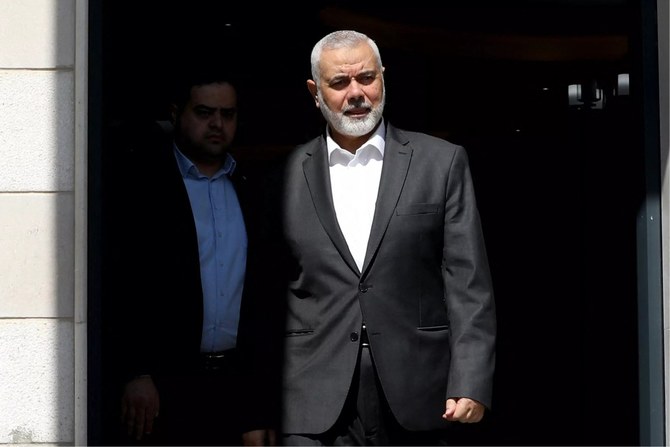
Qatar Foreign Ministry: No justification to end Hamas’ presence in Doha
- Qatar said it was re-evaluating its role as mediator in ceasefire talks between Israel and the Palestinian group Hamas
DUBAI: Qatar said on Tuesday there was no justification to end the presence of an office for Palestinian militant group Hamas in Doha while its mediation efforts continued in the Gaza war.
Foreign Ministry spokesperson Majed Al-Ansari added in a press conference that Qatar remained committed to mediation but was reassessing its role in "frustration with attacks" on its efforts.
Last week, Qatar said it was re-evaluating its role as mediator in ceasefire talks between Israel and the Palestinian group Hamas, citing concerns that its efforts are being undermined by politicians seeking to score points.
Qatari Prime Minister Sheikh Mohammed bin Abdulrahman Al-Thani, who is also foreign minister, said there was a "misuse of this mediation for narrow political interests, and this necessitated Qatar to undertake a full evaluation of this role".
Turkiye’s Erdogan says Iraq sees need to eliminate Kurdish PKK militia
- Ties between the neighbors were entering a new phase after they agreed to cooperate against militants, boost economic ties
- Erdogan visited Iraq for the first time since 2011 following years of tensions as Ankara carried out cross-border attacks on PKK militants based in northern Iraq
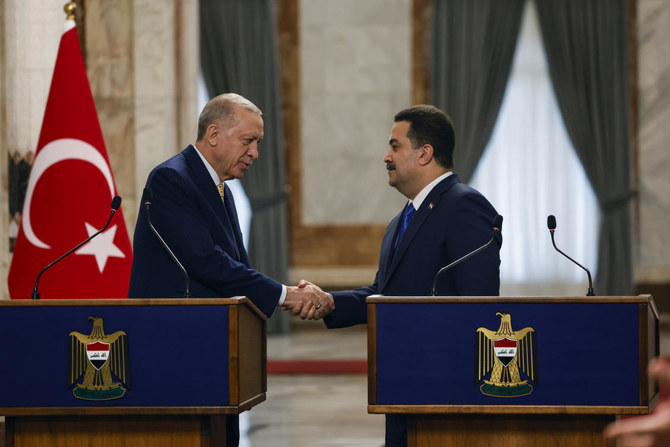
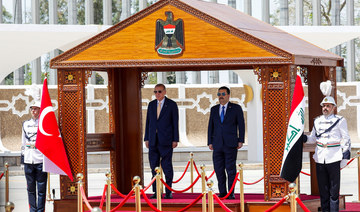
ANKARA: Turkish President Tayyip Erdogan said in remarks published on Tuesday he believed Iraq saw the need to eliminate the Kurdish PKK militia and had the will to do so, adding Ankara wanted Baghdad’s support in that battle.
Erdogan was speaking after talks in Baghdad and Irbil on Monday, the first visit by a Turkish leader to Iraq since 2011, following years of tensions as Ankara carried out cross-border attacks on PKK militants based in northern Iraq.
Ties between the neighbors were entering a new phase, Erdogan said, after they agreed to cooperate against militants, boost economic ties via a new corridor and consider Iraq’s needs for access to scarce water.
Speaking to reporters on his flight back from Iraq, Erdogan said Turkiye’s battle with terrorism would continue in line with international law, and added he hoped to see concrete results of Baghdad labeling the PKK a “banned organization” last month.
The PKK, designated a terrorist group by Turkiye, the US and the European Union, took up arms against the Turkish state in 1984. More than 40,000 people have been killed in the insurgency.
The conflict was long fought mainly in rural areas of southeastern Turkiye but is now more focused on the mountains of northern Iraq’s mountainous, semi-autonomous Kurdistan region.
“One would hope that our neighbors put the necessary stance forward against the threats directed at us from their lands, and we continue this battle jointly,” Erdogan said, according to a text of the in-flight comments published by his office.
“Eliminating this threat is also to the benefit of Iraq. I believe they see this reality and they will now put forth a will for this issue to be removed,” he said, adding he also discussed steps against the PKK during talks in Irbil.
Asked about Iraq’s needs for access to water, Erdogan said Turkiye was not a country with abundant water resources and also had to manage its own needs. He added plans taking into account “changing climate conditions” were needed for the sustainable use of water.
“Therefore, we need to take cautious steps. With evaluations to be held in that direction, it may be possible to find common ground,” he said.
On Monday, the two countries agreed to a strategic framework agreement overseeing security, trade and energy as well as a 10-year deal on the management of water resources that would take Iraq’s needs into account.
Two Hezbollah members killed in Israeli strikes
- The latest strike hit the Abu Al-Aswad area near the coastal city of Tyre
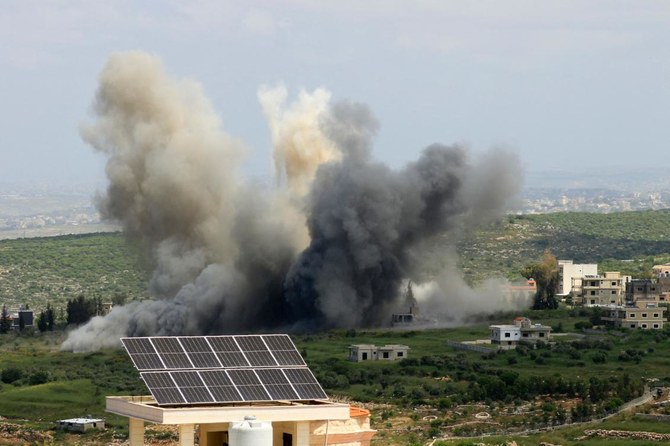
BEIRUT: Hezbollah announced two of its members had been killed by Israeli fire Tuesday, with the Israeli army saying it eliminated “two significant” members of the Iran-backed group in south Lebanon.
Since Hamas’s unprecedented October 7 attack on Israel triggered war in Gaza, there have been near-daily cross-border exchanges of fire between Hezbollah and the Israeli army.
But Hezbollah has stepped up its rocket attacks on Israeli targets in recent days.
On Tuesday morning, a source close to the group told AFP an Israeli drone strike deep into Lebanon killed an engineer working for Hezbollah’s air defense forces as he was traveling in a vehicle.
The strike hit the Abu Al-Aswad area near the coastal city of Tyre, some 35 kilometers (22 miles) from the border, an AFP journalist reported.
The fighter’s vehicle was completely burnt out.
Hezbollah said two of its fighters had been killed, one of them overnight.
The Israeli army said it had killed “two significant terrorists in Hezbollah’s aerial unit” on Tuesday morning and overnight.
On Sunday evening, Hezbollah shot down an Israeli drone, both sides said.
Since October 7, at least 378 people have been killed in Lebanon, mostly Hezbollah fighters but also 70 civilians, according to an AFP tally.
Israel says 11 soldiers and eight civilians have been killed on its side of the border.

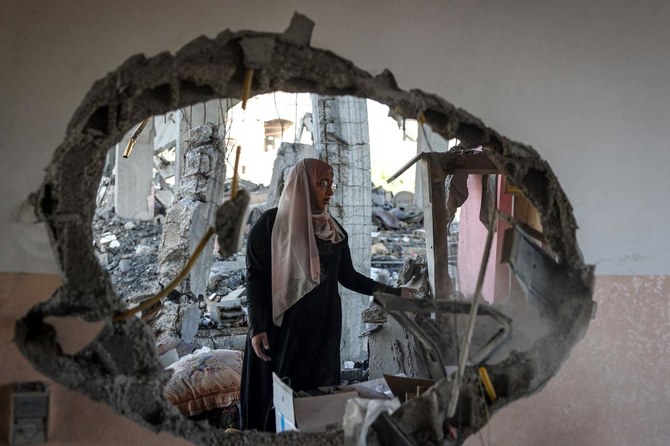
Israel military strikes northern Gaza in heaviest shelling in weeks
- Army tanks made a new incursion east of Beit Hanoun on the northern edge of the Gaza Strip, though they did not penetrate far into the city
- The renewed shelling and bombing of northern Gaza comes almost four months after the Israeli army announced it was drawing down its troops there
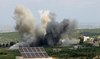
GAZA: Israel bombarded northern Gaza overnight in some of the heaviest shelling in weeks, causing panic among residents and flattening neighborhoods in an area from which the Israeli army had previously down its troops, residents said on Tuesday.
Army tanks made a new incursion east of Beit Hanoun on the northern edge of the Gaza Strip, though they did not penetrate far into the city, residents and Hamas media said. Gunfire reached some schools where displaced residents were sheltering.
In Israel, where government offices and businesses were shut to celebrate the Jewish Passover holiday, incoming rocket alerts sounded in southern border towns, although no casualties were reported.
The armed wing of Islamic Jihad, a group allied to Hamas, claimed responsibility for the rocket attacks on Sderot and Nir Am, indicating fighters were still able to launch them almost 200 days into the war, which has flattened large swathes of the enclave and displaced almost all of its 2.3 million people.
Thick black smoke could be seen rising in northern Gaza from across the southern Israeli border. Shelling was intense east of Beit Hanoun and Jabalia and continued on Tuesday morning in areas such as Zeitoun, one of Gaza City’s oldest suburbs, with residents reporting at least 10 strikes in a matter of seconds along the main road.
Just west of Beit Hanoun in Beit Lahiya, medics and Hamas media said strikes had hit a mosque and a crowd gathering on the coastal road to collect aid dropped from the air. Reuters could not immediately confirm those targets.
“It was one of those nights of horror that we had lived in at the start of the war. The bombing from tanks and planes didn’t stop,” said Um Mohammad, 53, a mother-of-six living 700 meters from Zeitoun.
“I had to gather with my children and my sisters who came to shelter with me in one place and pray for our lives as the house kept shaking,” she told Reuters via a chat app.
“I don’t know if we will make it alive before this war stops,” she added.
The Israeli army said rockets launched overnight into Israel had come from firing positions in northern Gaza. It had struck rocket launchers and killed several militants overnight, in what it called “targeted and precise” strikes.
“Over the past day, IAF fighter jets and additional aircraft struck approximately 25 terror targets throughout the Gaza Strip, including military infrastructure, observation posts, terrorists, launch posts,” it said in a statement.
Hitting areas where troops had withdrawn
The renewed shelling and bombing of northern Gaza comes almost four months after the Israeli army announced it was drawing down its troops there, saying Hamas no longer controlled those areas.
This month, Israel also drew down most of its forces in southern Gaza. But efforts to reach a ceasefire have failed, and Israeli bombardment and raids on territory where its troops have withdrawn are making it difficult for displaced Gazans to return to abandoned homes. Israel also struck Khan Younis in the south on Tuesday, a day after tanks raided eastern parts of that city.
Israel says it is seeking to eradicate Hamas, which controls the enclave, following an attack by the militant group on Oct. 7, killing 1,200 and taking 253 hostages by Israeli tallies.
Across the Gaza Strip, Israel’s military strikes killed 32 Palestinians and wounded 59 others in the past 24 hours, Palestinian health authorities said. They say more than 34,000 people have been confirmed killed in the seven-month war, with thousands more bodies as yet unrecovered.
Residents also reported bombing east of Deir Al-Balah on Tuesday in a central zone separating the north from the south.
In Nasser Hospital, southern Gaza’s main health facility, authorities recovered a further 35 bodies from what they say is one of at least three mass graves found at the site, taking the total found there to 310 in one week.
Israel says it was forced to battle inside hospitals because Hamas fighters operated there, which medical staff and Hamas deny.
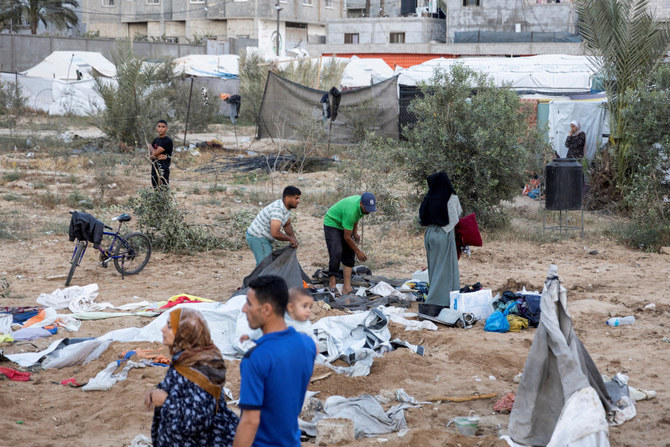
Tent compound rises in Khan Younis as Israel prepares for Rafah offensive
- Israel has said it plans to evacuate civilians from Rafah during an anticipated offensive on the southern city
- The Israel-Hamas war has killed more than 34,000 Palestinians
The tent construction is near Khan Younis, which has been targeted by repeated Israeli military operations over recent weeks. Israel has said it plans to evacuate civilians from Rafah during an anticipated offensive on the southern city, where hundreds of thousands of people have taken refuge during the war, now in its seventh month.
Also Monday, a failed rocket strike was launched at a base housing US-led coalition forces at Rumalyn, Syria, marking the first time since Feb. 4 that Iranian-backed militias have attacked a US facility in Iraq or Syria, a US defense official said. No personnel were injured in the attack, and no group has claimed responsibility for the attack.
The conflict has sparked regional unrest pitting Israel and the US against Iran and allied militant groups across the Middle East. Israel and Iran traded fire directly this month, raising fears of all-out war.
The war was sparked by the unprecedented Oct. 7 raid into southern Israel in which Hamas and other militants killed around 1,200 people, mostly civilians, and abducted around 250 hostages. Israel says militants are still holding around 100 hostages and the remains of more than 30 others.
The Israel-Hamas war has killed more than 34,000 Palestinians, according to local health officials, at least two-thirds of them children and women. It has devastated Gaza’s two largest cities and left a swath of destruction. Around 80 percent of the territory’s population have fled to other parts of the besieged coastal enclave.
The US House of Representatives approved a $26 billion aid package on Saturday that includes around $9 billion in humanitarian assistance for Gaza, which experts say is on the brink of famine, as well as billions for Israel. The US Senate could pass the package as soon as Tuesday, and President Joe Biden has promised to sign it immediately.