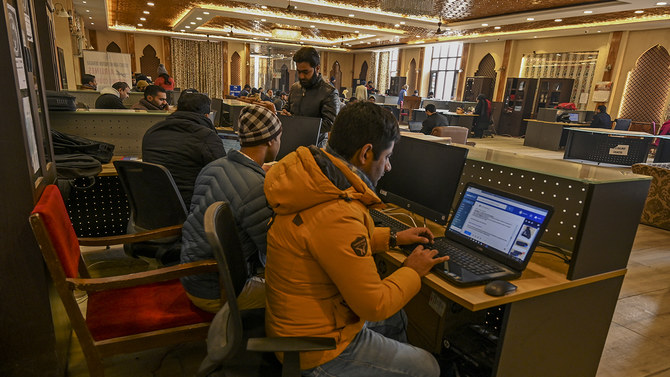
SRINAGAR: Indian authorities on Saturday restored Internet in Indian-administered Kashmir after a five-and-a half-month blackout but maintained a block on social media sites.
Prime Minister Narendra Modi’s government imposed a communications blackout in early August when it stripped the portion of Kashmir it controls — the country’s only Muslim-majority region — of its partial autonomy.
India also imposed a curfew, sent in tens of thousands of extra troops and detained dozens of Kashmiri political leaders and others, many of whom remain in detention, drawing criticism abroad.
Internet access was restored Saturday but only to 301 government-approved websites that include international news publications and platforms such as Netflix and Amazon.
Mobile phone data access was also restored, although it was limited to slower second-generation (2G) connections.
“It’s good some Internet access has been restored but it’s so slow I’m hardly able to access anything and social media is also off-limits,” Raashid Ahmad, a university student, told AFP.
Azhar Hussain, a local businessman, also complained about the Internet speed being “painfully slow.”
India is the world leader in cutting Internet services, activists say, and access was also temporarily suspended in other parts of the country during recent protests against a new citizenship law.
Since August, freedom of movement in heavily-militarized Kashmir has been gradually restored as has cellphone coverage, but apart from at a handful of locations, there has been no regular Internet access.
This made life even harder for the region’s seven million inhabitants and hit the local economy hard.
Modi’s government said that the blackout was for security reasons, aimed at restricting the ability of armed militants — who it says are backed by arch-rival Pakistan — to communicate.
However, the Supreme Court criticized the government earlier this month for the move, calling it an “arbitrary exercise of power.”
The court also stated that having access to the Internet “is integral to an individual’s right to freedom of speech and expression.”
Kashmir has been divided between India and Pakistan since independence in 1947, and has been the spark of two wars and numerous flare-ups between the two nuclear-armed foes.
A bloody insurgency against Indian rule that has raged in the scenic Himalayan region for decades has left tens of thousands dead, mostly civilians.


Indian government ends Internet blackout in restive Kashmir

https://arab.news/n4zsv
Indian government ends Internet blackout in restive Kashmir
- Social media sites remain blocked, with only 301 government approved websites accessible
- Indian- administered Kashmir’s 7 million inhabitants have been affected by web blackout since August last year
Once a fringe Indian ideology, Hindu nationalism is now mainstream, thanks to Modi’s decade in power
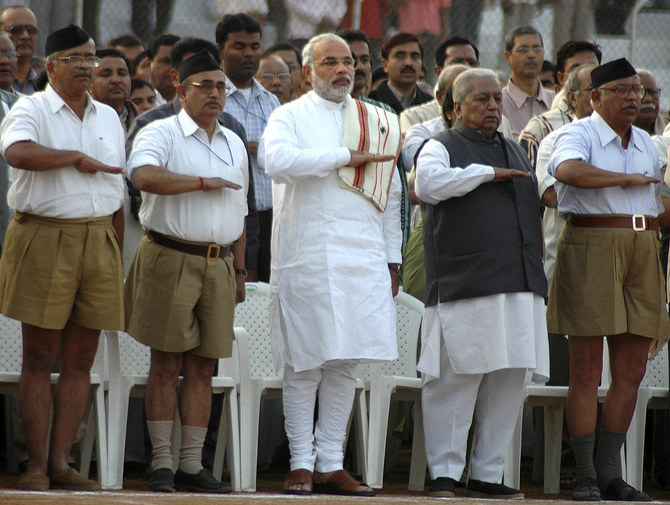
Once a fringe Indian ideology, Hindu nationalism is now mainstream, thanks to Modi’s decade in power
- While Mahatma Gandhi preached Hindu-Muslim unity a few decades earlier, the RSS advocated for transforming India into a Hindu nation
- RSS, which stands for Rashtriya Swayamsevak Sangh, is paramilitary, right-wing group founded nearly a century ago
- Modi joined the political wing of the RSS in the late 1960s in their home state, Gujarat, when he was a teenager
AHMEDABAD, India: Hindu nationalism, once a fringe ideology in India, is now mainstream. Nobody has done more to advance this cause than Prime Minister Narendra Modi, one of India’s most beloved and polarizing political leaders.
And no entity has had more influence on his political philosophy and ambitions than a paramilitary, right-wing group founded nearly a century ago and known as the RSS.
“We never imagined that we would get power in such a way,” said Ambalal Koshti, 76, who says he first brought Modi into the political wing of the Rashtriya Swayamsevak Sangh in the late 1960s in their home state, Gujarat.
Modi was a teenager. Like other young men — and even boys — who joined, he would learn to march in formation, fight, meditate and protect their Hindu homeland.
A few decades earlier, while Mahatma Gandhi preached Hindu-Muslim unity, the RSS advocated for transforming India — by force, if necessary — into a Hindu nation. (A former RSS worker would fire three bullets into Gandhi’s chest in 1948, killing him months after India gained independence.)
Modi’s spiritual and political upbringing from the RSS is the driving force, experts say, in everything he’s done as prime minister over the past 10 years, a period that has seen India become a global power and the world’s fifth-largest economy.
At the same time, his rule has seen brazen attacks against minorities — particularly Muslims — from hate speech to lynchings. India’s democracy, critics say, is faltering as the press, political opponents and courts face growing threats. And Modi has increasingly blurred the line between religion and state.
At 73, Modi is campaigning for a third term in a general election, which starts Friday. He and the ruling Bharatiya Janata Party are expected to win. He’s challenged by a broad but divided alliance of regional parties.
Supporters and critics agree on one thing: Modi has achieved staying power by making Hindu nationalism acceptable — desirable, even — to a nation of 1.4 billion that for decades prided itself on pluralism and secularism. With that comes an immense vote bank: 80 percent of Indians are Hindu.
“He is 100 percent an ideological product of the RSS,“in said Nilanjan Mukhopadhyay, who wrote a Modi biography. “He has delivered their goals.”

Uniting Hindus
Between deep breaths under the night sky in western India a few weeks ago, a group of boys recited an RSS prayer in Sanskrit: “All Hindus are the children of Mother India ... we have taken a vow to be equals and a promise to save our religion.”
More than 65 years ago, Modi was one of them. Born in 1950 to a lower-caste family, his first exposure to the RSS was through shakhas — local units — that induct boys by combining religious education with self-defense skills and games.
By the 1970s, Modi was a full-time campaigner, canvassing neighborhoods on bicycle to raise RSS support.
“At that time, Hindus were scared to come together,” Koshti said. “We were trying to unite them.”
The RSS — formed in 1925, with the stated intent to strengthen the Hindu community — was hardly mainstream. It was tainted by links to Gandhi’s assassination and accused of stoking hatred against Muslims as periodic riots roiled India.
For the group, Indian civilization is inseparable from Hinduism, while critics say its philosophy is rooted in Hindu supremacy.
Today, the RSS has spawned a network of affiliated groups, from student and farmer unions to nonprofits and vigilante organizations often accused of violence. Their power — and legitimacy — ultimately comes from the BJP, which emerged from the RSS.
“Until Modi, the BJP had never won a majority on their own in India’s Parliament,” said Christophe Jaffrelot, an expert on Modi and the Hindu right. “For the RSS, it is unprecedented.”
Scaling his politics
Modi got his first big political break in 2001, becoming chief minister of home state Gujarat. A few months in, anti-Muslim riots ripped through the region, killing at least 1,000 people.
There were suspicions that Modi quietly supported the riots, but he denied the allegations and India’s top court absolved him over lack of evidence.
Instead of crushing his political career, the riots boosted it.
Modi doubled down on Hindu nationalism, Jaffrelot said, capitalizing on religious tensions for political gain. Gujarat’s reputation suffered from the riots, so he turned to big businesses to build factories, create jobs and spur development.
“This created a political economy — he built close relations with capitalists who in turn backed him,” Jaffrelot said.
Modi became increasingly authoritarian, Jaffrelot described, consolidating power over police and courts and bypassing the media to connect directly with voters.
The “Gujarat Model,” as Modi coined it, portended what he would do as a prime minister.
“He gave Hindu nationalism a populist flavor,” Jaffrelot said. “Modi invented it in Gujarat, and today he has scaled it across the country.”
A few decades earlier,
In June, Modi aims not just to win a third time — he’s set a target of receiving two-thirds of the vote. And he’s touted big plans.
“I’m working every moment to make India a developed nation by 2047,” Modi said at a rally. He also wants to abolish poverty and make the economy the world’s third-largest.
If Modi wins, he’ll be the second Indian leader, after Jawaharlal Nehru, to retain power for a third term.
With approval ratings over 70 percent, Modi’s popularity has eclipsed that of his party. Supporters see him as a strongman leader, unafraid to take on India’s enemies, from Pakistan to the liberal elite. He’s backed by the rich, whose wealth has surged under him. For the poor, a slew of free programs, from food to housing, deflect the pain of high unemployment and inflation. Western leaders and companies line up to court him, turning to India as a counterweight against China.
He’s meticulously built his reputation. In a nod to his Hinduism, he practices yoga in front of TV crews and the UN, extols the virtues of a vegetarian diet, and preaches about reclaiming India’s glory. He refers to himself in the third person.
P.K. Laheri, a former senior bureaucrat in Gujarat, said Modi “does not risk anything” when it comes to winning — he goes into the election thinking the party won’t miss a single seat.
The common thread of Modi’s rise, analysts say, is that his most consequential policies are ambitions of the RSS.
In 2019, his government revoked the special status of disputed Kashmir, the country’s only Muslim-majority region. His government passed a citizenship law excluding Muslim migrants. In January, Modi delivered on a longstanding demand from the RSS — and millions of Hindus — when he opened a temple on the site of a razed mosque.
The BJP has denied enacting discriminatory policies and says its work benefits all Indians.
Last week, the BJP said it would pass a common legal code for all Indians — another RSS desire — to replace religious personal laws. Muslim leaders and others oppose it.
But Modi’s politics are appealing to those well beyond right-wing nationalists — the issues have resonated deeply with regular Hindus. Unlike those before him, Modi paints a picture of a rising India as a Hindu one.
Satish Ahlani, a school principal, said he’ll vote for Modi. Today, Ahlani said, Gujarat is thriving — as is India.
“Wherever our name hadn’t reached, it is now there,” he said. “Being Hindu is our identity; that is why we want a Hindu country. ... For the progress of the country, Muslims will have to be with us. They should accept this and come along.”

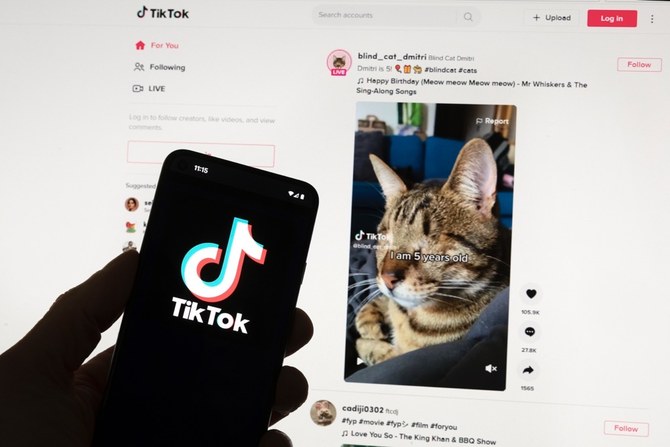
Legislation that could force a TikTok ban revived as part of House foreign aid package
WASHINGTON: Legislation that could ban TikTok in the US if its China-based owner doesn’t sell its stake won a major boost late Wednesday when House Republican leaders included it in a package of bills that would send aid to Ukraine and Israel. The bill could be law as soon as next week if Congress moves quickly.
The TikTok legislation, which passed the House in March and has widespread support in both chambers, was included in the House package as leaders have worked to win votes for the foreign aid bills and after negotiations with the Senate over how long the Chinese technology firm ByteDance Ltd. would have to sell its stake in the app to continue operating in the United States. President Joe Biden has said he would sign the TikTok legislation if it reaches his desk.
The new version of the legislation won a key endorsement from Senate Commerce Committee Chairwoman Maria Cantwell, who said in a statement that she had successfully pushed to extend the period from six months to a year to give the company enough time to find a buyer. While the original bill had a six-month deadline for TikTok to be sold, the revised legislation would give nine months and a possible three-month extension if a sale was in progress.
“Extending the divestment period is necessary to ensure there is enough time for a new buyer to get a deal done,” said Cantwell, who had previously expressed doubts about the bill. ”I support this updated legislation.”
If Congress passes the TikTok bill, it would be an extraordinary and unusual moment in which both parties unite against one company – something lawmakers are usually reluctant to do. But the popular social media app has prompted widespread outrage on Capitol Hill, where there is bipartisan concern about Chinese threats to the United States and where few members use the platform themselves.
Opponents say they believe the ban would be unconstitutional, and there would be likely court challenges if it passes. There has been aggressive pushback from the company, content creators who make money on the app and some of the platform’s 170 million US users, many of whom are young. In some cases, lawmakers have received profanity-laced calls from users who were prompted by the app to call their representatives in Congress.
To date, the US government has not provided evidence that shows TikTok shared US user data with the Chinese government, or that Chinese authorities have tinkered with the company’s popular algorithm, which influences what Americans see.
Since mid-March, TikTok has spent $5 million on TV ads opposing the legislation, according to AdImpact, an advertising tracking firm. The ads have included a range of content creators, including a nun, extolling the positive impacts of the platform on their lives and arguing a ban would trample on the First Amendment.
TikTok has also spent money on Facebook and Instagram ads that, among other things, talk about investments in data safety. In addition, the company has mounted a lobbying campaign in Washington that included flying in content creators who rely on the platform for income.
Alex Haurek, a spokesman for the company, said in a statement Thursday that “It is unfortunate that the House of Representatives is using the cover of important foreign and humanitarian assistance to once again jam through a ban bill that would trample the free speech rights of 170 million Americans, devastate 7 million businesses, and shutter a platform that contributes $24 billion to the US economy, annually.”
Nadya Okamoto, a content creator who has roughly four million followers on TikTok, said she’s been having conversations with other creators who are experiencing “so much anger and anxiety” about the bill and how it’s going to impact their lives. The 26-year-old, whose company “August” sells menstrual products and is known for her advocacy around destigmatizing menstrual periods, makes most of her income from TikTok.
“This is going to have real repercussions,” she said.
Dan Ives, a tech analyst at the financial advisory firm Wedbush Securities, said such a sale would be very complex to carry out, even with an extended timeline.
The platform would come with a hefty price tag that only the biggest tech companies could afford, something that’s likely to raise antitrust concerns. Then, there’s the issue of TikTok’s algorithm, the app’s secret sauce that recommends videos to users. The bill bars ByteDance from controlling TikTok’s algorithm, and a potential sale is likely to face opposition from China, which has been clamping down on exports of recommendation algorithms by Chinese tech companies.
“Buying TikTok without the algorithm would be like buying a Ferrari without the engine,” said Ives.
Some investors, including former Treasury Secretary Steven Mnuchin and “Shark Tank” star Kevin O’Leary, have already voiced interest in buying TikTok’s US business. If a sale isn’t approved and the platform does get banned, Ives said it would be a “dream scenario” for Snapchat, Meta and YouTube, which have faced stiff competition from TikTok the past few years.
If the bill does pass, it would be the most significant step Congress has taken in decades to regulate the tech industry. For years Congress has failed to act on legislation that would protect users’ privacy, protect children online, make companies more liable for their content and put loose guardrails around artificial intelligence, among other things.
Still, it is a narrow shot at one company when many lawmakers would like to see broader change.
Democratic Sen. Mark Warner of Virginia, the chairman of the Senate Intelligence Committee, has been pushing for years for tech regulation. If the TikTok bill passes, he said, “it will be the first guardrail we put on anything on social media.”
Warner said there are a lot of other things that Congress needs to do, “but you’ve got to start someplace.”
While most lawmakers support the TikTok bill, some have said it would set a dangerous precedent.
“The passage of the House TikTok ban is not just a misguided overreach; it’s a draconian measure that stifles free expression, tramples constitutional rights, and disrupts the economic pursuits of millions of Americans,” Kentucky Sen. Rand Paul posted on X after the House passed it.
Others are defending the app’s loyal users.
“I am a NO on the TikTok bill we are about to vote on,” Florida Rep. Maxwell Frost posted on X before the House vote. At 27, Frost is much younger than most of his colleagues.
“I believe the bill does set TikTok up to be banned,” Frost said. “There are first amendment issues I see with taking away a platform that over 170 million Americans use, and this won’t fix the serious issues we have with data privacy.”
Jenna Leventoff, a lawyer for the American Civil Liberties Union, previewed potential First Amendment challenges to the bill.
“Congress cannot take away the rights of over 170 million Americans who use TikTok to express themselves, engage in political advocacy, and access information from around the world,” she said.
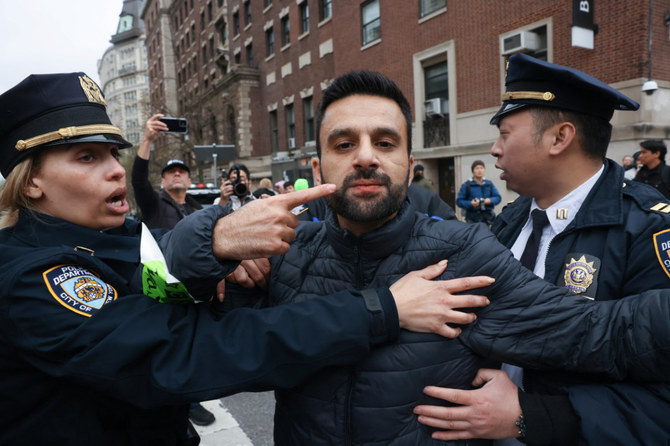
Over 100 pro-Palestinian protesters arrested from New York’s Columbia campus
- University President Nemat Minouche Shafik said she authorized police to remove tents set up by protesters for the safety of the campus
- Protesters clashed with police, bringing back memories of the demonstrations against the Vietnam War at Columbia more than 50 years ago
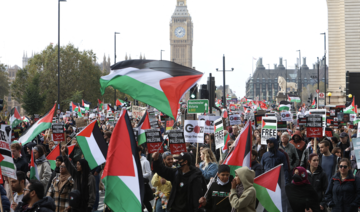
More than 100 pro-Palestinian protesters were arrested on Wednesday on the campus of Columbia University after its president authorized New York police to clear an encampment set up by students demonstrating against Israel’s actions in Gaza.
Columbia University President Nemat Minouche Shafik, who a day earlier came under fire from Republicans at a House of Representatives committee hearing on antisemitism on campus, said she had authorized police to clear an encampment of dozens of tents set up by protesters on Wednesday morning.
“Out of an abundance of concern for the safety of Columbia’s campus, I authorized the New York Police Department to begin clearing the encampment ... ” Shafik said in a statement.
Shafik said the protesters had violated the school’s rules and policies against holding unauthorized demonstrations, and were not willing to engage with administrators.
New York City Mayor Eric Adams said police made over 108 arrests, adding “there was no violence or injuries during the disturbance.” Adams added students had the right to free speech but not the right to violate university policies. Police officials said the arrests were related to trespassing.
Columbia said it had started to suspend students who had participated in the tent encampment, which the school considers an unauthorized protest.
“We are continuing to identify them and will be sending out formal notifications,” a spokesperson of the university said in an email.
At least three students have already received suspension notices from Barnard College, an affiliate of Columbia, for participating in the encampment, Institute for Middle East Understanding, a pro-Palestinian advocacy group, said.
The three students were Isra Hirsi, Maryam Iqbal, and Soph Dinu, the institute said. Hirsi is the daughter of US Representative Ilhan Omar, who had expressed support for protesters during the hearing at which Shafik testified on Wednesday.
“Those of us in Gaza solidarity encampment will not be intimidated,” Hirsi said on social media after being suspended.
The clash, reminiscent of the demonstrations against the Vietnam War at Columbia more than 50 years ago, is the latest in a series of demonstrations on US university campuses since the latest escalation of the Israeli-Palestinian conflict began on Oct. 7. Anti-war protests have been staged near airports and on bridges in New York, Los Angeles and other cities, while vigils and marches have taken place in Washington and elsewhere.
Alongside the proliferations of protests, human rights advocates have also pointed to a rise in bias and hate against Jews, Arabs and Muslims in recent months.
The congressional committee on Wednesday accused Shafik of failing to protect Jewish students on campus, echoing accusations leveled against three other elite university leaders at a hearing last year that sent shockwaves through higher education.
She responded by saying the university was facing a “moral crisis” with antisemitism on campus, and Columbia had taken strong actions against suspected perpetrators.
Protesters at Columbia have demanded a permanent ceasefire in the Gaza enclave and an end to US military assistance for Israel, as well as divestment by the university from companies that profit from Israel’s incursion into Gaza.
The encampment was organized by a student-led coalition of groups, including Columbia University Apartheid Divest, Students for Justice in Palestine, and Jewish Voice for Peace.
Separately on Thursday, a march was also planned at the University of Southern California in support of Asna Tabassum, a Muslim student whose valedictorian speech was canceled by the university, which cited safety concerns.
Tabassum and her supporters say the university sought to silence her because of her opposition to the Israeli assault on Gaza, which has killed over 33,000 people, according to the Gazan health ministry, and displaced nearly all its 2.3 million population.
Israel’s assault was triggered by the Oct. 7 cross-border attack by Hamas militants that killed 1,200 people, according to Israeli tallies.
Teenager charged with terrorism over stabbing attack on TikToker Sydney bishop
- Police said the boy had traveled for 90 minutes to reach the church from his home and stabbed Bishop Mar Mari Emmanuel at least six times
- The 53-year-old Assyrian Church bishop has a popular youth following on TikTok and has been a target of criticism, hate and online trolling
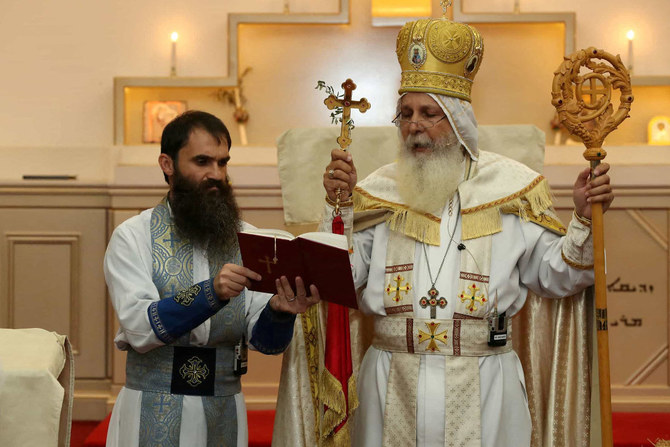
SYDNEY, Australia: A 16-year-old boy has been charged with a terrorism offense for allegedly stabbing an Assyrian church bishop in Sydney during a church service, Australian police said on Friday, as investigations continued into a riot after the knife attack.
Police from the joint counter-terrorism team questioned the boy, who is in a hospital under police guard recovering from injuries, on Thursday and charged him with committing a terrorist act. If convicted, he could get a maximum penalty of imprisonment for life.
He has been refused bail and is expected to appear before a bedside court hearing on Friday, New South Wales state Police Commissioner Karen Webb said during a press conference.
Police will allege the bishop was stabbed as many as six times and that the boy had traveled for 90 minutes to reach the church from his home, Webb said.
A riot broke out outside the church soon after the attack on Bishop Mar Mari Emmanuel after an angry crowd demanded the suspected attacker be handed over to them. More than 50 police officers were injured and 20 police cars were damaged.
The 53-year-old bishop has a popular youth following on TikTok and has been a target of criticism, hate and online trolling. His sermons range from homilies on the Bible to fiery criticisms of homosexuality, COVID-19 vaccinations, Islam and the election of US President Joe Biden.
Bishop Emmanuel, in an audio message on social media on Thursday, said he had forgiven his attacker and that he was recovering quickly.
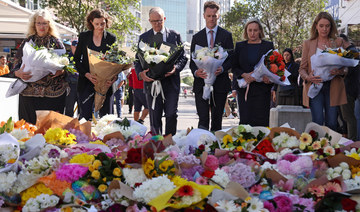
Two knife attacks within three days — at a mall near Bondi beach that killed six people on Saturday and at the Assyrian Christ The Good Shepherd Church in Sydney’s west on Monday — have shocked residents of Australia’s most populous city.
The incidents have sparked calls for greater public security in Australia, where gun crimes and knife attacks are rare due to tough laws.
The shopping center will reopen for business on Friday, while a candlelight vigil will be held on Sunday to mourn the victims. The attacker, 40-year-old Joel Cauchi, was shot to death by police inside the mall.


Ukraine seeks urgent G7, NATO help for battered air defenses
- NATO chief says working on a solution
- UK seeks ‘creative’ deal on seized Russian assets
CAPRI, Italy: Ukraine warned foreign ministers from the Group of Seven (G7) major powers on Thursday they had to change strategy if they wanted Kyiv to withstand increasingly destructive Russian air assaults.
The G7 ministers meeting on the island of Capri acknowledged the need to get more air defense systems to Ukraine and applauded Ukrainian Foreign Minister Dmytro Kuleba as he joined them on the second day of their three-day gathering.
The G7, comprising Italy, Canada, France, Germany, Japan, Britain, the United States and European Union representatives, has been fiercely critical of Russia’s two-year long invasion of Ukraine.
However, military aid to Kyiv has slowed in recent months, with European partners apparently running low on ammunition and vital US funding blocked by Republicans in Congress.
Speaking to reporters as he arrived in Capri, Kuleba bemoaned the fact that while US, British and French forces had intervened on Saturday to help prevent Iranian missiles from hitting Israel, his own country lacked vital defenses.
“The strategy of our partners in Israel seems to be in preventing damage and death. ... In the last months, the strategy of our partners in Ukraine seems to be in helping (us) to recover from damage,” he said.
“So our job today is to find a way where our partners will design a mechanism, a way that will allow us also to avoid death and destruction in Ukraine.”
NATO Secretary General Jens Stoltenberg also took part in Thursday’s G7 meetings, telling reporters beforehand that the military alliance was actively seeking to send more air defense systems as quickly as possible.
“We are working at the possibility of (dispatching) more Patriot batteries to Ukraine. We are in dialogue with some specific countries,” he said.
In Washington, Ukrainian Prime Minister Denys Shmyhal told reporters that Ukraine had asked for additional air defense equipment and another Patriot missile battery, adding that Kyiv was looking for a minimum of seven Patriot systems.
Shmyhal declined to say how many Patriot systems Ukraine had currently, saying that was classified information.
He said US and White House officials had assured the Ukrainian delegation that weapons would be supplied in a matter of weeks, not months, once a $60.8 billion US aid package for Ukraine was approved by Congress.
“We hope it will take days, but not more than weeks,” he said.
Domestic political wrangling has delayed delivery of the US aid, but the US House of Representatives might finally get to vote on the package this weekend, bringing some hope to G7 ministers.
Looking to Washington
Germany has already said it would hand over one Patriot system. European Union foreign policy chief Josep Borrell urged other EU nations to do likewise to help stave off concerted Russian attacks on vital Ukrainian infrastructure.
“Otherwise the electricity system of Ukraine will be destroyed. And no country can fight without having electricity at home, in the factories, online, for everything,” he told reporters in Capri.
“In these turbulent times, it is a hopeful sign that there are now signals from the Republicans in the US that support for Ukraine can be continued intensively,” German Foreign Minister Annalena Baerbock told a news conference.
Another key issue under review is how to use profits from some $300 billion of sovereign Russian assets held in the West to help Ukraine, as European Union member states hesitate over concerns about the legality of such a move.
“It’s important we try and get agreement. ... That’s what we’re discussing here. I’m in no doubt we will find a way, but we’re going to have to be creative. We’ll have to be flexible,” said British Foreign Secretary David Cameron.
Shmyhal told reporters in Washington that he had detailed discussions with US and G7 officials about how to use the frozen Russian assets, and he expected some results on that front this year.
Kuleba said he hoped to get immediate pledges this week on the delivery of more Patriot and SAMP/T air defense systems and also new Western sanctions targeting Iran’s production of armed drones, which are being exported to Russia.
Hours later, the United States and Britain announced they would introduce new sanctions on Iran targeting its drone program in retaliation for the April 13 strike on Israel.
But some G7 ministers also urged Israel not to exacerbate an already tense situation with a major retaliation of its own.
“Our appeal is always for prudence and de-escalation,” said Italian Foreign Minister Antonio Tajani. “We hope that Israel’s response, which will probably come, will be a targeted response and not something that provokes escalation.”