NEW DELHI: Prime Minister Narendra Modi embarked on a spiritual break Saturday as India’s acrimonious marathon election wound to a close after almost seven weeks awash with insults, violence and fake news.
On the eve of the seventh and final day of voting in the world’s biggest democratic exercise, local media reports said Modi, 68, would also spend some time in a “mediation cave.”
Having addressed more than 140 election rallies across the country, Modi arrived on Saturday in Dehradun, the capital of the Himalayan state of Uttarakhand famous for its Hindu pilgrimage sites.
Modi’s hectic campaign which started in March has seen him address three rallies a day on average, criss-crossing the length and breadth of the geographically diverse nation of 1.3 billion people.
From Dehradun, the Hindu nationalist premier traveled to Kedarnath and was due to go on to Badrinath to pay his respects at shrines dedicated to the Hindu deity Lord Shiva.
But it was not all relaxation, with the premier also expected to review reconstruction projects after floods in Uttarakhand in 2013 killed some 6,000 people.
Modi is seeking a second term from India’s 900 million voters after leading his right-wing Bharatiya Janata Party (BJP) to power in 2014, with results due on May 23.
Opinion polls, although unreliable, predict that the BJP may lose seats this time despite its formidable campaigning machine, meaning it might need a coalition to form a new government.
His main rival is Rahul Gandhi, 48, of the Congress party, the scion of India’s famed Nehru-Gandhi dynasty.
The rival parties have thrown almost daily barbs at each other, accusing each other of corruption, nepotism and fake nationalism.
As in previous elections, the polling has been marked by violence, most recently in West Bengal state where tens of thousands of security forces have been deployed following street clashes between BJP and rival supporters of the regional Trinamool Congress party.
The gargantuan election has also seen a flood of “fake news,” including photoshopped images and edited video clips, with both main parties using legions of people to manage social media.
“The likelihood that the ruling Bharatiya Janata Party wins a majority by itself is falling (10%, from 15% previously),” Eurasia Group, a political risk consultancy, said Friday in a report.


Modi meditates as India mega polls near end
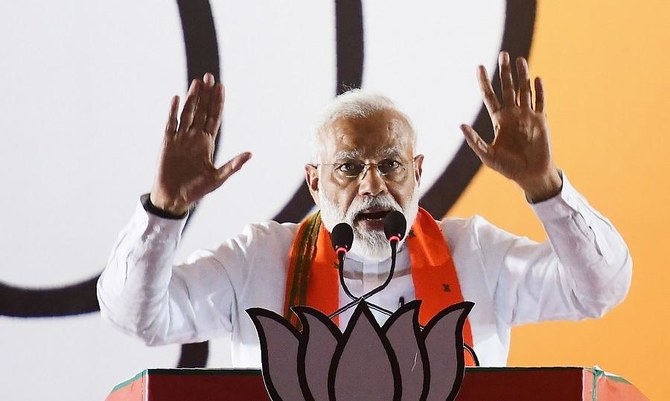
Modi meditates as India mega polls near end

- On the eve of the final voting day, Modi would also spend some time in a “mediation cave”
- Modi is seeking a second term from India’s 900 million voters


Indonesia sets rules limiting use of AI for schoolchildren
- Indonesian children spend about 7.5 hours daily on tablets, smartphones
- Gen Zs make up the majority of AI users in the country of 280m people
JAKARTA: The Indonesian government introduced on Thursday a new policy regulating the use of digital technology in education, limiting access to artificial intelligence for students.
Generation Alphas and Gen Zs make up almost half of Indonesia’s online population, which reached nearly 230 million people in 2025, according to a survey conducted by the Association of Indonesian Internet Service Providers.
As Indonesian children clock around 7.5 hours of daily screen time, the joint ministerial decree seeks to boost the benefits of digital technology and AI in formal and informal educational institutions, while also protecting the youth from risks in digital spaces.
“There are a lot of factors but the number of teenagers with mental health issues are high and continue to increase, and one of the suspected triggers — that have been proven academically — is the uncontrolled, unmitigated use of digital technology,” said Pratikno, Indonesia’s Coordinating Minister for Human Development and Cultural Affairs.
“The effects on education are also concerning, such as how it weakens brain activity due to dependence on digital technology tools and reduces critical thinking and cognitive and reflective abilities. This is what we have to regulate.”
Among Indonesia’s 280 million population, around a quarter of internet users are already using AI, with Gen Zs making up about 43 percent of that segment.
The joint decree, which Pratikno described as “comprehensive” and encompasses early childhood education to higher education, was signed in Jakarta by seven ministers, including Higher Education, Science and Technology Minister Brian Yuliarto and Primary and Secondary Education Minister Abdul Mu’ti.
“This decree seeks to ensure that our children are not controlled by technology but become the masters of technology for good, that is our goal. (It prioritizes) digital wellness, (for tech to be used) wisely and intelligently,” Pratikno said.
The policy is important to support young Indonesians, many of whom are internet users from adolescence, said Communication and Digital Affairs Minister Meutya Hafid, who also signed the ministerial decree.
“Indonesia has a significant number of children using the internet. Therefore, we must ensure that they are not only a target market for the technology industry, but also able to utilize technology according to their readiness,” she said.
“Every kind of technological advance has to consider the readiness of its users, especially children.”


