ISLAMABAD: The United States Bureau of Industry and Security (BIS), which works under the Department of Commerce, has placed sanctions on seven Pakistani firms purportedly engaged in nuclear trade and likely to damage Pakistan’s endeavor to join the Nuclear Suppliers Group (NSG).
“Indeed, it obstructs Pakistan’s bid for a full membership of NSG,” said Associate Professor Dr. Zafar Nawaz Jaspal, who is highly regarded for his academic work on nuclear issues.
He told Arab News that “sanctioning seven (Pakistani) companies is another attempt to pressurize Pakistan because Islamabad is determined not to accept the unrealistic dictates of the Trump Administration."
Pakistan’s Foreign Office spokesman could not be reached for comment by Arab News on Monday.
Twenty-three sanctioned companies from Pakistan, Singapore and South Sudan were placed on the US “Entity List” on March 22 according to the BIS document published on the US Federal Register website which “identifies entities reasonably believed to be involved, or to pose a significant risk of being or becoming involved, in activities contrary to the national security or foreign policy interests of the United States.”
Of the seven Pakistan firms based in Lahore, Karachi and Islamabad banned by the US, an eighth is operated by Pakistanis from Singapore.
Mushko Electronics Pvt. Ltd. in Singapore and Mushko Electronics Pvt. Ltd. in Pakistan are accused of procuring material for several sanctioned “Pakistani entities.” Solutions Engineering has been listed over “involvement in activity contrary” to US interests while Akhtar & Munir, Proficient Engineers and Pervaiz Commercial Trading Co. (PCTC) have been listed for “their involvement in the proliferation of unsafeguarded nuclear activities.”
Marine Systems Pvt. Ltd. is suspected of circumventing the export administration regulations restrictions assisting sanctioned Pakistani entities to acquire “items.” The last firm, Engineering and Commercial Services (ECS), has allegedly supplied material to a Pakistani nuclear entity.
Reuters reported that none of the seven sanctioned Pakistani companies, which are not well known, could be immediately reached for comment. Nor could a Singapore-based company which the bureau said was linked to one of the Pakistani companies.
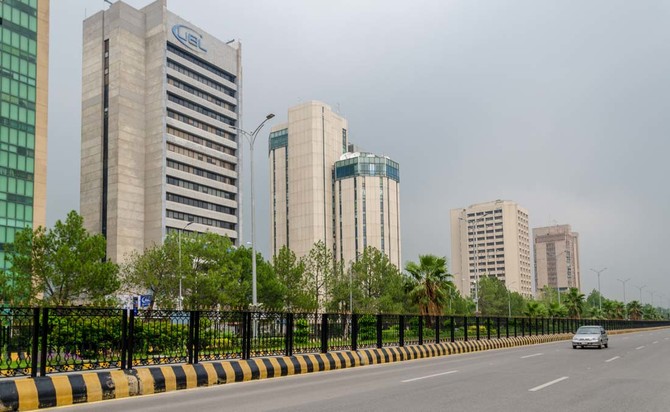
Arab News visited the office of ECS in a commercial building in Islamabad. The small office, which mostly remains closed and is manned by one person, works under the banner of “Galaxy Corporation” which is handwritten on a notebook paper attached to the door.
Neighboring offices involved in construction and trade were not aware of the name or the nature of ECS’ business.
“This is Engineering and Commercial Services,” said the company’s representative who identified himself as Arslan. He was surprised that Arab News was able to find the office.
Extremely reluctant to share information, Arslan confirmed that ECS procures “chemicals and related material” and deals “globally.” He refused to provide the owner’s name or contact but he told Arab News that the company’s main office is elsewhere.
The latest action by Washington is likely to further strain relations with Islamabad.
The two nations — once strong allies — have drifted apart over conflict of interests and widening trust deficit. Both sides have made attempts to repair relations but mixed signals from within each country’s government hierarchy have placed progress on a number of issues on shaky ground.
In February, the US, backed by Britain, France and Germany, emphasized concerns about the depth of Islamabad’s commitment to tackle money laundering and terror financing and tried to convince the Financial Action Task Force to place Pakistan back on its “gray list.”
Islamabad calls FATF’s attempt “politically motivated”.
The International Atomic Energy Agency Director-General Yukia Amano, who visited some of Pakistan’s nuclear plants and health facilities in March, commended the country’s command, control, knowledge, and safety of nuclear technology.
His concluding remark was: “The NSG would be better off with Pakistan inside rather than outside.”
The NSG was founded in 1974 to prevent nuclear proliferation through stringent checks and balances over the material export, technology and equipment used for nuclear weapons manufacturing.
Pakistan, backed by Turkey and China, applied for NSG’s membership on May 19, 2016, and maintains that non-discriminatory criteria-based approach is needed for all non-NPT countries for inclusion in the group.
The move is backed by several nations, including Kazakhstan and Belarus, and Russia has signaled its support.


7 Pakistani companies placed on US sanctions list
7 Pakistani companies placed on US sanctions list


Bangladesh begins exhuming mass grave from 2024 uprising
- The United Nations says up to 1,400 people were killed in crackdowns as Hasina attempted to cling to power — deaths that formed part of her conviction last month for crimes against humanity
DHAKA: Bangladeshi police began exhuming on Sunday a mass grave believed to contain around 114 unidentified victims of a mass uprising that toppled autocratic former prime minister Sheikh Hasina last year.
The UN-supported effort is being advised by Argentine forensic anthropologist Luis Fondebrider, who has led recovery and identification missions at mass graves worldwide for decades.
The bodies were buried at the Rayerbazar Graveyard in Dhaka by the volunteer group Anjuman Mufidul Islam, which said it handled 80 unclaimed bodies in July and another 34 in August 2024 — all people reported to have been killed during weeks of deadly protests.
The United Nations says up to 1,400 people were killed in crackdowns as Hasina attempted to cling to power — deaths that formed part of her conviction last month for crimes against humanity.
Criminal Investigation Department (CID) chief Md Sibgat Ullah said investigators believed the mass grave held roughly 114 bodies, but the exact number would only be known once exhumations were complete.
“We can only confirm once we dig the graves and exhume the bodies,” Ullah told reporters.
- ‘Searched for him’ -
Among those hoping for answers is Mohammed Nabil, who is searching for the remains of his brother Sohel Rana, 28, who vanished in July 2024.
“We searched for him everywhere,” Nabil told AFP.
He said his family first suspected Rana’s death after seeing a Facebook video, then recognized his clothing — a blue T-shirt and black trousers — in a photograph taken by burial volunteers.
Exhumed bodies will be given post-mortem examinations and DNA testing. The process is expected to take several weeks to complete.
“It’s been more than a year, so it won’t be possible to extract DNA from the soft tissues,” senior police officer Abu Taleb told AFP. “Working with bones would be more time-consuming.”
Forensic experts from four Dhaka medical colleges are part of the team, with Fondebrider brought in to offer support as part of an agreement with the UN rights body the OHCHR.
“The process is complex and unique,” Fondebrider told reporters. “We will guarantee that international standards will be followed.”
Fondebrider previously headed the Argentine Forensic Anthropology Team, founded in 1984 to investigate the tens of thousands who disappeared during Argentina’s former military dictatorship.
Authorities say the exhumed bodies will be reburied in accordance with religious rites and their families’ wishes.
Hasina, convicted in absentia last month and sentenced to death, remains in self-imposed exile in India.


